Space age engineers to verify control software for future robotic interplanetary missions
August 20, 2008 Mars Sample Return Ascent Module

Enlarge

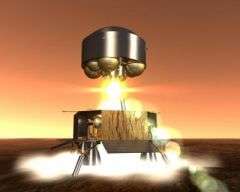
Artist's view of a future Mars Sample Return ascent module lifting off from Mars' surface with the Martian soil samples. Picture courtesy of ESA

An international team of engineers is to develop mission-critical control software for future European robotic space missions, it has been announced.

Dr. Declan Bates, a senior lecturer in the University of Leicester Department of Engineering, is part of an international consortium that has won €250K from the European Space Agency to develop new verification and validation techniques for next-generation satellite systems.

Dr. Bates will lead a team of researchers from the Control and Instrumentation Research Group on a two year project which aims to radically improve the reliability of the mission-critical control software required for the successful rendezvous of groups of satellites. The other members of the consortium are the Spanish advanced technology company GMV, the Canadian company NGC Aerospace, and the University of Oxford.

Dr. Bates said: "Leicester's involvement in this major research project is a direct result of our international reputation for research on the analysis of safety-critical control software.

"Future ESA missions, like the autonomous robotic satellites which will collect and return samples from the surface of Mars, require control systems involving complex requirements, system architectures, software algorithms and hardware implementations. A typical example is the design of a collision avoidance mode requiring a minimum separation distance between 'chaser' and 'target' satellites.

"Key elements for the development of such autonomous rendezvous control systems are the availability of reliable analysis tools for the verification and validation of complex system behaviour. It is essential to show that the control system is sufficiently robust to ensure the desired safety levels under a large number of adverse and unforeseen conditions.

"In this new project, we will develop and test control system analysis techniques to improve the reliability and efficiency of this verification and validation process."

Dr Bates added:

"This latest project is the third major research contract we have recently been awarded by ESA, and confirms that the Leicester Control Group is now at the forefront of European research on Space Control Systems."

Source: University of Leicester


print this article email this article download pdf blog this article bookmark this article     Stumble it Digg this share on Facebook retweet share on Reddit add to delicious
Rate this story - 3.5 /5 (2 votes)


August 20, 2008 all stories

Comments: 0

3.5 /5 (2 votes)
  • Stumble this up

  • Digg this

  • share this

  • hide
  • Related Stories

  • Suggestions for tech-happy holidays
    created Nov 25, 2009 | popularity not rated yet | comments 0
  • As robots become more common, Stanford experts consider the legal challenges
    created Nov 23, 2009 | popularity not rated yet | comments 0
  • NASA 'Drops' Next Generation Robotic Lander During Autonomous Tests
    created Nov 16, 2009 | popularity not rated yet | comments 0
  • Rosetta spacecraft may help unravel cosmic mystery (w/ Video)
    created Nov 12, 2009 | popularity not rated yet | comments 0
  • Station Prepares For New Spacecraft, Monitors Debris
    created Nov 06, 2009 | popularity not rated yet | comments 0


  • hide
  • Relevant PhysicsForums posts

  • Some help with a X-Ray astronomy question please!
    created 17 hours ago
  • Help with Images and Optical Instrument Question..
    created Nov 26, 2009
  • Redshift as a distance indicator
    created Nov 26, 2009
  • Question about 2-body gravity
    created Nov 24, 2009
  • More from Physics Forums - General Astronomy

Other News

Fermi Telescope Peers Deep into Microquasar

Fermi Telescope Peers Deep into Microquasar (w/ Video)

Space & Earth / Astronomy

created 11 hours ago | popularity 4.5 / 5 (6) | comments 0

(PhysOrg.com) -- NASA's Fermi Gamma-ray Space Telescope has made the first unambiguous detection of high-energy gamma-rays from an enigmatic binary system known as Cygnus X-3. The system pairs a hot, massive ...


The Energy Sources of Ultraluminous Galaxies

The Energy Sources of Ultraluminous Galaxies

Space & Earth / Astronomy

created 11 hours ago | popularity 4.3 / 5 (9) | comments 0

(PhysOrg.com) -- Ultraluminous infrared galaxies ((ULIRGs) are galaxies whose luminosity exceeds that of a trillion suns; for comparison, the Milky Way galaxy has a typical (and much more modest) luminosity ...


Space shuttle Atlantis, 7 astronauts back on Earth (AP)

Space shuttle Atlantis, 7 astronauts back on Earth

Space & Earth / Space Exploration

created 12 hours ago | popularity not rated yet | comments 0

(AP) -- Space shuttle Atlantis and its seven astronauts returned to Earth with a smooth touchdown Friday to end an 11-day flight that resupplied the International Space Station.


China is set to launch its second moon orbiter next October, state media have reported

China to launch second lunar probe: state media

Space & Earth / Space Exploration

created 16 hours ago | popularity 5 / 5 (4) | comments 0

China will launch its second moon orbiter next October, state media reported Friday, as it powers ahead with a space programme that has sparked concerns abroad.


Herschel takes a peek at the ingredients of the galaxies

Herschel takes a peek at the ingredients of the galaxies

Space & Earth / Astronomy

created 9 hours ago | popularity 4.3 / 5 (3) | comments 0

(PhysOrg.com) -- The European Space Agency has today released spectacular new observations from the Herschel Space Observatory, including the UK-led SPIRE instrument. Spectrometers on board all three Hershel ...