Brain surgery is getting easier on patients
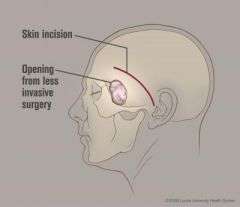
Dr. Edward Duckworth is part of a new generation of neurosurgeons who are making brain surgery a lot easier on patients. At Loyola University Hospital, Duckworth is using less-invasive techniques to remove tumors, to repair life-threatening aneurysms and to dramatically reduce seizures in epilepsy patients.
Rather than removing large sections of the skull or face, Duckworth is reaching the brain through much smaller openings. And in certain cases, he goes through the nose to get to the brain.
"It's not necessary to expose a large surface of the brain in order to access a small abnormality," said Duckworth, an assistant professor, neurological surgery, at Loyola University Chicago Stritch School of Medicine.
Less-invasive brain surgery can result in decreased pain and shorter hospital stays. It also makes patients less apprehensive, Duckworth said.
Duckworth recently performed a less-invasive aneurysm repair on David Shoblaske of Riverside, Ill. An aneurysm is a bulge in a blood vessel. Shoblaske's aneurysm was in the right side of his brain. It was spotted on a CT done in an attempt to find the source of Shoblaske's nonstop headaches. If the aneurysm had burst, Shoblaske likely would have suffered a serious stroke. To prevent that from happening, Duckworth closed off the aneurysm with a small titanium clip.
In a traditional aneurysm repair, the surgeon cuts out a piece of skull roughly 3 inches high and 3 inches wide. After repairing the aneurysm, the surgeon uses small plates and screws to reattach the skull piece. By contrast, the opening Duckworth created in Shoblaske was only about one inch across.
It's difficult to work with such a small opening. "You have to be much more meticulous," Duckworth said.
But the effort paid off for Shoblaske, a 64-year-old retired business executive with a history of heart disease that also has been treated successfully at Loyola. Despite the complexity of the procedure and the additional risks Shoblaske faced as a heart patient, he experienced no surgical complications or changes in his cognitive abilities. And, his headaches went away. "It was a complete success," he said.
Duckworth has performed more than 50 similar aneurysm repairs at Loyola; at the University of South Florida, where he trained and at Northwestern Memorial Hospital, where he did a fellowship. Duckworth gave a presentation on the procedure at a recent meeting of the American Association of Neurological Surgeons.
Duckworth also performs less-invasive brain surgeries on epilepsy patients. In this procedure, Duckworth removes a small part of the brain that is triggering seizures. In a recent issue of the journal Neurosurgery, Duckworth and a colleague reported results on 201 of their patients at the University of South Florida. After being followed a minimum of two years, 78 percent were free of the most disabling type of seizures. And only 1.5 percent experienced complications. Patients stayed in the hospital an average of 2.6 days. By comparison, an earlier study found that patients who underwent surgery with a larger opening stayed seven days.
In certain cases, Duckworth can reach the brain by passing instruments through the nose and cutting a 1-centimeter-wide hole in the skull. A surgical instrument goes through one nostril and an endoscope through the other. An endoscope is a tube with a light and a lens. It enables the surgeon to see tissue. Using this technique, Duckworth can remove certain tumors located in the pituitary gland or at the base of the skull.
Duckworth predicts less-invasive brain surgery will become increasingly common because it offers big advantages. "Because the openings are smaller, less brain tissue is exposed," he said. "There's less blood loss. Surgery times are shorter, and patients spend less time in the hospital. It's better cosmetically, too. Smaller incisions leave smaller scars."
Source: Loyola University


