An Unconventional Metal
August 20, 2008
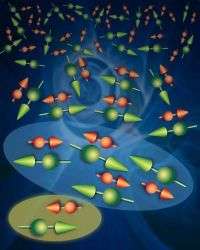
The magnetic bar magnets (called "magnetic moments") associated with the mobile electrons (red arrows) responsible for electrical conduction and manganese atoms (green arrows) in manganese doped iron silicide (Fe1-xMnxSi). This figure depicts the coupling of the magnetic moments as the temperature is reduced from room temperature (top of the figure) where the magnetic dipoles are independent, to very low temperature (bottom of the figure) where coupling between the dipoles creates regions where the moments add to zero (light blue region). The existence of a population of uncoupled complexes (depicted here in the yellow region) down to the lowest temperatures results in the material being neither a magnet nor common semiconductor. External magnetic fields align these rare yellow regions to the magnetic field, switching on ordinary semiconducting behavior. Image: UCL/London Centre for Nanotechnology
The semiconductor silicon and the ferromagnet iron are the basis for much of mankind's technology, used in everything from computers to electric motors. In this week's issue of the journal Nature (August 21st) an international group of scientists, including academic and industrial researchers from the UK, USA and Lesotho, report that they have combined these elements with a small amount of another common metal, manganese, to create a new material which is neither a magnet nor an ordinary semiconductor.
The paper goes on to show how a small magnetic field can be used to switch ordinary semiconducting behaviour (such as that seen in the electronic-grade silicon which is used to make transistors) back on.
The new material exists in a quantum halfway house between magnet and semiconductor - in the same way that much more complex materials such as ceramics which exhibit high temperature superconductivity exist in quantum halfway houses between metals and magnetic insulators. The research is of fundamental importance because it demonstrates, for the first time, a simple recipe for reaching this halfway house, whilst also suggesting new mechanisms for controlling electrical currents and magnetism in semiconductor devices.
Professor J.F. DiTusa of Louisiana State University and a co-author of the paper said: "It's amazing that something which was thought to exist theoretically in mathematical physics could actually be found in an alloy which was simply formed by melting together a few common elements."
Professor Gabriel Aeppli of UCL (University College London), another member of the research team and Director of the London Centre for Nanotechnology, added: "It might be possible to see similar effects in devices made using materials and methods found in laser pointers. This would put what we've seen firmly in the realm of that which can easily be achieved using current technologies."
The first author of the paper, Dr. N. Manyala of the National University of Lesotho, said: "We are looking forward to investigating whether we can see these effects using thin layers of the same materials deposited directly on the silicon wafers. These wafers are the same as those used by mass market electronics manufacturers as the basis for integrated circuits." Dr. Ramirez, who is now with LGS-Bell Labs Innovations echoed this thought, noting that, "with the end of Moore's law in sight, mechanisms for controlling and understanding possible new information bits such as spins in solids are actively being sought after."
Source: University College London
-
Physicists build highly efficient 'no-waste' laser
Feb 08, 2012 |
4.9 / 5 (20) |
5
-
Flipping a light switch in the cell: Quantum dots used for targeted neural activation
Feb 08, 2012 |
5 / 5 (7) |
1
-
All set and ready to glow
Feb 07, 2012 |
5 / 5 (1) |
1
-
New tool for analyzing solar-cell materials
Feb 07, 2012 |
not rated yet |
0
-
New form of hafnium oxide developed
Feb 07, 2012 |
4.6 / 5 (5) |
4
-
Engineers build first sub-10-nm carbon nanotube transistor
Feb 01, 2012 |
4.9 / 5 (33) |
30
-
Something old, something new: Evolution and the structural divergence of duplicate genes
Jan 31, 2012 |
4.6 / 5 (7) |
1
-
The hidden nanoworld of ice crystals: Revealing the dynamic behavior of quasi-liquid layers
Jan 30, 2012 |
5 / 5 (4) |
1
-
Stock market network reveals investor clustering
Jan 27, 2012 |
3.9 / 5 (23) |
8
-
Of microchemistry and molecules: Electronic microfluidic device synthesizes biocompatible probes
Jan 26, 2012 |
5 / 5 (2) |
0
-
polymer nanocomposites
Feb 10, 2012
-
Corrosion Tests on Magnesium
Feb 09, 2012
-
polyethylene copper nanocomposite
Feb 09, 2012
-
Output of xrd analysis
Feb 08, 2012
-
Transport phenomena problem based on problems 18.B11 and 19B.6 from Bird, stewart, lw
Feb 06, 2012
-
Help with material selection - Car Piston
Feb 05, 2012
- More from Physics Forums - Materials & Chemical Engineering
More news stories
Lab study raises questions over nano-particle impact
Tests involving chickens have raised questions about the impact on health from engineered nano-particles, the ultra-fine grains commonly used in drugs and processed foods, scientists said on Sunday.
Nanotechnology / Bio & Medicine
9 hours ago |
5 / 5 (5) |
0
New kind of solar cell could capture significantly more energy than current cells
New solar cells could increase the maximum efficiency of solar panels by over 25%, according to scientists from the University of Cambridge.
Feb 08, 2012 |
4.5 / 5 (13) |
14
|
Nanoshell whispering galleries improve thin solar panels
Visitors to Statuary Hall in the U.S. Capitol Building may have experienced a curious acoustic feature that allows a person to whisper softly at one side of the cavernous, half-domed room and for another on ...
Nanotechnology / Nanomaterials
Feb 07, 2012 |
4.4 / 5 (7) |
6
|
'Dark plasmons' transmit energy
Microscopic channels of gold nanoparticles have the ability to transmit electromagnetic energy that starts as light and propagates via "dark plasmons," according to researchers at Rice University.
Feb 09, 2012 |
4.8 / 5 (10) |
1
|
Revealing how a battery material works
Since its discovery 15 years ago, lithium iron phosphate (LiFePO4) has become one of the most promising materials for rechargeable batteries because of its stability, durability, safety and ability to deliver ...
Nanotechnology / Nanomaterials
Feb 08, 2012 |
5 / 5 (6) |
0
|
Scientists discover molecular secrets of 2,000-year-old Chinese herbal remedy
For roughly two thousand years, Chinese herbalists have treated Malaria using a root extract, commonly known as Chang Shan, from a type of hydrangea that grows in Tibet and Nepal. More recent studies suggest that halofuginone, ...
New method to examine batteries -- MRI from the inside
There is an ever-increasing need for advanced batteries for portable electronics, such as phones, cameras, and music players, but also to power electric vehicles and to facilitate the distribution and storage of energy derived ...
Google might launch Drive for cloud storage soon
(PhysOrg.com) -- Google's next big move, according to the Wall Street Journal, is a cloud storage service called Drive. Hardly first to the plate, Google is simply catching up to introducing its cloud reposi ...
A mitosis mystery solved: How chromosomes align perfectly in a dividing cell
Although the process of mitotic cell division has been studied intensely for more than 50 years, Whitehead Institute researchers have only now solved the mystery of how cells correctly align their chromosomes during symmetric ...
Starve a virus, feed a cure? Findings show how some cells protect themselves against HIV
A protein that protects some of our immune cells from the most common and virulent form of HIV works by starving the virus of the molecular building blocks that it needs to replicate, according to research published online ...
Researchers find extensive RNA editing in human transcriptome
In a new study published online in Nature Biotechnology, researchers from BGI, the world's largest genomics organization, reported the evidence of extensive RNA editing in a human cell line by analysis of RNA-seq data, demons ...
Aug 23, 2008
Rank: not rated yet
http://superstrun...part.gif
The formation of such zones is promoted by decreasing of temperature at the places, where the electrons are packed more closely, i.e. at the places of holes, where positivelly charged atoms are collecting the electrons from their neighourhood.
Briefly speaking, the holes are promoting a formation of isolated droplets of layered electron liquid with superfluous properties at low temperatures. The spin of these isolated droplets remains entangled (i.e. unique for most of electrons in the droplet) and as such it can be switched by using of weak external magnetic field as a whole, which enables the potential usage in spinotronic circuits.
Aug 23, 2008
Rank: not rated yet
It's evident, the simple injection of large amount of randomly distributed holes isn't sufficient for such purpose, the structure matrix of HT superconductor must be specially adopted to such solution. The layered structure of YBaCuO cuprates enables to achieve this trick: you can think, it's penetrated by ordered lines of holes (formed by replacing an La3 atoms by Sr2 atoms), where the electrons are highly packed into the form of continuous superconductive "pipes", through which they can propagate in transversal waves. The strong repulsive forces between electrons must be compensated by strongly attractive forces between highly oxidized atoms in neighboring layers, so that just a tiny volume fraction of superconductive phase can be formed in such matrix. This limits the critical current density of HT superconductors.