Hubble sees magnetic monster in erupting galaxy
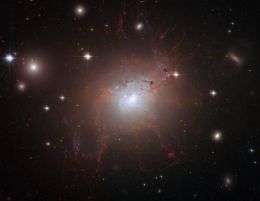
August 20th, 2008 Magnetic Monster NGC 1275

Enlarge

This stunning image of NGC 1275 was taken using the NASA/ESA Hubble Space Telescope's Advanced Camera for Surveys in July and August 2006. It provides amazing detail and resolution of the fragile filamentary structures, which show up as a reddish lacy structure surrounding the central bright galaxy NGC 1275. These filaments are cool despite being surrounded by gas that is around 55 million degrees Celsius hot. They are suspended in a magnetic field which maintains their structure and demonstrates how energy from the central black hole is transferred to the surrounding gas. By observing the filamentary structure, astronomers were, for the first time, able to estimate the magnetic field's strength. Using this information they demonstrated how the extragalactic magnetic fields have maintained the structure of the filaments against collapse caused by either gravitational forces or the violence of the surrounding cluster during their 100-million-year lifetime. This is the first time astronomers have been able to differentiate the individual threads making up such filaments to this degree. Astonishingly, they distinguished threads a mere 200 light-years across. By contrast, the filaments seen here can be a gaping 200,000 light-years long. The entire image is approximately 260,000 light-years across. Also seen in the image are impressive lanes of dust from a separate spiral galaxy. It lies partly in front of the giant elliptical central cluster galaxy and has been completed disrupted by the tidal gravitational forces within the galaxy cluster. Several striking filaments of blue newborn stars are seen crossing the image. Image: NASA, ESA and Andy Fabian (University of Cambridge, UK)

NGC 1275 is one of the closest giant elliptical galaxies and lies at the centre of the Perseus Cluster of galaxies. It is an active galaxy, hosting a supermassive black hole at its core, which blows bubbles of radio-wave emitting material into the surrounding cluster gas. Its most spectacular feature is the lacy filigree of gaseous filaments reaching out beyond the galaxy into the multi-million degree X-ray emitting gas that fills the cluster.

These filaments are the only visible-light manifestation of the intricate relationship between the central black hole and the surrounding cluster gas. They provide important clues about how giant black holes affect their surrounding environment.

A team of astronomers using the NASA/ESA Hubble Space Telescope Advanced Camera for Surveys have for the first time resolved individual threads of gas which make up the filaments. The amount of gas contained in a typical thread is around one million times the mass of our own Sun. They are only 200 light-years wide, are often surprisingly straight, and extend for up to 20 000 light-years. The filaments are formed when cold gas from the galaxy's core is dragged out in the wake of rising bubbles blown by the black hole.

It has been a challenge for astronomers to understand how the delicate structures withstood the hostile high-energy environment of the galaxy cluster for more than 100 million years. They should have heated up, dispersed, and evaporated over a very short period of time, or collapsed under their own gravity to form stars. Even more puzzling is the fact that they haven't been ripped apart by the strong tidal pull of gravity in the cluster's core.

A new study led by Andy Fabian from the University of Cambridge, UK, published in Nature on 21 August 2008 proposes that the magnetic fields hold the charged gas in place and resist forces that would distort the filaments. This skeletal structure has been able to contain and suspend these peculiarly long threads for over 100 million years. "We can see that the magnetic fields are crucial for these complex filaments - both for their survival and for their integrity", said Fabian.

The new Hubble data also allowed the strength of the magnetic fields in the filaments to be determined from their size. Thinner filaments are more fragile, requiring stronger magnetic fields for support. However, the finer the filaments, the more difficult they are to observe.

The filamentary system in NGC 1275 provides the most striking example of the workings of extragalactic magnetic fields so far and is a spectacular by-product of the complex interaction between the cluster gas and the supermassive black hole at the galaxy's heart. Similar networks of filaments are found around many other, even more remote, central cluster galaxies. They cannot be observed in anything like the detail of NGC 1275, so the team will apply the understanding gained here to interpret observations of these more distant galaxies.

Source: ESA/Hubble Information Centre


print this article email this article download pdf blog this article bookmark this article     Digg this Stumble it share on Facebook share on Reddit add to delicious save to Yahoo! bookmarks
4.7/5 after 26 votes

Rank Filter

Move the slider to adjust rank threshold, so that you can hide some of the comments.


Display comments: newest first

  • gmurphy - Aug 21, 2008
    • Rank: 3 / 5 (2)
    goddang!, sitting here in my office, reading about these things blows my freakin mind!!!!
  • yyz - Aug 21, 2008
    • Rank: 5 / 5 (1)
    At last, my favorite peculiar galaxy gets the Hubble Heritage treatment. The original paper in Nature along with supplemental & unpublished images of this galaxy can be found at http://www-xray.a...ngc1275/ . Some very cool closeup & multiwavelength pics are also posted here. Even at 400 million l.y. this galaxy is among the brightest object in the radio & X-ray sky! Just some mind blowing images (some quite large) at the site mentioned above.
  • yyz - Aug 21, 2008
    • Rank: 5 / 5 (1)
    NGC 1275 page http://www-xray.a...ngc1275/ is where more photos & papers can be found.

  • vidyunmaya - Aug 21, 2008
    • Rank: 1 / 5 (2)
    Sub: Magnetic Universe-Cosmology Vedas Interlinks
    MAGNETIC-MONSTER.
    NGC 1275 AT 230 MLY
    Constellation: Perseus
    Distance: About 230 million light-years (70 Megaparsecs)
    Dimensions: 4 arcminutes (260,000 light-years or 78,000 parsecs) across.
    Courtesy:HST
    Confirrmation-MAGNETIC FIELD LINKS UNIVERSE
    Cosmology Vedas Interlinks Magnetic Field Universe-author Vidyardhi Nanduri- Copy Rights
    FIELD UNIVERSE- MAGNETIC LINKS ~10^8 LY
    PLASMA VISION OF THE UNIVERSE-1993 (Reg No: TXu 729718 ) (No# Pages-95, Figures 58)
    THE VISION OF COSMIC TO *PREM UNIVERSE-1995 (Reg No: TXu 893693 ) *PREM: Plasma Regulated Electro-Magnetic Universe (No# Pages 148, Figures 56)
    Search Further: Cosmos Yoga Vision series I-IV
    and Dynamic Universe -SeriesV
    CONCENTRATION, MEDITATION AND DEDICATION ARE THE KEYS FOR PROGRESS INDEX-
    All Books - CONTACT AUTHOR-Vidyardhi Nanduri
    http://www.ebooko...?Aid=241
    COSMOLOGY VEDAS-Interlinks-FREE DOWNLOAD : http://www.buymye...kId=1422

August 20th, 2008 all stories
Space & Earth / Astronomy

Comments: 4
Rank: 4.7/5 after 26 votes

  • Stumble this up

  • Digg this

  • Share it:
  • share on Facebook
  • share on MySpace
  • share on Slashdot
  • rss-newsfeed
  • share on Google
  • share on Reddit
  • add to delicious
  • save to Yahoo! bookmarks
  • share on Windows Live
  • Add to Mixx!
Rating: 4.7/5 after 26 votes


  • Physicists Demonstrate Quantum Memory with Matter Qubits
    Physicists Demonstrate Quantum Memory with Matter Qubits
    Physics / General Physics
    created Jul 03, 2009 | popularity 4.4 / 5 (17) | comments 1
  • 'Holey' Nanosheets for Wastewater Dye Removal
    Nanotechnology / Nanomaterials
    created Jul 01, 2009 | popularity 5 / 5 (5) | comments 1
  • Jellyfish Robot Swims Like its Biological Counterpart
    Jellyfish Robot Swims Like its Biological Counterpart
    Electronics / Robotics
    created Jun 26, 2009 | popularity 4.4 / 5 (8) | comments 1
  • Could Maxwell's Demon Exist in Nanoscale Systems?
    Could Maxwell's Demon Exist in Nanoscale Systems?
    Physics / General Physics
    created Jun 24, 2009 | popularity 4.4 / 5 (18) | comments 29
  • Living Safely with Robots, Beyond Asimov's Laws
    Living Safely with Robots, Beyond Asimov's Laws
    Electronics / Robotics
    created Jun 22, 2009 | popularity 4.6 / 5 (52) | comments 40
  • Other News

    Scientists: Silent tremors may foretell next Big One

    Space & Earth / Earth Sciences

    created 18 minutes ago | popularity not rated yet | comments 0

    The seismometer is snugged in its hole and tamped over with dirt. Now it's time for the stomp test.


    California to require sun-blocking car windows

    Space & Earth / Environment

    created 16 minutes ago | popularity not rated yet | comments 0

    New cars sold in California must include windshields that block or absorb the sun's rays beginning in 2012, the state's Air Resources Board recently ruled.


    Steam billows from the cooling towers at a nuclear power generating station in Byron

    Tropical zone expanding due to climate change: study

    Space & Earth / Earth Sciences

    created 2 hours ago | popularity 5 / 5 (2) | comments 0

    Climate change is rapidly expanding the size of the world's tropical zone, threatening to bring disease and drought to heavily populated areas, an Australian study has found.


    US ambitions to send astronauts back to the moon as a prelude to missions to Mars have been put in doubt

    Forty years ago man first walked on the moon

    Space & Earth / Space Exploration

    created 23 hours ago | popularity 4.4 / 5 (5) | comments 2

    Forty years ago on July 20, 1969, American astronaut Neil Armstrong realized the oldest dream of human civilizations when he became the first man to walk on the moon.


    The least sea ice in 800 years

    The least sea ice in 800 years

    Space & Earth / Earth Sciences

    created Jul 01, 2009 | popularity 4.1 / 5 (65) | comments 60

    New research, which reconstructs the extent of ice in the sea between Greenland and Svalbard from the 13th century to the present indicates that there has never been so little sea ice as there is now. The ...