New 'nano-positioners' may have atomic-scale precision
August 20th, 2008 Monolithic Comb Drive

Enlarge

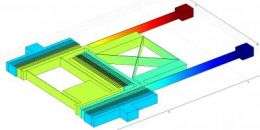
This illustration depicts a tiny device called a monolithic comb drive, which might be used as a high-precision "nanopositioner" for such uses as biological sensors, computer hard drives and other possible applications. The device was created by Jason Vaughn Clark, an assistant professor of electrical and computer engineering and mechanical engineering at Purdue University. Credit: Birck Nanotechnology Center, Purdue University

Engineers have created a tiny motorized positioning device that has twice the dexterity of similar devices being developed for applications that include biological sensors and more compact, powerful computer hard drives.

The device, called a monolithic comb drive, might be used as a "nanoscale manipulator" that precisely moves or senses movement and forces. The devices also can be used in watery environments for probing biological molecules, said Jason Vaughn Clark, an assistant professor of electrical and computer engineering and mechanical engineering, who created the design.

The monolithic comb drives could make it possible to improve a class of probe-based sensors that detect viruses and biological molecules. The sensors detect objects using two different components: A probe is moved while at the same time the platform holding the specimen is positioned. The new technology would replace both components with a single one - the monolithic comb drive.

The innovation could allow sensors to work faster and at higher resolution and would be small enough to fit on a microchip. The higher resolution might be used to design future computer hard drives capable of high-density data storage and retrieval. Another possible use might be to fabricate or assemble miniature micro and nanoscale machines.

Research findings were detailed in a technical paper presented in July during the University Government Industry Micro/Nano Symposium in Louisville. The work is based at the Birck Nanotechnology Center at Purdue's Discovery Park.

Conventional comb drives have a pair of comblike sections with "interdigitated fingers," meaning they mesh together. These meshing fingers are drawn toward each other when a voltage is applied. The applied voltage causes the fingers on one comb to become positively charged and the fingers on the other comb to become negatively charged, inducing an attraction between the oppositely charged fingers. If the voltage is removed, the spring-loaded comb sections return to their original position.

By comparison, the new monolithic device has a single structure with two perpendicular comb drives.

Clark calls the device monolithic because it contains comb drive components that are not mechanically and electrically separate. Conventional comb drives are structurally "decoupled" to keep opposite charges separated.

"Comb drives represent an advantage over other technologies," Clark said. "In contrast to piezoelectric actuators that typically deflect, or move, a fraction of a micrometer, comb drives can deflect tens to hundreds of micrometers. And unlike conventional comb drives, which only move in one direction, our new device can move in two directions - left to right, forward and backward - an advance that could really open up the door for many applications."

Clark also has invented a way to determine the precise deflection and force of such microdevices while reducing heat-induced vibrations that could interfere with measurements.

Current probe-based biological sensors have a resolution of about 20 nanometers.

"Twenty nanometers is about the size of 200 atoms, so if you are scanning for a particular molecule, it may be hard to find," Clark said. "With our design, the higher atomic-scale resolution should make it easier to find."

Properly using such devices requires engineers to know precisely how much force is being applied to comb drive sensors and how far they are moving. The new design is based on a technology created by Clark called electro micro metrology, which enables engineers to determine the precise displacement and force that's being applied to, or by, a comb drive. The Purdue researcher is able to measure this force by comparing changes in electrical properties such as capacitance or voltage.

Clark used computational methods called nodal analysis and finite element analysis to design, model and simulate the monolithic comb drives.

The research paper describes how the monolithic comb drive works when voltage is applied. The results show independent left-right and forward-backward movement as functions of applied voltage in color-coded graphics.

The findings are an extension of research to create an ultra-precise measuring system for devices having features on the size scale of nanometers, or billionths of a meter. Clark has led research to create devices that "self-calibrate," meaning they are able to precisely measure themselves. Such measuring methods and standards are needed to better understand and exploit nanometer-scale devices.

The size of the entire device is less than one millimeter, or a thousandth of a meter. The smallest feature size is about three micrometers, roughly one-thirtieth as wide as a human hair.

"You can make them smaller, though," Clark said. "This is a proof of concept. The technology I'm developing should allow researchers to practically and efficiently extract dozens of geometric and material properties of their microdevices just by electronically probing changes in capacitance or voltage."

In addition to finite element analysis, Clark used a simulation tool that he developed called Sugar.

"Sugar is fast and allows me to easily try out many design ideas," he said. "After I narrow down to a particular design, I then use finite element analysis for fine-tuning. Finite element analysis is slow, but it is able to model subtle physical phenomena that Sugar doesn't do as well."

Source: Purdue University


print this article email this article download pdf blog this article bookmark this article     Digg this Stumble it share on Facebook share on Reddit add to delicious save to Yahoo! bookmarks
4.5/5 after 14 votes

Rank Filter

Move the slider to adjust rank threshold, so that you can hide some of the comments.


Display comments: newest first

  • superhuman - Aug 20, 2008
    • Rank: not rated yet
    Current probe-based biological sensors have a resolution of about 20 nanometers.


    Piezoelectric actuators which have sub-nanometer resolution are in every STM and AFM out there, they can be bought for less then $100. Just google "piezoactuator", heres one example from first link i checked:
    http://www.physik...r=200510

    and a quote from it:

    P-772.0L piezo nanopositioning stage
    * Small Flexure-Guided Stage
    * 50 Picometer Resolution
    * 10 Micrometer Travel
    * Ultra-Fast Response (1.7 kHz Resonant Frequency)

August 20th, 2008 all stories
Nanotechnology / Nanophysics

Comments: 1
Rank: 4.5/5 after 14 votes

  • Stumble this up

  • Digg this

  • Share it:
  • share on Facebook
  • share on MySpace
  • share on Slashdot
  • rss-newsfeed
  • share on Google
  • share on Reddit
  • add to delicious
  • save to Yahoo! bookmarks
  • share on Windows Live
  • Add to Mixx!
Rating: 4.5/5 after 14 votes

  • Related Stories

  • Fermi Telescope reveals a population of radio-quiet gamma-ray pulsars
    created Jul 02, 2009 | popularity not rated yet | comments 0
  • Remembering what to remember and what to forget
    created Jun 25, 2009 | popularity not rated yet | comments 0
  • Changes in brain architecture may be driven by different cognitive challenges
    created Jun 23, 2009 | popularity not rated yet | comments 0
  • Ancient tombs discovered by Kingston University-led team
    created Jun 09, 2009 | popularity not rated yet | comments 0
  • Goal: developing the best atomic clock in the world
    created May 29, 2009 | popularity not rated yet | comments 0


  • Physicists Demonstrate Quantum Memory with Matter Qubits
    Physicists Demonstrate Quantum Memory with Matter Qubits
    Physics / General Physics
    created Jul 03, 2009 | popularity 4.4 / 5 (17) | comments 1
  • 'Holey' Nanosheets for Wastewater Dye Removal
    Nanotechnology / Nanomaterials
    created Jul 01, 2009 | popularity 5 / 5 (5) | comments 1
  • Jellyfish Robot Swims Like its Biological Counterpart
    Jellyfish Robot Swims Like its Biological Counterpart
    Electronics / Robotics
    created Jun 26, 2009 | popularity 4.4 / 5 (8) | comments 1
  • Could Maxwell's Demon Exist in Nanoscale Systems?
    Could Maxwell's Demon Exist in Nanoscale Systems?
    Physics / General Physics
    created Jun 24, 2009 | popularity 4.4 / 5 (18) | comments 29
  • Living Safely with Robots, Beyond Asimov's Laws
    Living Safely with Robots, Beyond Asimov's Laws
    Electronics / Robotics
    created Jun 22, 2009 | popularity 4.6 / 5 (52) | comments 40
  • Other News

    A 'quantum of sol' -- how nanotechnology could hold the key to a solar-powered future

    A 'quantum of sol' -- how nanotechnology could hold the key to a solar-powered future

    Nanotechnology / Nanomaterials

    created Jun 30, 2009 | popularity 3.9 / 5 (15) | comments 17

    (PhysOrg.com) -- A new generation of 'nano-structured' millimetre-sized solar cells that could convert the sun's energy to electricity more than twice as efficiently as current technology, is the subject of ...


    Australian researchers are set to begin human trials of a tiny nano-cell that acts as a "Trojan horse" against cancer

    Hi-tech 'Trojan horse' can kill cancer cells: researchers

    Nanotechnology / Bio & Medicine

    created Jun 29, 2009 | popularity 4.7 / 5 (12) | comments 7

    Australian researchers are set to begin human trials of a tiny nano-cell that acts as a "Trojan horse" against cancer cells, a breakthrough they say may curb the need for debilitating chemotherapy.


    'Holey' Nanosheets for Wastewater Dye Removal

    Nanotechnology / Nanomaterials

    created Jul 01, 2009 | popularity 5 / 5 (5) | comments 1

    (PhysOrg.com) -- Researchers have discovered that extremely thin sheets of nickel oxide with hexagonally shaped holes can absorb hazardous dyes from wastewater nearly as well as the best traditional methods, but are recyclable. ...


    Harnessing Nanoparticles To Track Cancer Cell Changes

    Nanotechnology / Bio & Medicine

    created Jul 03, 2009 | popularity not rated yet | comments 1

    The more dots there are, the more accurate a picture you get when you connect them. Cancer researchers adopting that philosophy have developed a new imaging technology that could give scientists the ability to simultaneously ...


    Computer-Guided Nanoparticle Therapy Destroys Tumors

    Nanotechnology / Bio & Medicine

    created Jun 29, 2009 | popularity 4.9 / 5 (12) | comments 0

    Gold nanoshells are among the most promising new nanoscale therapeutics being developed to kill tumors, acting as antennas that turn light energy into heat that cooks cancer to death. Now, a multi-institutional research team ...