Most Black Holes Might Come in Only Small and Large
August 20th, 2008 Most Black Holes Might Come in Only Small and Large

Enlarge

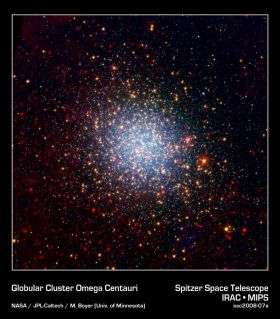
Until now, astronomers had suspected that globular clusters like the one pictured here were the most likely place to find medium-sized black holes -- elusive objects that have proved difficult to pin down. Globular clusters are spherical collections of stars that orbit around larger galaxies like our Milky Way. Scientists analyzed a globular cluster called RZ2109 and found it does not possess a medium-sized black hole. RZ2109 is much farther away than the globular cluster pictured here, called Omega Centauri.Image Credit: NASA/JPL-Caltech/ NOAO/AURA/NSF

(PhysOrg.com) -- Black holes are sometimes huge cosmic beasts, billions of times the mass of our sun, and sometimes petite with just a few times the sun's mass. But do black holes also come in size medium? A new study suggests that, for the most part, the answer is no.

Astronomers have long suspected that the most likely place to find a medium-mass black hole would be at the core of a miniature galaxy-like object called a globular cluster. Yet nobody has been able to find one conclusively.

Now, a team of astronomers has thoroughly examined a globular cluster called RZ2109 and determined that it cannot possess a medium black hole. The findings suggest that the elusive objects do not lurk in globular clusters, and perhaps are very rare.

"Some theories say that small black holes in globular clusters should sink down to the center and form a medium-sized one, but our discovery suggests this isn't true," said Daniel Stern of NASA's Jet Propulsion Laboratory in Pasadena, Calif. Stern is second author of a study detailing the findings in the Aug. 20 issue of Astrophysical Journal. The lead author is Stephen Zepf of Michigan State University, East Lansing.

Black holes are incredibly dense points of matter, whose gravity prevents even light from escaping. The least massive black holes known are about 10 times the mass of the sun and form when massive stars blow up in supernova explosions. The heftiest black holes are up to billions of times the mass of the sun and lie deep in the bellies of almost all galaxies.

That leaves black holes of intermediate mass, which were thought to be buried at the cores of globular clusters. Globular clusters are dense collections of millions of stars, which reside within galaxies containing hundreds of billions of stars. Theorists argue that a globular cluster should have a scaled down version of a galactic black hole. Such objects would be about 1,000 to 10,000 times the mass of the sun, or medium in size on the universal scale of black holes.

In a previous study, Zepf and his colleagues looked for evidence of a black hole in RZ2109, located 50 million light-years away in a nearby galaxy. Using the European Space Agency's XMM-Newton telescope (which derives its name from X-ray Multi-Mirror design), they discovered the telltale X-ray signature of an active, or "feeding" black hole. But, at that point, they still didn't know its size.

Zepf and Stern then teamed up with others to obtain a chemical fingerprint, called a spectrum, of the globular cluster, using the W.M. Keck Observatory on Mauna Kea in Hawaii. The spectrum revealed that the black hole is petite, with roughly 10 times the mass of our sun.

According to theory, a cluster with a small black hole cannot have a medium one, too. Medium black holes would be quite hefty with a lot of gravity, so if one did exist in a globular cluster, scientists argue that it would quickly drag any small black holes into its grasp.

"If a medium black hole existed in a cluster, it would either swallow little black holes or kick them out of the cluster," said Stern. In other words, the small black hole in RZ2109 rules out the possibility of a medium one.

How did the scientists figure out that the globular cluster's black hole was small in the first place? Using modeling techniques, Zepf and his colleagues concluded that the spectrum taken by Keck reveals high-velocity flows of matter, or "winds," firing out of the black hole. Only a small black hole could spit out these observed high winds.

Zepf explains, "We knew from X-ray data that this black hole was actively swallowing up, or accreting, material. If an intermediate-sized black hole were accreting this material, it wouldn't be too big of a deal for it. But if a small black hole were accreting this material, it would be a lot for it to take and therefore some material would be ejected in the form of high winds. Thus, the high winds were our smoking gun showing that this black hole is small."

Is this the end of the story for medium black holes? Zepf said it is possible such objects are hiding in the outskirts of galaxies like our Milky Way, either in surrounding so-called dwarf galaxies or in the remnants of dwarf galaxies being swallowed by a bigger galaxy. If so, the black holes would be faint and difficult to find.

Provided by NASA


print this article email this article download pdf blog this article bookmark this article     Digg this Stumble it share on Facebook share on Reddit add to delicious save to Yahoo! bookmarks
4.3/5 after 32 votes

Rank Filter

Move the slider to adjust rank threshold, so that you can hide some of the comments.


Display comments: newest first

  • TimESimmons - Aug 20, 2008
    • Rank: 2.3 / 5 (3)
    An explanation for globular clusters that doesn't require black holes:-

    http://www.presto...ndex.htm
  • earls - Aug 20, 2008
    • Rank: not rated yet
    Tim, why are the cluster spherical instead of planar like galaxies?
  • Modernmystic - Aug 20, 2008
    • Rank: not rated yet
    I've always wondered about that too. Most systems seem to settle down in flat configurations as far as orbits go. Solar systems, galaxies, even planetary systems.
  • Valentiinro - Aug 20, 2008
    • Rank: not rated yet
    Because there is not enough interaction between the widely spaced stars in the cluster to flatten out. In a solar system all the dust and such is near enough to interact often enough to settle into a disk and eventually planets.
    Or at least that's the last coherent explanation I hear somewhere or other.
  • Alizee - Aug 20, 2008
    • Rank: 1 / 5 (3)
    By AWT giant black holes at center of large gallaxies are of primordial origin and the matter has evaporated from them insidead of falling into them. The medium class BH can appear by classical mechanism, but such mechanism is quite rare, in fact. A smallest BH are remnant of individual hypernovaes.

    http://superstrun...apse.gif

    The gallaxies are flat just because of radiating of matter from central BH, which emanates the matter in polar jets, thus forming a giant fountain, until excessive matter will not evaporate. The falling of stars into equator plane of BH initiates the rotation of stars, which in turn creates the common flat shape.
  • superhuman - Aug 21, 2008
    • Rank: not rated yet
    So cause one globular cluster has petite black hole none can have medium one? I don't follow that logic.

    Besides how can it have only 10 solar masses and at the same time be accreting a lot of material? It would mean that it just started feeding after eons of starvation which seems unlikely.
    Even if it is the case other clusters should have holes and different stages, some of them already fed up to medium size.
  • TimESimmons - Aug 21, 2008
    • Rank: 2 / 5 (4)
    earls, a globular cluster is lile a small scale elliptical galaxy. most stars are within the AGM boundary of the group. in a spiral galaxy the core is within its own AGM Boundary but the arms are outside the core's AGM Boundary.
  • TimESimmons - Aug 21, 2008
    • Rank: 1 / 5 (4)
    and here's that link again.

    http://www.presto...ndex.htm
  • Alizee - Aug 21, 2008
    • Rank: 1 / 5 (1)
    ...how can it have only 10 solar masses and at the same time be accreting a lot of material?..
    Here exists a number of limits of the black hole size, i.e. the maximal amount of matter, which the black hole can swallow by accretion. Above this limit most of matter will evaporate into radiation during fall into BH, so it doesn't increase the mass of black hole significantly.

    http://superstrun...fall.gif

    This mass limit can by understood by many ways, probably the simplest one is based on energy ballance: the kinetic energy of matter falling into BH from distance is larger then the energy required for complete anihillation of matter. From this follows, the larger BH cannot form by accretion during Universe life and this fact limits the BH size distribution. You can read about another QT based derivation of BH mass limit from here, for example: http://arxiv.org/abs/0807.1938
  • Alizee - Aug 21, 2008
    • Rank: not rated yet
    At the very beginning, every large galaxy is formed by spherical cloud of dust condensing from gamma radiation of central quasar (white hole, naked singularity), where it remains kept at the distance by radiation pressure. As the quasar evaporates, its surface radiation is becoming reflected by event horizon back with exception of polar areas, where it can still escape from BH, thus forming polar jets. You can think about jets of black holes as about exaggerated case of so called gravitational brightening, which can be observed even at the case of giant stars (i.e. Regullus, Sirius A, etc.).

    It means, the radiation pressure is lower at the equatorial plane of black hole, which leads to the gradual formation of flat belt of stars. At the very end, the central BH stops to radiate totally and the shape of gallaxy will change into spherical again, so we can observe the old gallaxies as an elliptical ones. The small clusters lacks the central BH, so they're remain in their original shape and no antimatter is required for such explanation.
  • Alizee - Aug 21, 2008
    • Rank: not rated yet
    Medium sized BH aren't so rare, but they're revolving large BHs in close proximity, which makes somewhat difficult to observe them directly.

    http://www.nature...8-2.html
  • rkolter - Aug 21, 2008
    • Rank: not rated yet
    I also wondered about why a globular cluster could not have small black holes if a medium black hole existed in it. Does this mean that it could not have a star with 10 or more solar masses either? Don't clusters have large stars in them too?
  • Question - Aug 21, 2008
    • Rank: not rated yet
    Can anyone explain how star clusters can remain stable for billions of years? What keeps them from collapsing gravitationally?
  • NeilFarbstein - Aug 22, 2008
    • Rank: 1 / 5 (1)
    rotational and orbital angular moemetum are conserved so the stars in the cluster still have the same aggregate amount of momentum after billions of years.
  • Question - Aug 22, 2008
    • Rank: not rated yet
    Thanks, but I still find it confusing because if these star cluster rotate around a common center how could they keep their spherical shape for billions of years? Would they not flatten out like galaxies that rotate? Besides I have never read about star cluster rotating, the Doppler shifting of their light should be able to prove or disprove this.
  • Alizee - Aug 22, 2008
    • Rank: not rated yet
    Would they not flatten out like galaxies that rotate?
    The questions is exactly the opposite: which force should lead to the formation of asymetric, thin galactic disk, instead? The symmetric, spherical shape is just most probable here. As I wrote already, even the thin galaxies are getting spherical with age, whenever possible. Elliptical galaxies are known for their old, red stars.
  • Question - Aug 22, 2008
    • Rank: not rated yet
    Whether galaxies get more spherical with age I cannot say but that does bring two question to mind. What happens to the angular momentum of the star obiting the elliptical galaxy? And doesn't any soft rotating object take on a disc shape, so why wouldn't a galaxy?
  • Alizee - Aug 22, 2008
    • Rank: 5 / 5 (1)
    What happens to the angular momentum of the star obiting the elliptical galaxy?
    It's radiated in tidal effects and gravitational waves and distributed over the whole rest of galaxy. After all, we can observe this even at the scope of solar system, where the original planets are moving along quite circular paths (the more, the higher speed they're off).
  • TimESimmons - Aug 24, 2008
    • Rank: 1 / 5 (1)
    Alizee. I believe the answer to your question is here:-

    http://www.presto...ndex.htm
  • TimESimmons - Aug 25, 2008
    • Rank: 1 / 5 (1)
    Added text to explain why galaxies are flat:-

    http://www.presto...ndex.htm
  • Glis - Aug 25, 2008
    • Rank: not rated yet
    So this basically completely destroys Hawkings theory on evaporating black holes or says something very significant about the age of the universe?
  • Alizee - Sep 12, 2008
    • Rank: 1 / 5 (1)
    ..this basically completely destroys Hawkings theory on evaporating black holes..
    By AWT the Hawking's evaporation is relevant only for relativelly small black holes, the larger black holes (above 5 milions of solar masses) can radiate neutrinos and electromagnetic radiation quite freely like tiny hot stars (quasars).

August 20th, 2008 all stories
Space & Earth / Astronomy

Comments: 22
Rank: 4.3/5 after 32 votes

  • Stumble this up

  • Digg this

  • Share it:
  • share on Facebook
  • share on MySpace
  • share on Slashdot
  • rss-newsfeed
  • share on Google
  • share on Reddit
  • add to delicious
  • save to Yahoo! bookmarks
  • share on Windows Live
  • Add to Mixx!
Rating: 4.3/5 after 32 votes

  • Related Stories

  • VLBA locates superenergetic bursts near giant black hole
    created Jul 02, 2009 | popularity not rated yet | comments 0
  • New class of black holes discovered
    created Jul 01, 2009 | popularity not rated yet | comments 0
  • Baby Stars Finally Found in Jumbled Galactic Center
    created Jun 10, 2009 | popularity not rated yet | comments 0
  • Computer Finds Massive Black Hole in Nearby Galaxy
    created Jun 09, 2009 | popularity not rated yet | comments 0
  • Math theories may hold clues to origin, future of life in universe
    created Jun 09, 2009 | popularity not rated yet | comments 0


  • Physicists Demonstrate Quantum Memory with Matter Qubits
    Physicists Demonstrate Quantum Memory with Matter Qubits
    Physics / General Physics
    created Jul 03, 2009 | popularity 4.4 / 5 (17) | comments 1
  • 'Holey' Nanosheets for Wastewater Dye Removal
    Nanotechnology / Nanomaterials
    created Jul 01, 2009 | popularity 5 / 5 (5) | comments 1
  • Jellyfish Robot Swims Like its Biological Counterpart
    Jellyfish Robot Swims Like its Biological Counterpart
    Electronics / Robotics
    created Jun 26, 2009 | popularity 4.4 / 5 (8) | comments 1
  • Could Maxwell's Demon Exist in Nanoscale Systems?
    Could Maxwell's Demon Exist in Nanoscale Systems?
    Physics / General Physics
    created Jun 24, 2009 | popularity 4.4 / 5 (18) | comments 29
  • Living Safely with Robots, Beyond Asimov's Laws
    Living Safely with Robots, Beyond Asimov's Laws
    Electronics / Robotics
    created Jun 22, 2009 | popularity 4.6 / 5 (53) | comments 40
  • Other News

    China environmental phenomena monitored from space

    Space & Earth / Earth Sciences

    created 46 minutes ago | popularity not rated yet | comments 0

    China is in a very seismically active area and has had many catastrophic earthquakes during its history. A joint European-Chinese team is using satellite radar data to monitor ground deformation across major continental faults ...


    California to require sun-blocking car windows

    Space & Earth / Environment

    created 2 hours ago | popularity 2.3 / 5 (3) | comments 4

    New cars sold in California must include windshields that block or absorb the sun's rays beginning in 2012, the state's Air Resources Board recently ruled.


    Scientists: Silent tremors may foretell next Big One

    Space & Earth / Earth Sciences

    created 2 hours ago | popularity not rated yet | comments 0

    The seismometer is snugged in its hole and tamped over with dirt. Now it's time for the stomp test.


    Steam billows from the cooling towers at a nuclear power generating station in Byron

    Tropical zone expanding due to climate change: study

    Space & Earth / Earth Sciences

    created 4 hours ago | popularity 3 / 5 (4) | comments 0

    Climate change is rapidly expanding the size of the world's tropical zone, threatening to bring disease and drought to heavily populated areas, an Australian study has found.


    The least sea ice in 800 years

    The least sea ice in 800 years

    Space & Earth / Earth Sciences

    created Jul 01, 2009 | popularity 4.1 / 5 (65) | comments 60

    New research, which reconstructs the extent of ice in the sea between Greenland and Svalbard from the 13th century to the present indicates that there has never been so little sea ice as there is now. The ...