Anropologist explores plausibility of bulbs and tubers in the diet of early human ancestors
August 20, 2008
Anropologist explores plausibility of bulbs and tubers in the diet of early human ancestors

Enlarge

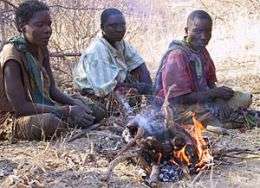
Roasting tubers, as shown in this photo of Hadza hunter-gatherers in Tanzania, enhances their digestibility, according to anthropologist Nate Dominy. Photo by N. Dominy.

(PhysOrg.com) -- It was a dirty job, but somebody had to do it. Anthropologist Nathaniel J. Dominy of the University of California, Santa Cruz, has advanced the investigation of the diet of early human ancestors by painstakingly measuring the mechanical properties of the underground parts of nearly 100 plant species across sub-Saharan Africa.

Call it the "chewability factor" if you will, but determining the relative toughness and hardness of rhizomes, tubers, corms, and bulbs was the next step in Dominy's exploration of the hypothesis that our earliest ancestors may have eaten a diet rich in plants, specifically their carbohydrate-rich underground storage organs (USOs).

The flat, thickly enameled molars of early humans have led scientists to infer that their diet consisted primarily of hard, brittle foods, with recent evidence suggesting that USOs played a key role as "fallback foods" eaten during times of scarcity.

"This was the first time anyone has measured the properties of these hypothetical foods to see if they match what we've been inferring from the fossil record," said Dominy, who field-tested the hardness and toughness of 98 species of USOs. "Our data for bulbs and corms fit most researchers' expectations for the physical properties of hominin foods. What we found in some ways merely confirmed the obvious."

But Dominy's new study, published in the online edition of the journal Evolutionary Biology, also adds unexpected insights, because his analysis suggests that different hominin species relied to varying degrees on USOs. Particularly when combined with other lines of evidence, Dominy's newest findings fill an important empirical void.

The study marks the third avenue of investigation Dominy has employed in his pathbreaking research on diet and human evolution. Dominy has drawn on the fields of chemistry, molecular biology, and genetics to explore the source of the nutritional bonanza that gave early human ancestors an edge over all other primates. His contributions include the revelation that humans are uniquely adapted to digest starch and the resolution of a conundrum that bolstered the USO hypothesis by confirming that USOs leave the same chemical signature on tooth enamel as grass does (see earlier press releases about starch and USOs).

In the new paper, entitled "Mechanical Properties of Plant Underground Storage Organs and Implications for Dietary Models of Early Hominins," Dominy tested USOs, which plants use to store water and carbohydrates. His data establish rhizomes as the toughest, followed by tubers, corms, and bulbs (familiar examples of which include Bermuda grass, potatoes, iris, and onions, respectively). Corms and bulbs emerged as the most plausible hominin foods, according to Dominy, because their physical qualities match up with dietary inferences based on dental morphology and modern chemical isotopic analysis.

The new data also allowed Dominy to correlate plant characteristics with the dental morphology of different species of hominins. The teeth of Australopithecus, for example, appear well-suited to process bulbs, while the teeth of Paranthropus appear well-adapted to process hard and brittle corms.

Finally, prompted by his own observations of Hadza hunter-gatherers in northern Tanzania, Dominy also conducted a pilot field study of the effects of roasting by Hadza on the toughness of five tuber species. The results, that roasting lessens the work of chewing and thereby enhances digestibility, add to the plausibility of relatively tough tubers in the diet of hominins.

Dominy's coauthors on the paper were Erin R. Vogel, an associate researcher and lecturer in anthropology at UCSC; Justin D. Yeakel, a doctoral candidate in ecology and evolutionary biology at UCSC; Paul Constantino, a postdoctoral associate at George Washington University; and Peter W. Lucas, a professor of anthropology at George Washington University.

Provided by University of California, Santa Cruz

4.1 /5 (7 votes)  

Rank 4.1 /5 (7 votes)
Relevant PhysicsForums posts
  • Factors affecting beet root cell membrane
    created11 hours ago
  • Stem cell question.
    createdFeb 10, 2012
  • Protease cleavage
    createdFeb 10, 2012
  • Pertubance in a model
    createdFeb 10, 2012
  • Cancer drugs and Alzheimer's, Oh my!
    createdFeb 09, 2012
  • Squishing cells
    createdFeb 09, 2012
  • More from Physics Forums - Biology

More news stories

A frank discussion of the power law and linking correlation to causation

(PhysOrg.com) -- Michael Stumpf a mathematics professor at Imperial College in London, and Mason Porter a lecturer at Oxford have teamed together to write and publish a perspective piece in Science regarding the in ...

Other Sciences / Mathematics

created Feb 10, 2012 | popularity 5 / 5 (5) | comments 11 | with audio podcast report

US workers are 'giving away the store,' costing firms billions

Nearly 70 percent of the nation's service employees give away free goods and services – from hamburgers to cable TV – costing companies billions of dollars a year, according to a groundbreaking study.

Other Sciences / Economics & Business

created Feb 09, 2012 | popularity 3 / 5 (5) | comments 11

Employers feel no love for unscrupulous practice of 'service sweethearting'

A new study led by two Florida State University marketing professors finds that some frontline service employees who are rewarded for hikes in customer loyalty and satisfaction also may engage in "service ...

Other Sciences / Economics & Business

created Feb 10, 2012 | popularity 3.3 / 5 (3) | comments 10

New insights into how to correct false knowledge

The abundance of false information available on the Internet, in movies and on TV has created a big challenge for educators.

Other Sciences / Social Sciences

created Feb 07, 2012 | popularity 4.9 / 5 (7) | comments 9 | with audio podcast

Neanderthal demise due to many influences, including cultural changes: study

As an ice age crept upon them thousands of years ago, Neanderthals and modern human ancestors expanded their territory ranges across Asia and Europe to adapt to the changing environment.

Other Sciences / Archaeology & Fossils

created Feb 07, 2012 | popularity 4.4 / 5 (5) | comments 8 | with audio podcast


Scientists discover molecular secrets of 2,000-year-old Chinese herbal remedy

For roughly two thousand years, Chinese herbalists have treated Malaria using a root extract, commonly known as Chang Shan, from a type of hydrangea that grows in Tibet and Nepal. More recent studies suggest that halofuginone, ...

New method to examine batteries -- MRI from the inside

There is an ever-increasing need for advanced batteries for portable electronics, such as phones, cameras, and music players, but also to power electric vehicles and to facilitate the distribution and storage of energy derived ...

A mitosis mystery solved: How chromosomes align perfectly in a dividing cell

Although the process of mitotic cell division has been studied intensely for more than 50 years, Whitehead Institute researchers have only now solved the mystery of how cells correctly align their chromosomes during symmetric ...

Google might launch Drive for cloud storage soon

(PhysOrg.com) -- Google's next big move, according to the Wall Street Journal, is a cloud storage service called Drive. Hardly first to the plate, Google is simply catching up to introducing its cloud reposi ...

Lab study raises questions over nano-particle impact

Tests involving chickens have raised questions about the impact on health from engineered nano-particles, the ultra-fine grains commonly used in drugs and processed foods, scientists said on Sunday.

Overeating may double risk of memory loss

New research suggests that consuming between 2,100 and 6,000 calories per day may double the risk of memory loss, or mild cognitive impairment (MCI), among people age 70 and older. The study was released today and will be ...