Tahitian vanilla originated in Maya forests
The origin of the Tahitian vanilla orchid, whose cured fruit is the source of the rare and highly esteemed gourmet French Polynesian spice, has long eluded botanists. Known by the scientific name Vanilla tahitensis, Tahitian vanilla is found to exist only in cultivation; natural, wild populations of the orchid have never been encountered.
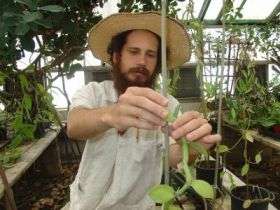
Now, a team of investigators led by Pesach Lubinsky, a postdoctoral researcher with Norman Ellstrand, a professor of genetics in UC Riverside's Department of Botany and Plant Sciences, claims to have traced Tahitian vanilla back to its true origins.
In the August issue of the American Journal of Botany, Lubinsky and colleagues use genetic and ethnohistoric analysis to argue that Tahitian vanilla began its evolutionary journey as a pre-Columbian Maya cultivar inside the tropical forests of Guatemala.
"All the evidence points in the same direction," Lubinsky said. "Our DNA analysis corroborates what the historical sources say, namely, that vanilla was a trade item brought to Tahiti by French sailors in the mid-19th century. The French Admiral responsible for introducing vanilla to Tahiti, Alphonse Hamelin, used vanilla cuttings from the Philippines. The historical record tells us that vanilla – which isn't native to the Philippines – was previously introduced to the region via the Manila Galleon trade from the New World, and specifically from Guatemala."
The Manila galleons (1565-1815) were Spanish trading ships that sailed once or twice each year across the Pacific Ocean between Manila in the Philippines and Acapulco, Mexico. The ships brought Chinese porcelain, silk, ivory, spices, and other exotic goods to Mexico in exchange for New World silver.
The genetic data Lubinsky and his colleagues obtained confirmed that the closest relatives to Tahitian vanilla, from among 40 different Vanilla species they analyzed from across the world, were two species that grow naturally only in the tropical forests of Central America: Vanilla planifolia and Vanilla odorata. V. planifolia is also the primary species cultivated for commercial vanilla, and is grown principally in Madagascar and Indonesia. V. odorata has never been cultivated.
Yet, even with this initial genetic data, the researchers faced a conundrum. They could find no Tahitian vanilla growing wild in Guatemala, which is where its closest relatives grew. The researchers decided to give their genetic data a second look. This time, by comparing patterns of relatedness in DNA sequences from both the nucleus and the chloroplast (a plant cell's photosynthetic factory), they discovered that Tahitian vanilla fit the pattern of being a hybrid offspring between V. planifolia and V. odorata.
"And that's where the Maya cultivators come in," Lubinsky explained. "The pre-Columbian Maya had been managing their forests for millennia to cultivate cacao and to make chocolate, and we know they were also cultivating vanilla to use it as a chocolate spice. The Maya created these forest gardens by introducing different types of species of wild cacao and vanilla from the surrounding forests, which meant that species that had previously been geographically separated were then able to hybridize because they were in the same place. That's the scenario we present in our research paper for how Tahitian vanilla got started. It is an evolutionary product, but also a Maya artifact."
Seung-Chul Kim, an assistant professor of systematics in the Department of Botany and Plant Sciences and a coauthor on the research paper, served as an advisor to Lubinsky on the project.
"Pesach has demonstrated that Vanilla species can exchange genes quite frequently across species barriers," Kim said. "This provides an opportunity to breed new commercial varieties of vanilla through hybridization in the future."
Lubinsky, Kim and their colleagues plan to do further research on vanilla. In January 2009, they will begin mapping cacao-vanilla forest gardens in Belize, southern Mexico and Guatemala. They also are actively advising on sustainable agricultural development projects using vanilla in Mexico and Belize, and have plans to assemble a vanilla germplasm collection.
Source: University of California - Riverside


