FBI unveils science of anthrax investigation
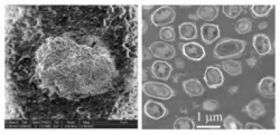
They have worked for almost seven years in secret. Most people did not know that the work in Ray Goehner's materials characterization department at Sandia National Laboratories was contributing important information to the FBI's investigation of letters containing bacillus anthracis, the spores that cause the disease anthrax. The spores were mailed in the fall of 2001 to several news media offices and to two U.S. senators. Five people were killed.
Sandia's work demonstrated to the FBI that the form of bacillus anthracis contained in those letters was not a weaponized form, a form of the bacteria prepared to disperse more readily. The possibility of a weaponized form was of great concern to investigators, says Joseph Michael, the principal investigator for the project. This information was crucial in ruling out state-sponsored terrorism.
In fall of 2001, the FBI considered how to best investigate the anthrax letters. The agency convened two blue ribbon exploratory panels, and Sandia's name came up during both panels for its expertise in electron and ion microscopies and microanalysis over the range of length scales from millimeters down to nanometers. The first spore material from the letters arrived at Sandia in February of 2002.
Sandia faced some uncertainty in working on this type of investigation. Researchers signed nondisclosure agreements and agreed to make themselves available to government agencies on short notice when called to give information.
Joseph Michael, transmission electron microscopy (TEM) lab owner Paul Kotula, and a team of roughly a dozen others examined more than 200 samples in those six and a half years. They received samples from the letter delivered to the New York Post, to former Sen. Tom Daschle (D-S.D.), and to Sen. Patrick Leahy (D-Vt.). The samples looked different, in part because of how the samples were prepared, which made examination initially difficult.
When bacillus anthracis spores are weaponized, the spores are coated with silica nanoparticles that look almost like lint under the microscope. The "lint" makes the particles "bouncier" and less likely to clump and fall to the ground. That makes the spores more respirable and able to do more damage, says Michael. Weaponization of the spores would be an indicator of state sponsored terrorism.
"Initially, scanning electron microscopy [SEM] conducted at another laboratory, showed high silicon and oxygen signals that led them to conclude that the spores were a weaponized form, says Kotula. "The possible misinterpretation of the SEM results arose because microanalysis in the SEM is not a surface-sensitive tool," says Kotula. "Because a spore body can be 1.5 to 2 microns wide by 1 micron long, a SEM cannot localize the elemental signal from whole spore bodies."
Using more sensitive transmission electron microscopy (TEM), Kotula and Michael's research indicated that the silica in the spore samples was not added artificially, but was incorporated as a natural part of the spore formation process. "The spores we examined," Kotula says, "lacked that fuzzy outer coating that would indicate that they'd been weaponized."
Sandia's work was the first to actually link the spore material in the New York Post, the Daschle and the Leahy letters. The elemental signatures and the locations of these signatures, while not indicating intentional weaponization, did show that the spores were indistinguishable and therefore likely came from the same source. That conclusion was corroborated a few years later by the DNA studies.
The materials characterization lab serves as a materials analysis resource for a diverse collection of projects. The lab plays an important role in stockpile surveillance, supporting Sandia's nuclear weapons mission.
Michael was recently released from his nondisclosure agreement and flown to Washington, D.C., to participate in press conferences at FBI Headquarters along with several members of research teams who'd been asked to examine other aspects of the anthrax case.
The FBI was pleased with Sandia's work, says Michael.
Source: DOE/Sandia National Laboratories


