Malaria researchers identify new mosquito virus
August 22, 2008 Anopheles gambiae Mosquito

Enlarge

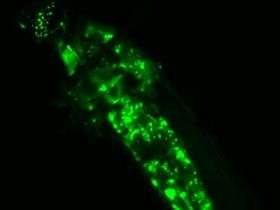
Anopheles gambiae mosquito infected with GFP-expressing AgDNV. Credit: Johns Hopkins Bloomberg School of Public Health

Researchers at the Johns Hopkins Bloomberg School of Public Health's Malaria Research Institute have identified a previously unknown virus that is infectious to Anopheles gambiae—the mosquito primarily responsible for transmitting malaria. According to the researchers, the discovered virus could one day be used to pass on new genetic information to An. gambiae mosquitoes as part of a strategy to control malaria, which kills over one million people worldwide each year. The study was published August 22 online in the peer-reviewed open access journal PLoS Pathogens.

The virus, AgDNV, is a densonucleosis virus or "densovirus," which are common to mosquitoes and other insects, but do not infect vertebrate animals such as humans. Although the virus does not appear to harm the mosquitoes, the researchers determined it is highly infectious to mosquito larvae and is easily passed on to the adults.

According to Jason Rasgon, PhD, senior author of the study, the discovery came about serendipitously while the research team was conducting experiments to determine whether Wolbachia bacteria could be used to infect An. gambiae mosquito cells. During the analysis, Xiaoxia Ren, a postdoctoral fellow with Johns Hopkins Malaria Research Institute, noticed an "artifact," that appeared as a prominent band in the gel used to detect the bacteria.

"Finding artifacts such as this one during experiments is not uncommon, but we decided to investigate this one further since we kept observing it over and over. When we sequenced it we were surprised to learn that we had found a new virus," explained Rasgon, an assistant professor with the Bloomberg School's W. Harry Feinstone Department of Molecular Microbiology and Immunology.

According to Rasgon, the virus could be potentially altered to kill the mosquito or make An. gambiae incapable of transmitting malaria. To test the concept, the research team successfully used altered AgDNV to express harmless green fluorescent protein in the adult mosquitoes which could be easily spotted under the microscope.

"In theory, we could use this virus to produce a lethal toxin in the mosquito or instruct the mosquito to die after 10 days, which is before it can transmit the malaria parasite to humans. However, these concepts are many years away," said Rasgon.

Source: Johns Hopkins University Bloomberg School of Public Health


print this article email this article download pdf blog this article bookmark this article     Stumble it Digg this share on Facebook retweet share on Reddit add to delicious
Rate this story - 4 /5 (4 votes)


August 22, 2008 all stories

Comments: 0

4 /5 (4 votes)
  • Stumble this up

  • Digg this

  • share this

  • hide
  • Related Stories

  • Discovery of natural odors could help develop mosquito repellents (w/ Video)
    created Aug 26, 2009 | popularity not rated yet | comments 0
  • Human Movement Plays Critical Role in Disease Transmission
    created Jul 21, 2009 | popularity not rated yet | comments 0
  • Climate change amplifying animal disease
    created May 25, 2009 | popularity not rated yet | comments 0
  • Device targets mosquitoes with deadly nectar
    created May 06, 2009 | popularity not rated yet | comments 0
  • Vaccine and drug research aimed at ticks and mosquitoes to prevent disease transmission
    created Dec 02, 2008 | popularity not rated yet | comments 0


  • hide
  • Relevant PhysicsForums posts

Other News

eBay Mind Games

Medicine & Health / Psychology & Psychiatry

created 8 hours ago | popularity 3 / 5 (2) | comments 1

Psychologists have long known that when two people haggle over a price, it pays for the seller to start high.


Scientists set their sights on hearing breakthrough for babies

Scientists set their sights on hearing breakthrough for babies

Medicine & Health / Research

created 8 hours ago | popularity not rated yet | comments 0

(PhysOrg.com) -- The first year to two years of life is a critical time for hearing impaired children and their language development. Whilst young babies with hearing difficulties can now be fitted with cochlear ...


Neuroscience in the driving seat

Neuroscience in the driving seat

Medicine & Health / Neuroscience

created 9 hours ago | popularity 5 / 5 (1) | comments 0

It emerged today that more drivers are using hand-held mobile phones than two years ago, despite the introduction of tougher penalties. The Transport Research Laboratory is worried because phone-using drivers ...


Scientists identify natural anti-cancer defenses

Medicine & Health / Cancer

created 11 hours ago | popularity 5 / 5 (5) | comments 2

Canadian researchers have discovered a novel molecular mechanism that prevents cancer. In the December 11 edition of the prestigious journal Molecular Cell, scientists from the Université de Montréal and th ...


Why England's soccer team keeps losing on penalties

Why England's soccer team keeps losing on penalties

Medicine & Health / Psychology & Psychiatry

created 12 hours ago | popularity 4 / 5 (4) | comments 3

A new study may explain why the England soccer team keeps losing in penalty shootouts - and could help the team address the problem in time for the World Cup 2010. Research by the University of Exeter shows ...