Genome of simplest animal reveals ancient lineage, confounding array of complex capabilities
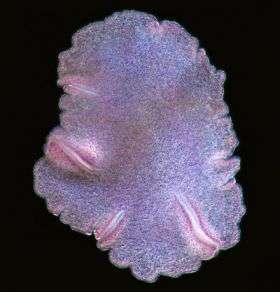
As Aesop said, appearances are deceiving—even in life's tiniest critters. From first detection in the 1880s, clinging to the sides of an aquarium, to its recent characterization by the U.S. Department of Energy Joint Genome Institute (DOE JGI), a simple and primitive animal, Trichoplax adhaerens, appears to harbor a far more complex suite of capabilities than meets the eye. The findings, reported in the August 21 online edition of the journal Nature, establish a group of organisms as a branching point of animal evolution and identify sets of genes, or a "parts list," employed by organisms that have evolved along particular branches.
With each sequenced genome, another dataset is made available to advance the quest of evolutionary biologists seeking to reconstruct the tree of life. The analysis of the 98 million base pair genome of Trichoplax (literally "hairy-plate") illuminates its ancestral relationship to other animals. Trichoplax is the sole member of the placozoan ("tablet," or "flat" animal) phylum, whose relationship to other animals, such as bilaterians (humans, flies, worms, snails, et al) and cnidarians (jellyfish, sea anemones, corals, et al), and sponges is contentious.
"Our whole genome analysis supports placing the placozoans after the sponge lineage branched from other animals," said Daniel Rokhsar, the publication's senior author, DOE JGI's head of Computational Genomics Program, and Professor of Genetics, Genomics and Development at the University of California, Berkeley.
"Trichoplax has had just as much time to evolve as humans, but because of its morphological simplicity, it is tempting to think of it as a surrogate for an early animal," said Mansi Srivastava, the study's first author, a graduate student under the direction of Rokhsar, at the Center for Integrative Genomics, U.C. Berkeley.
Earlier mitochondrial DNA studies suggested that this "mother of all metazoans," Trichoplax, was the earliest branch, before sponges diverged, but this remains debatable—even among collaborators.
"The latest and most complex analysis again suggests that placozoans populated the oceans long before sponges evolved," said Bernd Schierwater, director of the Institute of Animal Ecology & Cell Biology and head of the Center for Biodiversity at TiHo Hannover, Germany. Schierwater, a study co-author, joined Stephen Dellaporta and Leo Buss of Yale University in proposing the Trichoplax sequencing project in 2004 to DOE JGI's Community Sequencing Program [http://www.jgi.doe.gov/CSP/overview.html].
"The outcome of the Trichoplax adhaerens genome sequencing is so exciting that we are now culturing another 13 placozoan species in order to identify the most basal placozoan lineage and genome," said Schierwater.
"Trichoplax is an ancient lineage—a good representation of the ancestral genome that is shedding light of the kinds of genes, the structures of genes, and even how these genes were arranged on the genome in the common ancestor 600 million years ago," said Srivastava. "It has retained a lot of primitive features relative to other living animals."
Originally collected from the Red Sea, and cultured over the last 40 years in the laboratory, Trichoplax is a two-millimeter flat disk containing fluid sandwiched between two cell layers. It lacks organs and only has four or five cell types. Yet, despite its apparent simplicity, its genome encodes a panoply of signaling genes and transcription factors usually associated with more complex animals.
Trichoplax has no neurons, but has many genes that are associated with neural function in more complex animals. "It lacks a nervous system, but it still is able to respond to environmental stimuli. "It has genes, such as ion channels and receptors, that we associate with neuronal functions, but no neurons have ever been reported," explained Rokhsar.
Of the 11,514 genes identified in the six chromosomes of Trichoplax, 80 percent are shared with cnidarians and bilaterians. Trichoplax also shares over 80 percent of its introns—the regions within genes that are not translated into proteins—with humans. Even the arrangement of genes is conserved between the Trichoplax and human genomes. This stands in contrast to other model systems such as fruit flies and soil nematodes that have experienced a paring down of non-coding regions and a loss of the ancestral genome organizations.
With its pancake shape, gutless feeding, and genomic primitiveness, the rich array of metabolic capabilities begs additional consideration. While it has been observed to motor around via cilia, eat by mounting its prey, and reproduce by fission (pulling itself into pieces)—it may in fact have a secret sex life.
"Some of our new placozoan species show frequent sexual reproduction while others never show any signs of sex," said Schierwater. "The genome data allow us to search for the genes responsible for sex and life cycle complexity."
"It's remarkable that we have the whole genome sequence but we still know so little about this animal in the wild," said Rokhsar. "Hopefully the genome sequence will stimulate more studies of this enigmatic creature."
Source: DOE/Joint Genome Institute


