UC San Diego engineers part of nationwide effort to make buildings earthquake safe
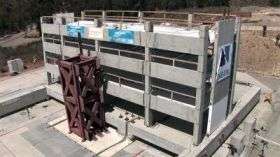
Engineering researchers from UC San Diego and the University of Arizona have concluded three months of rigorous earthquake simulation tests on a half-scale three-story structure, and will now begin sifting through their results so they can be used in the future designs of buildings across the nation. The engineers produced a series of earthquake jolts as powerful as magnitude 8.0 on a structure resembling a parking garage.
The one-million pound precast concrete structure is the largest footprint of any structure ever tested on a shake table in the United States. The earthquake tests were conducted at the UC San Diego Jacobs School of Engineering's Englekirk Structural Engineering Center, which is about eight miles east of the university's main campus. As part of the project, the researchers are testing the seismic response of precast concrete floor systems used in structures such as parking garages, college dormitories, hotels, stadiums, prisons and office buildings. They are also trying to figure out ways to improve the connections in precast concrete buildings.
"One of the purposes of our research is to develop better designs for precast concrete buildings," said Jose Restrepo, co-principal investigator of the project and a structural engineering professor at UC San Diego's Jacobs School of Engineering. "The results of our research have been tremendous."
Precast concrete, which is built in pieces and then put together to construct buildings, has been a breakthrough in the industry in terms of saving time and money, and increasing durability. While precast concrete has proven to be a robust design material for structures, researchers are working to provide the industry with new methods of connecting these pieces more efficiently.
"This is really important to our industry because we'll be able to develop structures that can resist nature's most difficult loads, including earthquakes," said Tom D'Arcy, spokesman for the Precast/Prestressed Institute and chairman of The Consulting Engineers Group, Inc.
The $2.3 million research project is a collaboration between UC San Diego, the University of Arizona and Lehigh University. It is funded by the Precast/Prestressed Concrete Institute and its member companies and organizations, the National Science Foundation, the Charles Pankow Foundation and the Network for Earthquake Engineering Simulation (NEES).
During the tests, the researchers simulated earthquakes for different regions of the country, including Berkeley, Calif..; Knoxville, Tenn; and Seattle, Wash.
"We conducted tests from lower seismicity all the way to higher seismicity and shook the building stronger and stronger each time with a higher intensity," Restrepo said.
The results of the research are expected to be implemented into building codes across the United States within the next few years. The researchers and industry leaders hope that this project and others like it will help prevent the future failure of buildings, much like what happened during the 6.7 magnitude earthquake in Northridge, Calif. in 1994, with the collapse of several precast parking structures.
"Since that time, we have been working to come up with designs that will make these structures survive a Northridge earthquake or stronger," said Robert Fleischman, principal investigator of the project and a civil engineering professor at the University of Arizona.
Seismic Simulation
Before the testing, the researchers performed computer simulations to help design the three-story structure and to determine where sensors should be placed on it. The data recorded by the sensors were used to take measurements of certain physical phenomena on the structure such as displacements, strains, and accelerations caused by the shaking; and to estimate forces in the structure. The data collected will also explain behavior of the structure during and after jolts, and will be used to compare directly to the simulations to either validate or adjust the computer models.
The use of these sensors, along with the computer simulation, may help lower costs of future seismic tests.
"We are only able to perform physical experiments on that one structure, but if we can show that our models capture important response properly, we can run hundreds of earthquake simulations a year for the cost of a graduate student, a fast computer and a software license, which, at around $50,000, is substantially less than the costs of these kinds of tests," Fleischman said, adding that the researchers hope to have their first formal report on the seismic tests completed by early 2009.
The $9 million Englekirk shake table is one of 15 earthquake testing facilities. The UCSD-NEES shake table, the largest in the United States and the only outdoor shake table in the world, is ideally suited for testing tall, full-scale buildings.
"The Englekirk Center is very important to the research community and to the industry because it has an outdoor environment where we can perform large scale tests that can't be done anywhere else in the world," Restrepo said.
The recent seismic tests are an example of how the Jacobs School is performing research at the forefront of the National Academy of Engineering's Grand Challenges for Engineering in the 21st Century.
Source: University of California - San Diego


