Spitzer Reveals Stellar "Family Tree"
August 22, 2008 Spitzer Reveals Stellar "Family Tree"

Enlarge

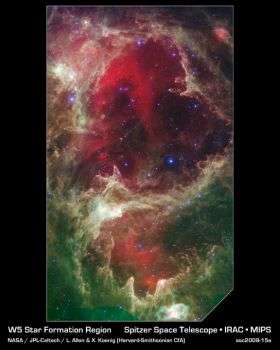
This is a three-color composite showing infrared observations from two Spitzer instruments. Blue represents 3.6-micron light and green shows light of 8 microns, both captured by Spitzer's infrared array camera. Red is 24-micron light detected by Spitzer's multiband imaging photometer. Credit: NASA/JPL-Caltech/Harvard-Smithsonian CfA

A new image from NASA's Spitzer Space Telescope tells a tale of life and death, and reveals a rich family history. The striking infrared picture shows a colorful cosmic cloud, called W5, studded with multiple generations of blazing stars.

It also provides dramatic new evidence that massive stars - through their brute winds and radiation - can trigger the birth of stellar newborns.

"Triggered star formation continues to be very hard to prove," said Xavier Koenig of the Harvard Smithsonian Center for Astrophysics in Cambridge, Mass. "But our preliminary analysis shows that the phenomenon can explain the multiple generations of stars seen in the W5 region." Koenig is lead author of a paper about the findings in the December 1, 2008, issue of the Astrophysical Journal.

The image is being unveiled today at the Griffith Observatory in Los Angeles as part of Spitzer's five-year anniversary celebration. Spitzer launched on August 25, 2003, from Cape Canaveral Air Force Station, Fla.

The most massive stars in the universe form out of thick clouds of gas and dust. The stars are so massive, ranging from 15 to about 60 times the mass of the Sun, that some of their material slides off in the form of winds. The scorching-hot stars also blaze with intense radiation. Over time, both the wind and radiation blast away surrounding cloud material, carving out expanding cavities.

Astronomers have long suspected that the carving of these cavities causes gas to compress into successive generations of new stars. As the cavities grow, it is believed that more and more stars arise along the cavities' expanding rims. The result is a radial "family tree" of stars, with the oldest in the middle of the cavity and younger and younger stars farther out.

Evidence for this theory can be seen easily in pictures of many star-forming regions, such as W5, Orion and Carina. For example, in the new Spitzer picture of W5, the most massive stars (some of the blue dots) are at the center of two hollow cavities, and younger stars (pink or white) are embedded in the elephant-trunk-like pillars as well as beyond the cavity rim. However, it is possible that the younger stars just happen to be near the edge of the cavities and were not triggered by the massive stars.

Koenig and his colleagues set out to test the triggered star-formation theory by studying the ages of the stars in the W5 region. They used Spitzer's infrared vision to peer through the dusty clouds and get a better look at the stars' various stages of evolution. The results show that stars within the W5 cavities are older than stars at the rims, and even older than stars farther out past the rim. This ladder-like separation of ages provides some of the best evidence yet that massive stars do, in fact, give rise to younger generations.

"Our first look at this region suggests we are looking at one or two generations of stars that were triggered by the massive stars," said co-author Lori Allen of the Harvard-Smithsonian Center for Astrophysics. "We plan to follow up with even more detailed measurements of the stars' ages to see if there is a distinct time gap between the stars just inside and outside the rim."

Millions of years from now, the massive stars in W5 will die in tremendous explosions. When they do, they will destroy some of the young nearby stars - the same stars they might have triggered into being.

W5 spans an area of sky equivalent to four full moons and is about 6,500 light-years away in the constellation Cassiopeia. The Spitzer picture was taken over a period of 24 hours. The color red shows heated dust that pervades the region's cavities. Green highlights the dense clouds, and white knotty areas are where the youngest of stars are forming. The blue dots are older stars in the region, as well as other stars in the background and foreground.

Source: Harvard-Smithsonian Center for Astrophysics


print this article email this article download pdf blog this article bookmark this article     Stumble it Digg this share on Facebook retweet share on Reddit add to delicious
Rate this story - 4.2 /5 (17 votes)

Rank Filter

Move the slider to adjust rank threshold, so that you can hide some of the comments.


Display comments: newest first

  • barakn - Aug 22, 2008
    • Rank: 1 / 5 (1)
    ".. the massive stars in W5 will die in tremendous explosions. When they do, they will destroy some of the young nearby stars - the same stars they might have triggered into being." This is the first time I've heard of this form of star death for stars that are not strongly gravitationally bound to the exploding star, such as in a binary system. My suspicion is that it is a load of B.S.

August 22, 2008 all stories

Comments: 1

4.2 /5 (17 votes)
  • Stumble this up

  • Digg this

  • share this

  • hide
  • Related Stories

  • Testing relativity in the lab
    created Jul 20, 2009 | popularity not rated yet | comments 0
  • Astronomers unveiling life's cosmic origins
    created Feb 12, 2009 | popularity not rated yet | comments 0
  • Superbubble of supernova remnants caught in act of forming
    created Jan 09, 2007 | popularity not rated yet | comments 0
  • Chandra reviews black hole musical: Epic but off-key
    created Oct 05, 2006 | popularity not rated yet | comments 0
  • Astrophysicists put kibosh on alternative theory of star formation
    created Nov 17, 2005 | popularity not rated yet | comments 0


  • hide
  • Relevant PhysicsForums posts

  • dark energy can escape black holes.
    created 8 hours ago
  • Are there green, purple and pink stars?
    created 20 hours ago
  • Sideral question
    created Nov 21, 2009
  • Doppler shifted blackbody spectrum
    created Nov 21, 2009
  • More from Physics Forums - General Astronomy

Other News

Supervolcano eruption -- in Sumatra -- deforested India 73,000 years ago

Supervolcano eruption -- in Sumatra -- deforested India 73,000 years ago

Space & Earth / Earth Sciences

created 58 minutes ago | popularity not rated yet | comments 0

A new study provides "incontrovertible evidence" that the volcanic super-eruption of Toba on the island of Sumatra about 73,000 years ago deforested much of central India, some 3,000 miles from the epicenter, ...


Intensive land management leaves Europe without carbon sinks

Intensive land management leaves Europe without carbon sinks

Space & Earth / Earth Sciences

created 3 hours ago | popularity 3 / 5 (4) | comments 0

A new calculation of Europe's greenhouse gas balance shows that emissions of methane and nitrous oxide tip the balance and eliminate Europe's terrestrial sink of greenhouse gases.


Is global warming unstoppable?

Space & Earth / Environment

created 9 hours ago | popularity 3.3 / 5 (14) | comments 18

In a provocative new study, a University of Utah scientist argues that rising carbon dioxide emissions - the major cause of global warming - cannot be stabilized unless the world's economy collapses or society builds the ...


Astronauts take spacewalk No. 3 after suit snag (AP)

Astronauts take spacewalk No. 3 after suit snag

Space & Earth / Space Exploration

created 4 hours ago | popularity not rated yet | comments 0

(AP) -- A pair of astronauts stepped out on the third and final spacewalk of their shuttle mission Monday, helping to install an enormous oxygen tank at the International Space Station.


Scientist: Leak of climate e-mails appalling

Space & Earth / Environment

created 3 hours ago | popularity 3.2 / 5 (5) | comments 5

(AP) -- A leading climate change scientist whose private e-mails are included in thousands of documents that were stolen by hackers and posted online said Sunday the leaks may have been aimed at undermining next month's ...