Catalyst for water oxidation adopted from plants: a means for energy-efficient production of hydrogen?
August 25th, 2008
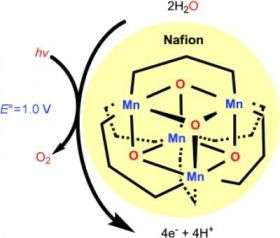
A manganese-oxo complex with a cubic {Mn4O4}7+ core catalyzes the electrooxidation of water when suspended within the aqueous channels of a Nafion membrane (see picture). Illumination with visible light under an applied potential of 1.0 V (vs Ag/AgCl) generates current over one thousand turnovers. The catalytically active species arises from photolysis and subsequent dissociation of the manganese complex. (c) Wiley-VCH 2008
(PhysOrg.com) -- Hydrogen will be one of the most important fuels of the future. It would be ideal to obtain hydrogen by splitting water instead of from petroleum. However, the electrolysis of water is a very energy intensive process, making it both expensive and unsustainable if the electricity necessary to generate it comes from the burning of fossil fuels. Photolysis, the splitting of water by light, is a highly promising alternative.
A team of Australian and American researchers has now developed a catalyst that effectively catalyzes one of the necessary half reactions, the photooxidation of water. As it reports in the journal Angewandte Chemie, the core of the catalyst is a manganese-containing complex modeled after those found in photosynthetic organisms.
Electrolysis is the reverse of the process that occurs in a battery: that is electrical energy is converted to chemical energy. The electrolysis of water involves two half reactions: at the cathode, protons (positively charged hydrogen ions) are reduced to hydrogen, whereas at the anode the oxidation of water produces oxygen.
The goal of the researchers is to use sunlight to get this energy-intensive process going. To make this work, the light-harvesting power of modern solar cells must be combined with effective photocatalysts for the oxidation of water and reduction of hydrogen ions into hydrogen gas.
The biggest hurdle to overcome in the photocatalytic splitting of water to date has been the lack of a robust catalyst that oxidizes water. In fact, the best known catalyst, which very effectively oxidizes water when irradiated with visible light, is a manganese-containing enzyme in the photosynthetic apparatus of living organisms.
Robin Brimblecombe and Leone Spiccia at Monash University (Australia), Gerhard F. Swiegers at the Commonwealth Scientific and Industrial Research Organisation (CSIRO, Australia), and G. Charles Dismukes at Princeton University (USA) have used this structure as a model for their photocatalyst.
The catalyst in question is a manganese oxo complex with a cubic core made of four manganese and four oxygen atoms capped by ancillary phosphinate molecules. The catalytically active species is formed when energy from light causes the release of one the capping molecules from the cube.
However, the manganese complex is not soluble in water. The researchers have overcome this problem by coating one electrode with a wafer-thin Nafion membrane. Housed within the aqueous channels of this membrane, the catalytic species is stabilized and has good access to the water molecules. Irradiation with visible light under an applied 1.2 volts leads to the effective electro-oxidation of water.
This anodic half-cell could be easily paired with a catalytic hydrogen-producing cathode cell. This would result in a photoelectrochemical cell that produces pure hydrogen and oxygen from water and sunlight.
Citation: Leone Spiccia, Sustained Water Oxidation Photocatalysis by a Bioinspired Manganese Cluster, Angewandte Chemie International Edition 2008, 47, No. 38, doi: 10.1002/anie.200801132
Provided by Wiley


Academia is needed to get things started, but it's time for the outside world to step in and actually get something made. It's time to 5h1t or get off the pot!
Don't let industry convince us that an expensive and inefficient conversion to hydrogen is in anyones interest except big industry. Hydrogen is artificial and when it leaks it rises to the upper atmosphere and reacts with ozone, depleting it. The water then formed at such a high altitude is a vastly more powerful greenhouse gas than CO2.
Hydrocarbons converted from cellulose and grown from hydroponic algae can provide far more energy if developed over the next 10 years.
Miscanthus might be the fuel source of choice. It already outperforms everything else and it has not been genetically engineered. If that grass is transformed with CO2 fixing enzymes it might grow 30% faster or with 30% bigger yields.
Run the world on grass power.
Do not 'exhaust' the water vapor; 'close the loop'.
Condense the 'steam' water vapor,
feeding the water back into the 'photosynthetic'
H2 O generator, and back into the engine.
Oxygen may be added for optimize combustion ratio.
Roy Stewart,
Phoenix AZ
Proof required.
Artificial?
And, the combustion of hydrocarbons produces no H2O or CO2?
Nature has shown that hydrocarbons are the most effective form of energy transportation for our environment... Proof required...
A strict proof is probably impossible but I am not aware of nature using a more energy dense storage molecule (fat) that is not toxic.
Hydrogen is artificial... Artificial?
As in the environment we live in does not have molecular hydrogen in it, so it needs to be man-made by artificial means.
And, the combustion of hydrocarbons produces no H2O or CO2?
Production of H2O at low altitude is a proverbial drop in the bucket and does not change effective humidity there. Water at the top of the atmosphere where hydrogen rises to and reacts with ozone is not natural and raises the humidity where there is normally none. CO2 from renewable hydrocarbon sources is carbon neutral and represents CO2 that was previously captured from the atmosphere.
By nature, and by those who understand their properties and heres why:
1. high energy density
2. ease of storage
3. ease of handling
4. safety
5. Wide variety of possible chemical modifications which allow us to farther tailor their physical and chemical properties to specific needs without seriously affecting energy content.
The only drawback is that burned completely they emit CO2, if however we were to use atmospheric CO2 to create them in the first place it wouldn't be a problem anymore since with the closed cycle the atmospheric CO2 content would not increase.
6. compatibility with present technology
7. already accumulated knowledge concerning them
8. the fact that they are used as structural material by chemical, pharmaceutical, and textile industries (who now also relay on fossil fuels for their supply and will need to find an alternative)
You confuse man's preferences with the artifacts of natural processes. That hydrocarbons exist owes, not to nature's seeking "the most effective form of energy transportation," but merely to it's adhering to its own physical laws.
An artificial distinction of no relevance.
Neutral only in the sense of Earth and its atmosphere being a closed system.
However, within the bio-sphere itself, it is definitely NOT carbon neutral.
All of which vary greatly according to 1) the particular hydrocarbon under discussion, 2) the particular end need to be met, 3) the other resources available toward meeting such end, and 4) the extent to which the unwanted consequences of use are tolerable.
In short, Nature cares not a wit about creating materials that we find to be convenient for our own uses of the moment.
Eh? My understanding of that statement is that anything that emits CO2 is not neutral, regardless of how much CO2 went into it's creation, which would be nonsense.
"An artificial distinction of no relevance."
That is just high brow name calling. Try a reasoned response like this: "Most of the universe is made from hydrogen, therefore it is natural and can't be bad for our environment and can be released into our atmosphere without consideration."
"You confuse man's preferences with the artifacts of natural processes. That hydrocarbons exist owes, not to nature's seeking "the most effective form of energy transportation," but merely to it's adhering to its own physical laws."
Wow, that really confuses me. I'm guessing your a creationist and not familiar with evolution principles. But nature adhering to laws of physics that are different than... er... ours? I guess? That aside, humans are also dependent on "natures laws", what ever they are, so it is in our interest to play nice and stay as close to them as is practical.
Try a reasoned response like this: "Most of the universe is made from hydrogen, therefore it is natural and can't be bad for our environment and can be released into our atmosphere without consideration."
You're not serious, right? Most of that hydrogen is also in the form of a plasma. Abundance != Safety.
Take a chamber of any size, filled with ordinary sea level air, and divide it into 4 smaller sub-chambers, each hermetically sealed.
Now, excluding sub-chamber 4, move all of the O2 into sub-chamber 1, all of the CO2 into sub-chamber 2, and all of the N2 into sub-chamber 3. Although each sub-chamber's contents are now different, the entire closed system's contents remain unchanged.
Which sub-chamber would you prefer to be placed in?
Hydrocarbons such as coal & oil reside outside the biosphere. When extracted and burned their byproducts are released into the biosphere. Those byproducts remain in the biosphere for a considerable amount of time before they are sequestered. They do not promptly vanish back into the bowels of the Earth from whence they were ripped.
As for the rest of your missive, you continue to confuse discretionary preferences with actions of physical necessity, thereby conflating acts of men with those of nature.
The universe doesn't give a damn about what we prefer.
I'm not sure how that experiment applies, probably something more relevant would be two chambers one with a large container of Hydrogen and one with a large container of diesel. Which chamber would you want to be placed in then have the containers opened.
"Hydrocarbons such as coal & oil reside outside the biosphere. When extracted and burned their byproducts are released into the biosphere."
Ah, I think this is the disconnect. Hydrocarbons from non food competing crops and algae do not grow on a diet of coal and oil. All the carbon comes from CO2 in the atmosphere and the energy comes from the sun. In fact some proposals include sequestering some of the carbon making them a carbon-negative possibility.