Hearts a flutter as exam includes audio portion for first time
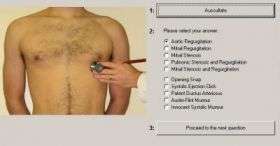
Hearts will be racing faster this fall for every medical student in the country. That's because the three-part test every medical student and resident must pass will be delivered in a new way: by listening to a heartbeat. It's a skill that some say has become an Achilles heel in the medical field.
"Most of the doctors and residents out there taking this test know they don't have this auditory skill," says Michael Barrett, M.D., clinical professor of medicine and cardiologist at Temple University School of Medicine and Hospital. "They're very nervous about this."
Long bothered by this lack of proficiency with the stethoscope, Barrett said such skills are critical to identifying dangerous heart conditions and minimizing dependence on expensive medical tests. He has pioneered the use of heartbeat recordings as a means of training students to know the difference between a healthy and a diseased heart.
In the past, students never had to listen to heart murmurs and recognize them because the test was given on paper. That changed thanks to new technology and over the last year, the United States Medical Licensing Examination board phased in an audio portion that tests cardiac auscultation, or listening to the heart.
This is the first major exam to require this skill and this fall is the first time all three parts will include an audio portion. At issue is whether those taking the test can identify heart murmurs and abnormal heart sounds, from the five different families of murmurs, which encompass nearly 25 different sounds and murmurs.
Test-takers will put on headphones and listen as an image appears of a stethoscope over a certain part of the torso. They press a button, it plays a murmur and the test-taker must name the murmur from a list.
"The skill level required to recognize these murmurs is much different than it used to be," says Barrett." "Traditional curriculum is that you lecture for a couple hours and maybe play 25 beats of a murmur, but the students have never heard enough of each type of murmur to be able to recognize it in a patient or before the boards."
Instead of identifying the murmur by ear, Barrett says, doctors end up relying on expensive tests, like echocardiograms, to identify potentially dangerous heart conditions. That's what prompted Barrett to introduce a four-year heart auscultation curriculum program at Temple. It used iPods, among other simulators, to teach medical students how to recognize heart murmurs by listening to the sounds over and over again.
Students can download mp3 files of heart sounds to their iPod or mp3 player and listen to them while they are working out or commuting. In fact, Barrett's research found that intensive repetition, listening at least 400 times to each heart sound, greatly improved the stethoscope abilities of students, from 40% to 80% recognition, after one month of listening repeatedly to the murmurs.
"They know they can't recognize these murmurs until they take our course," says Barrett. "Apart from the medical school exams, this is the bottleneck examination that determines if you'll practice as a doctor."
Source: Temple University


