Model helps computers sort data more like humans
August 25, 2008
Model helps computers sort data more like humans

Enlarge

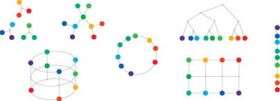
MIT associate professor Josh Tenenbaum and his former student, Charles Kemp, have developed a computer algorithm that can select the best type of structure to fit a set of data. Such structures, shown here, include linear order, rings and clusters. Image courtesy / Charles Kemp

(PhysOrg.com) -- Humans have a natural tendency to find order in sets of information, a skill that has proven difficult to replicate in computers. Faced with a large set of data, computers don't know where to begin -- unless they're programmed to look for a specific structure, such as a hierarchy, linear order, or a set of clusters.

Now, in an advance that may impact the field of artificial intelligence, a new model developed at MIT can help computers recognize patterns the same way that humans do. The model, reported earlier this month in the Proceedings of the National Academy of Science, can analyze a set of data and figure out which type of organizational structure best fits it.

"Instead of looking for a particular kind of structure, we came up with a broader algorithm that is able to look for all of these structures and weigh them against each other," said Josh Tenenbaum, an associate professor of brain and cognitive sciences at MIT and senior author of the paper.

The model could help scientists in many fields analyze large amounts of data, and could also shed light on how the human brain discovers patterns.

The computer algorithm was developed by recent MIT PhD recipient Charles Kemp, now an assistant professor of psychology at Carnegie Mellon University, along with Tenenbaum.

The model considers a range of possible data structures, such as trees, linear orders, rings, dominance hierarchies, clusters, etc. It finds the best-fitting structure of each type for a given data set and then picks the type of structure that best represents the data.

Humans perform the same feat in everyday life, often unconsciously. Several scientific milestones have resulted from the human skill of finding patterns in data -- for example, the development of the periodic table of the chemical elements or the organization of biological species into a tree-structured system of classification.

Children exhibit this data organization skill at a young age, when they learn that social networks can be organized into cliques, and that words can fit into overlapping categories (for example, dog, mammal, animal).

"We think of children as taking in data, forming theories, and testing those theories with experiments. They're like little scientists," Tenenbaum said. "Until now there's been no good computational model for how children can, like scientists, grasp the underlying global structure of a set of data."

Provided by MIT

4.5 /5 (26 votes)  

Rank 4.5 /5 (26 votes)
Related Stories
Relevant PhysicsForums posts

More news stories

Google users warned of threat to smartphone wallets

Users of Google smartphone wallets were being warned on Friday that there is a way to crack pass codes intended to thwart thieves from going on illicit shopping sprees.

Technology / Internet

created 3 hours ago | popularity 5 / 5 (1) | comments 0

Anonymous knocks CIA website offline (Update)

The website of the Central Intelligence Agency was inaccessible on Friday after the hacker group Anonymous claimed to have knocked it offline.

Technology / Internet

created 5 hours ago | popularity 5 / 5 (6) | comments 10

New error-correcting codes guarantee the fastest possible rate of data transmission

Error-correcting codes are one of the triumphs of the digital age. They’re a way of encoding information so that it can be transmitted across a communication channel — such as an optical fiber o ...

Technology / Computer Sciences

created 13 hours ago | popularity 5 / 5 (5) | comments 6 | with audio podcast

New power source discovered

(PhysOrg.com) -- Researchers at the Massachusetts Institute of Technology (MIT) and RMIT University have made a breakthrough in energy storage and power generation.

Technology / Energy & Green Tech

created 12 hours ago | popularity 4.8 / 5 (19) | comments 7 | with audio podcast

Small modular reactor design could be a 'SUPERSTAR'

(PhysOrg.com) -- Though most of today's nuclear reactors are cooled by water, we've long known that there are alternatives; in fact, the world's first nuclear-powered electricity in 1951 came from a reactor ...

Technology / Energy & Green Tech

created 13 hours ago | popularity 4.3 / 5 (11) | comments 20 | with audio podcast


Complex wiring of the nervous system may rely on a just a handful of genes and proteins

Researchers at the Salk Institute have discovered a startling feature of early brain development that helps to explain how complex neuron wiring patterns are programmed using just a handful of critical genes. ...

The power of estrogen -- male snakes attract other males

A new study has shown that boosting the estrogen levels of male garter snakes causes them to secrete the same pheromones that females use to attract suitors, and turned the males into just about the sexiest ...

Putting the squeeze on planets outside our solar system

(PhysOrg.com) -- Using high-powered lasers, scientists at Lawrence Livermore National Laboratory and collaborators discovered that molten magnesium silicate undergoes a phase change in the liquid state, abruptly ...

Humans may have helped the decline of African rainforests 3000 years ago

(PhysOrg.com) -- Large areas of rainforests in Central Africa mysteriously disappeared over three thousand years ago, to be replaced by savannas. The prevailing theory has been that the cause was a change ...

NASA sees wide-eyed cyclone Jasmine

Cyclone Jasmine's eye has opened wider on NASA satellite imagery, as it moves through the Southern Pacific Ocean.

NASA sees Giovanna reach cyclone strength, threaten Madagascar

Tropical Storm 12S built up steam and became a cyclone on February 10, 2012 as NASA's Terra satellite passed overhead. Residents of east-central Madagascar should prepare for this cyclone to make landfall ...