Scientists identify quantum differences between light and heavy water
August 26, 2008 By Lisa Zyga Scientists identify quantum differences between light and heavy water

Enlarge

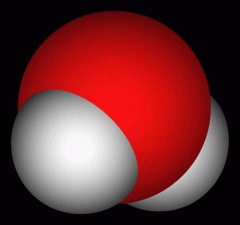
A molecule of water: the red atom is oxygen, and the gray atoms are either hydrogen (light water) or deuterium (heavy water). Physicists have investigated the underlying mechanisms for why heavy water is more structured than light water.

Scientists know that light water (H2O) and heavy water (D2O) have similar but not identical structures. Using quantum mechanics, researchers have recently identified several differences between the two water isotopes that previous research had not predicted.

Alan Soper from the Rutherford Appleton Laboratory in Oxfordshire, UK, and Chris Benmore from Argonne National Laboratory in Argonne, Illinois, have published their results in a recent issue of Physical Review Letters.

Chemically speaking, D2O is an isotope of normal H2O, with each of the deuterium atoms having one neutron while the normal hydrogen atoms have no neutrons. The extra neutrons make heavy water about 10% denser than H2O, which can be seen when heavy water ice cubes sink in a glass of normal water. Biologically, this difference means that large amounts of heavy water can have harmful effects on animals, although it would take about two weeks of consuming only D2O and no H2O to kill a human.

In their study, Soper and Benmore investigated the differences between light and heavy water on the quantum level. They used a combination of techniques – x-ray diffraction, neutron diffraction, and computer simulation – to discover the underlying mechanisms for why heavy water is more structured than light water, as previous research has indicated.

“The task of understanding the structure and properties of any material is immense, and, in the case of water, is doubly difficult because of (a) the very keen interest in its properties, which are actually rather amazing and complicated compared to many common liquids, and (b) the difficulty of getting really reliable data on its properties,” Soper told PhysOrg.com. “The significance of our results is that they will challenge the theoreticians to come up with better models for water, something that has often eluded them and which even today is a subject of much study and endeavor.”

Soper explained that some of their results could be controversial, since they contrast with predictions. First, the scientists found that H2O has a longer intramolecular OH bond than D2O’s corresponding OD bond length. Specifically, the OH bond is longer by about 0.03 angstroms, or 3%.

Second, the intermolecular hydrogen bond (which connects two separate molecules) is shorter in H2O than in D2O. Here, the difference is about 0.07 angstroms, or 4%. Neither of these differences in bond length had been predicted in previous studies.

Further, because the OH/OD bond length difference and the hydrogen bond length difference are not equivalent (3% and 4%), there also exist geometrical differences between the structures of light and heavy water. While previous research had predicted an overall broadening of the H2O structure compared to the D2O structure, Soper and Benmore have pinpointed three specific differences, some of which are in opposition to earlier predictions.

For one thing, the intermolecular OH peak is more asymmetric in H2O than D2O. Also, the distance between the hydrogen atoms on neighboring molecules is about 2% larger for H2O than in D2O. Finally, the number of hydrogen bonds per water molecule is less in H2O than in D2O (3.62 vs. 3.76). Together, these structural differences give light water a broader structure, and heavy water a narrower, more tetrahedral shape.

Soper said that some of these unexpected results (such as the large degree of asymmetry in the hydrogen bond in H2O compared to D2O and the OH/OD bond length difference) may be contested by computer simulators.

He also explained that the hydrogen bond length is caused by small electron movements that impact the proton (in hydrogen) or deuteron positions. Since the proton has a smaller mass than the deuteron, it sits higher in the quantum potential well (that holds the hydrogen atom) compared with the deuteron’s lower position in its potential well.

“If that potential well is now perturbed by an approaching water molecule forming a hydrogen bond, then because the proton is higher in the well, it is more likely to be influenced by the approaching water molecule, drawing it away from the parent oxygen, more so than the deuteron, which is deeper in the well, and therefore less sensitive to perturbations from neighboring water molecules,” Soper said. This effect may play a role in the difference between the OH and OD bond lengths.

The researchers also explained that understanding the structures of light and heavy water might not have any immediate applications, but could help researchers in a variety of fields down the road.

“There is no obvious immediate impact from understanding these structures, apart from the obvious point that it will no doubt spur theoreticians to greater efforts to see if they can understand our findings,” Soper said. “Water is arguably the most important material in the human environment. Though there are lots of other materials we can and do study, somehow water captures major interest because of its fundamental importance to us.

“Ultimately, if we understand water better, we will become better at predicting its properties, such as its ability to form crystals and water droplets in the atmosphere which in turn can cause immensely damaging storms as a consequence, its ability to act as the medium in which life has evolved, as the medium in which proteins will fold to their native structures, as the material used by our industry to both heat and cool, as the material used as a solvent and as a cleaner. The list is rather endless!”

More information: Soper, A.K. and Benmore, C.J. “Quantum Differences between Heavy and Light Water.” Physical Review Letters 101 065502 (2008).

Copyright 2008 PhysOrg.com.
All rights reserved. This material may not be published, broadcast, rewritten or redistributed in whole or part without the express written permission of PhysOrg.com.


print this article email this article download pdf blog this article bookmark this article     Stumble it Digg this share on Facebook retweet share on Reddit add to delicious
Rate this story - 4.4 /5 (55 votes)

Rank Filter

Move the slider to adjust rank threshold, so that you can hide some of the comments.


Display comments: newest first

  • ShadowRam - Aug 26, 2008
    • Rank: 5 / 5 (1)
    I taught in school heavy water was H30.. guess you learn something new every day... Lesson learned, don't believe everything you hear/see in school
  • ShadowRam - Aug 26, 2008
    • Rank: not rated yet
    Sorry meant to say.. "I was taught.." (I don't teach)
  • gopher65 - Aug 26, 2008
    • Rank: 2 / 5 (2)
    Yeah. Having seen how some of those science "teachers" are themselves taught, that doesn't surprise me. It also doesn't surprise me that gym teachers are too stupid to teach science classes, yet they do, all the time.

    I wonder how long it will take for *real* science teachers to be mandatory? One of my science teachers in highschool was teaching the class because, get this, she'd taken Astro-101 and physics 110 in university (both the lowest courses in those subjects that you can take). The high school considered that to be sufficient for her to be teaching a science class. I was just blown away by that. (She was useless of course.)
  • earls - Aug 26, 2008
    • Rank: 5 / 5 (2)
    "two weeks of consuming only D2O and no H2O to kill a human"

    "There is no obvious immediate impact from understanding these structures"


    Non-sense!! I just found a new marketing angle for bottled water! "PURE H20 - NO DEADLY NEUTRONS!"
  • googleplex - Aug 26, 2008
    • Rank: not rated yet
    earls,
    That is indeed contradictory.
    I don't see how D2O can be toxic. As life forms have been exposed to D2O for eons I would think that they would have adapted to it. Its abundance is low (0.015%). Perhaps a good anology is vitamins which are essential in small doses but toxic in higher doses (except vit. C).
  • Glis - Aug 26, 2008
    • Rank: 4 / 5 (3)
    The main reason it is toxic for humans (that I know of) is because the weight messes up the osmotic pressure of your cells. You basically dehydrate and organs start sagging. That and decreased efficiency for nearly every chemical process in your body.

    If not it would be one hell of a way to weight train.
  • Rigdanir - Aug 26, 2008
    • Rank: not rated yet
    This has reminded me of something else I recently read:

    "Subtle differences in structural transitions between poly-L- and poly-D-amino acids of equal length in water."

    http://www.ncbi.n...16482275
  • googleplex - Aug 26, 2008
    • Rank: not rated yet
    After reading the wiki on D2O it is clear how it is toxic. The Hydrogen mass is doubled thereby affecting the chemical properties. Interestingly it appears that it impacts circadian cycles in cells. Perhaps eliminating it altogether would also be a bad thing.
  • physpuppy - Aug 26, 2008
    • Rank: 5 / 5 (2)
    Uh - Hydrogens take part in an awful lot of biological processes/cycles. Many of these processes are kind of dependent on rate limiting steps being what they are. If you introduce deuterium into these processes, since chemistry is pretty much the same but mass is about twice, reaction rates change and now all of a sudden things are not going at proper speed, allowing other (possibly detrimental) reactions to occur. That's why D2O is "toxic". I'm sure someone is going to think - wait - we're talking water, not free hydrogens. Well, mix D2O with H2O and you get HDO - the hydrogens tend to exchange. They'll also exchange with any bio molecule with an even slightly acidic hydrogen. You see this stuff everyday in NMR and mass spectroscopy.
  • ancible - Aug 26, 2008
    • Rank: 1 / 5 (2)
    Every time someone starts a post with "uh", my brain inserts a stereotypical "valley girl" voice. You know: Yah, whatever, totally, etc.

    More seriously, why must people scoff at the wrong idea's (if, indeed, they are wrong) of others? I personally have a hard time admitting to wrongdoing when I am being insulted by whoever is trying to correct me.
  • Bob_Kob - Aug 26, 2008
    • Rank: 5 / 5 (2)
    I taught in school heavy water was H30.. guess you learn something new every day... Lesson learned, don't believe everything you hear/see in school


    I believe youve mistaken the Hydronium Ion, H30 for heavy water, D20. H30 is the basis for all acidic reactions.
  • earls - Aug 27, 2008
    • Rank: 5 / 5 (2)
    Googleplex, perhaps now you are willing to purchase some Protium Energy Water: The 99.99999% neutron free, light hearted hydrogen and oxygen pure bio-fuel of the future that is positively refreshing! Don't put the osmotic pressure of your cells in risk: BUY Protium Energy Water TOOOOODAY!

    $19.99 an ounce.
  • Alizee - Aug 28, 2008
    • Rank: 3 / 5 (2)
    The difference between ordinary and heavy water can be distinguished at the first sight in thick layer. The heavy water is discolored, while the ordinary water has a pretty bluish shade. The ocean of heavy water would have an ugly grey to green color due the Rayleigh dispersion.

    http://www.webexh.../5B.html
  • physpuppy - Aug 28, 2008
    • Rank: not rated yet
    ...thick layer. The heavy water is discolored, ...
    http://www.webexh.../5B.html


    According to the article that you linked, heavy water is colorless. I would guess you mean that heavy water would be grey due to sediment being more visible? I use D2O in my work - at most a few oz. at a time and its colorless but I can't comment on its color in larger quantities (but in oz. amount plain water appears colorless too). D2O and H2O is fairly miscible and upon standing it doesn't separate easily - at least in my experience.
  • googleplex - Aug 28, 2008
    • Rank: not rated yet
    Googleplex, perhaps now you are willing to purchase some Protium Energy Water: The 99.99999% neutron free, light hearted hydrogen and oxygen pure bio-fuel of the future that is positively refreshing! Don't put the osmotic pressure of your cells in risk: BUY Protium Energy Water TOOOOODAY!

    $19.99 an ounce.


    I will take 5 tonnes please. I have a feeling that you are selling it at a loss and I can resell at a profit.
  • googleplex - Aug 28, 2008
    • Rank: 4 / 5 (1)
    ...thick layer. The heavy water is discolored, ...
    http://www.webexh.../5B.html


    According to the article that you linked, heavy water is colorless. I would guess you mean that heavy water would be grey due to sediment being more visible? I use D2O in my work - at most a few oz. at a time and its colorless but I can't comment on its color in larger quantities (but in oz. amount plain water appears colorless too). D2O and H2O is fairly miscible and upon standing it doesn't separate easily - at least in my experience.


    If it naturally settled out into layers then we would not use vast amounts of electricity and time to refine it from natural water. There was a Nazi hydro plant that the allies destroyed in Norway during WW2 because it was producing heavy water - didnt you see the movie?

August 26, 2008 all stories

Comments: 16

4.4 /5 (55 votes)
  • Stumble this up

  • Digg this

  • share this

  • hide
  • Related Stories

  • Scientists advance facile synthesis of nanoparticles with multiple functions
    created Jul 13, 2009 | popularity not rated yet | comments 0
  • Researchers Observe Hydrogen-Bond Exchange
    created May 08, 2008 | popularity not rated yet | comments 0
  • Mice Can Sense Oxygen Through Skin
    created Apr 17, 2008 | popularity not rated yet | comments 0
  • Nanoscience will change the way we think about the world
    created Mar 20, 2008 | popularity not rated yet | comments 0
  • Molecular chords
    created Nov 16, 2007 | popularity not rated yet | comments 0


  • hide
  • Relevant PhysicsForums posts

  • Bodies in motionÂ…..
    created 3 hours ago
  • Refraction optics help
    created 3 hours ago
  • A basketball Jump Shot
    created 3 hours ago
  • help with accelerometer
    created 5 hours ago
  • Young's Double Slit - Fringe Width
    created 9 hours ago
  • Pressure exerted by a liquid is different to gas?
    created 10 hours ago
  • More from Physics Forums - General Physics

Other News

Solving big problems

Solving big problems with new quantum algorithm

Physics / Quantum Physics

created 1hour ago | popularity 4 / 5 (6) | comments 0

(PhysOrg.com) -- In a recently published paper, Aram Harrow at the University of Bristol and colleagues from MIT in the United States have discovered a quantum algorithm that solves large problems much faster ...


First Bose-Einstein condensation of strontium

First Bose-Einstein condensation of strontium

Physics / Quantum Physics

created 6 hours ago | popularity 5 / 5 (4) | comments 1

In an international first, scientists from the Institute of Quantum Optics and Quantum Information (IQOQI, Austria) produced a Bose-Einstein condensate of the alkaline-earth element strontium, thus narrowly ...


The LHC tunnel

Peckish bird briefly downs big atom smasher

Physics / General Physics

created 13 hours ago | popularity 3.8 / 5 (9) | comments 11

A peckish bird briefly knocked out part of the world's biggest atom smasher by causing a chain reaction with a piece of bread, the European Organisation for Nuclear Research (CERN) said Monday.


Plasma-in-a-bag for sterilizing devices

Physics / General Physics

created 4 hours ago | popularity not rated yet | comments 0

The practice of sterilizing medical tools and devices helped revolutionize health care in the 19th century because it dramatically reduced infections associated with surgery. Through the years, numerous ways of sterilization ...


Ginzburg helped develop the Soviet Union's hydrogen bomb in the late 1940s and early 1950s

Russian bomb physicist Ginzburg dead at 93

Physics / General Physics

created 14 hours ago | popularity 5 / 5 (4) | comments 0

Nobel Physics prize winner Vitaly Ginzburg, who helped develop the Soviet hydrogen bomb, has died at age 93, the Russian Academy of Sciences said Monday.