GLAST Observatory reveals entire gamma-ray sky
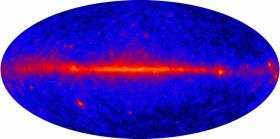
(PhysOrg.com) -- NASA's newest space telescope is giving scientists their best look yet at the highest-energy gamma ray bursts generated by violent events in space. For Toby Burnett, a University of Washington physics professor, it's a welcome payoff for 13 long years of work.
Launched in June as the Gamma-ray Large Area Satellite Telescope, the instrument's observations already are exceeding expectations. Using UW-designed software, the telescope homes in on gamma-ray bursts throughout the universe and pinpoints their locations.
"The instrument is working beautifully. It's like hitting the first pitch out of the park," Burnett said. "Plus, we can scan the entire sky. No instrument before us could do that."
In fact, the telescope can scan the entire sky several times a day, which means it is more likely than predecessors to identify and locate extreme events such as particle jet emissions from supermassive black holes or immense star explosions called supernovae.
NASA announced this week that the mission has been renamed the Fermi Gamma-ray Space Telescope. The project is a successor to an instrument called the Energetic Gamma Ray Experiment Telescope, which in its five-year functional life identified and located 270 gamma ray sources. The new telescope is designed to far exceed that number.
"We came close to 100 new sources in the first week after we started operating," Burnett said. "Already we are able to make pictures that are better than the previous mission produced."
The new telescope can measure the location of a specific gamma ray source to one-hundredth of a degree, compared with one-tenth of a degree for the previous telescope. That's the equivalent of slicing a circle into 36,000 equal pieces instead of 3,600.
Burnett and UW physics graduate students wrote basic software to simulate and reconstruct positions of gamma ray sources so they can be photographed. The UW team also contributed to the ability to determine the angle of a gamma ray entering the telescope's detector, a key to pinpointing location, and created software that compares the spacecraft's view of space with an onboard space map to make sure the telescope is aimed correctly.
"This is something that highlights our capability, and it's something the UW is uniquely qualified to do," Burnett said.
The telescope, about 9 feet high and 8 feet in diameter, cost nearly $700 million and is expected to operate for at least five years, with a goal of 10 years. It will produce maps with different colors representing different energy ranges of the gamma ray sources.
The project involves a broad collaboration, including NASA and the U.S. Department of Energy, along with seven U.S. universities and other public and private partners from the U.S., France, Germany, Italy, Japan and Sweden.
The mission's main objectives are to understand how particle acceleration functions in objects called active galactic nuclei, as well as in neutron stars and supernova remnants; to characterize unidentified gamma ray sources; to determine the high-energy behavior of gamma-ray bursts; and to gather information on dark matter, believed to make the vast majority of the universe's observable mass; and to probe the nature of the early universe.
In orienting itself, the telescope will focus on known gamma ray sources, including Vela, a pulsar in a constellation also called Vela, and the Crab nebula, the remnants of a supernova that was seen on Earth in the year 1054 and has a neutron star at its center.
Vela creates gamma rays because it rotates rapidly, creating powerful and compact magnetic fields that approach the speed of light, Burnett said, and the Crab Nebula has been studied for centuries. Knowing the nature of those phenomena will allow the telescope to use them as calibration tools by which it can measure unknown gamma ray sources.
"This is really a new window on the universe," Burnett said. "It will be easier for us to associate new things that we find with things that we've already seen but that we didn't know emitted gamma rays."
Provided by University of Washington


