Mars Rover Opportunity Climbing out of Victoria Crater
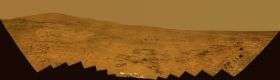
(PhysOrg.com) -- NASA's Mars Exploration rover Opportunity is heading back out to the Red Planet's surrounding plains nearly a year after descending into a large Martian crater to examine exposed ancient rock layers.
"We've done everything we entered Victoria Crater to do and more," said Bruce Banerdt, of NASA's Jet Propulsion Laboratory in Pasadena, Calif. Banerdt is project scientist for Opportunity and its rover twin, Spirit.
Having completed its job in the crater, Opportunity is now preparing to inspect loose cobbles on the plains. Some of these rocks, approximately fist-size and larger, were thrown long distances when objects hitting Mars blasted craters deeper than Victoria into the Red Planet. Opportunity has driven past scores of cobbles but examined only a few.
"Our experience tells us there's lots of diversity among the cobbles," said Scott McLennan of the State University of New York, Stony Brook. McLennan is a long-term planning leader for the rover science team. "We want to get a better characterization of them. A statistical sampling from examining more of them will be important for understanding the geology of the area."
Opportunity entered Victoria Crater on Sept. 11, 2007, after a year of scouting from the rim. Once a drivable inner slope was identified, the rover used contact instruments on its robotic arm to inspect the composition and textures of accessible layers.
The rover then drove close to the base of a cliff called "Cape Verde," part of the crater rim, to capture detailed images of a stack of layers 6 meters (20 feet) tall. The information Opportunity has returned about the layers in Victoria suggest the sediments were deposited by wind and then altered by groundwater.
"The patterns broadly resemble what we saw at the smaller craters Opportunity explored earlier," McLennan said. "By looking deeper into the layering, we are looking farther back in time." The crater stretches approximately 800 meters (half a mile) in diameter and is deeper than any other seen by Opportunity.
Engineers are programming Opportunity to climb out of the crater at the same place it entered. A spike in electric current drawn by the rover's left front wheel last month quickly settled discussions about whether to keep trying to edge even closer to the base of Cape Verde on a steep slope. The spike resembled one seen on Spirit when that rover lost the use of its right front wheel in 2006. Opportunity's six wheels are all still working after 10 times more use than they were designed to perform, but the team took the spike in current as a reminder that one could quit.
"If Opportunity were driving with only five wheels, like Spirit, it probably would never get out of Victoria Crater," said JPL's Bill Nelson, a rover mission manager. "We also know from experience with Spirit that if Opportunity were to lose the use of a wheel after it is out on the level ground, mobility should not be a problem."
Opportunity now drives with its robotic arm out of the stowed position. A shoulder motor has degraded over the years to the point where the rover team chose not to risk having it stop working while the arm is stowed on a hook. If the motor were to stop working with the arm unstowed, the arm would remain usable.
Spirit has resumed observations after surviving the harshest weeks of southern Martian winter. The rover won't move from its winter haven until the amount of solar energy available to it increases a few months from now. The rover has completed half of a full-circle color panorama from its sun-facing location on the north edge of a low plateau called "Home Plate."
"Both rovers show signs of aging, but they are both still capable of exciting exploration and scientific discovery," said JPL's John Callas, project manager for Spirit and Opportunity.
The team's plan for future months is to drive Spirit south of Home Plate to an area where the rover last year found some bright, silica-rich soil. This could be possible evidence of effects of hot water.
Provided by Jet Propulsion Laboratory


