A clash of clusters provides another clue to dark matter
August 27, 2008
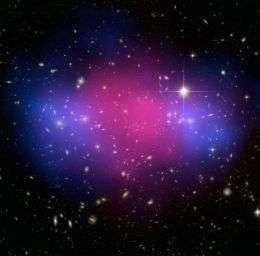
This astounding view of galaxy cluster MACSJ0025 demonstrates how ordinary matter and mysterious dark matter interact. The blue cloud-shaped parts flanking the centre show the position of dark matter, mapped by the Advanced Camera for Surveys onboard the NASA/ESA Hubble Space Telescope. The pink middle indicates ordinary matter, charted by NASA’s Chandra X-Ray Observatory. The position of the two matter types shown in the image are explained by MACSJ0025’s origin. It was formed when a pair of large galaxy clusters collided. Ordinary matter in the form of hot gas slowed down and pooled at the centre but ghostly dark matter passed straight through. Hubble used a technique known as gravitational lensing to obtain its data. The light observed was bent by the gravitationally massive galaxy cluster, resulting in an incredibly detailed image. This technique was originally predicted by Einstein. MACSJ0025 is located in the constellation Cetus, the Whale. Credit: NASA, ESA, CXC, M. Bradac (University of California, Santa Barbara, USA), and S. Allen (Stanford University, USA).
New Hubble and Chandra observations of the cluster known as MACSJ0025.4-1222 indicate that a titanic collision has separated dark from ordinary matter. This provides independent confirmation of a similar effect detected previously in a target dubbed the Bullet Cluster, showing that the Bullet Cluster is not an anomalous case.
A powerful collision of galaxy clusters has been captured with NASA's Chandra X-ray Observatory and Hubble Space Telescope. Like its famous cousin, the so-called Bullet Cluster, this clash of clusters provides striking evidence for dark matter and insight into its properties.
Like the Bullet Cluster, this newly studied cluster, officially known as MACSJ0025.4-1222, shows a clear separation between dark and ordinary matter. This helps answer a crucial question about whether dark matter interacts with itself in ways other than via gravitational forces.
This finding is important because it independently verifies the results found for the Bullet Cluster in 2006. The new results show the Bullet Cluster is not an exception and that the earlier results were not the product of some unknown error.
Just like the original Bullet Cluster, MACSJ0025 formed after an incredibly energetic collision between two large clusters in almost the plane of the sky. In some ways, MACSJ0025 can be thought of as a prequel to the Bullet Cluster. At its much larger distance of 5.7 billion light years, astronomers are witnessing a collision that occurred long before the Bullet Cluster's.
Using optical images from Hubble, the team was able to infer the distribution of the total mass (colored in blue) -- dark and ordinary matter -- using a technique known as gravitational lensing. The Chandra data enabled the astronomers to accurately map the position of the ordinary matter, mostly in the form of hot gas, which glows brightly in X-rays (pink).
An important difference between the Bullet Cluster and the new system is that MACSJ0025 does not actually contain a "bullet". This feature is a dense, X-ray bright core of gas that can be seen moving through the Bullet Cluster. Nonetheless, the amount of energy involved in this mammoth collision is nearly as extreme as that found in the Bullet Cluster.
As the two clusters that formed MACSJ0025 (each almost a whopping million billion times the mass of the Sun) merged at speeds of millions of miles per hour, the hot gas in each cluster collided and slowed down, but the dark matter did not. The separation between the material shown in pink and blue therefore provides direct evidence for dark matter and supports the view that dark matter particles interact with each other only very weakly or not at all, apart from the pull of gravity.
One of the great accomplishments of modern astronomy has been to establish a complete inventory of the matter and energy content of the Universe. The so-called dark matter makes up approximately 23% of this content, five times more than the ordinary matter that can be detected by telescopes. The latest results with MACSJ0025 once again confirm these findings.
The results will appear in an upcoming issue of The Astrophysical Journal.
Source: Hubble Information Centre


http://www.nasa.g...ure.html
But somehow they are all supposed to prove the existence of dark matter. I don't think so.
If you read towards the last paragraph, the linked article actually states that "Although the invisible matter has been found before in other galaxy clusters, astronomers say it has never been detected to be so largely separated from the hot gas and the galaxies that make up galaxy clusters."
So basically the effect from your article, and the effect from the above article are the same, in which a galactic collision separated the hot gas from the dark matter resulting in discernable dark matter presence without baryonic matter presence via gravitational lensing.
off hand it seems pretty simple. In the picture above the ordinary matter has collided and come to a stop, with dark passing through and coming out the other sides. In the bullet I would guess we are earlier in the collisoin, so the ordinary matter has slowed down and the two sets of dark matter have met in the middle. I think later the bullet will look like the above as the dark matter keeps moving.
The article was deficient in explaining the connection and nature of the blue haze, which according to one reader is %u201Cinvisible.%u201D Have scientists definitively determined the unseen force is actually matter? Isn't it still plausible that this mystery involves a type of force without mass? The article was interesting but far from edifying for those of us who follow the hunt for "dark matter." Other readers inferred that dark matter bent or distorted light. This infers that scientist know something of the fundamental nature of dark matter; other than its gravitational influence. This is news to me, and the authors of this article failed to reveal what they knew specifically and why they believed gravitational lensing can expose this unseen force. One reader even referenced the absence of baryonic matter as a way of "peeking into the unknown and the indefinable." Please have the authors eloborate.
http://www.nasa.g...ure.html
is very different. I agree with ripley that while we have identified lensing that doesn't prove there is extra mass there. I have my own crackpot theory which is set out here:-
http://www.presto...ndex.htm
Dark matter has gravitational effect but no other known effect like baryonic matter on it's surrounds as far as we can detect.
To explain the ring system the two systems collided and the baryonic (visible) matter has been splayed out by the gravitational interactions while the dark matter has settled into a conventional ring shape.
In the bullet and this new cluster the interaction is assumed to have happened more recently so the dark matter is still splaying out from the standard ring shape due to gravitational interaction from the baryonic matter on the dark matter.
As for gravitational lensing and dark matter I can give a layman's explaination. Dark matter is suspected to have a gravitational effect, and so the presence of dark matter can be seen when there is no sufficient gravitational force yet light is being bent around an object exerting gravitational force. So by seeing the light bend with no baryonic cause it is assumed to be dark matter exerting it's gravitational influence on the passing light.
The coloration in the images is added after the fact to show the areas of dark matter, real dark matter you wouldn't be able to see (according to theory).
I hope this is a little more clear.
And there is a giant problem with your AGM theory. We exist. If there was a sufficient amount of AGM out there it would have disrupted galactic formation, not encouraged it.
http://www.nasa.g...ven.html
is that the dark matter has passed through the collisions while the gas clouds have not. The message of the blue ring article here:-
http://www.nasa.g...ure.html
is that the dark matter has "rippled" outwards. Different behaviour. Once again my crackpot theory that explains the difference is here:-
http://www.presto...ndex.htm
Velanarris - Please explain why AG Matter would have disrupted galaxy formation. I have explained in my website how it actually causes galaxy formation. Please explain how galaxies form without AG Matter. Discs, cores, spiral arms, globular clusters, molecular clouds, supernova remnants etc.
http://www.nasa.g...ven.html
http://www.nasa.g...ure.html
http://www.presto...ndex.htm
Now here's where your theory turns to trash:
If AGM was in existance since the beginning and repulses everything due to it's negative mass then it would technically have negative energy as proposed by e=mc^2. If it has negative energy, and not negative energy in relation to it's environs, but negative energy in relation to everything then it would annihilate itself at the beginning when the universe was of infinetesimal size.
Ok since you left us with no math to support your AGM setup we'll rough it out with empirical logic. How exactly would AGM explain your models on Galactic formation if it repulses everything?
If AGM and regular grvatic matter were in existance at the onset of the universe then all the gas that ever existed would have been forced to the middle of the universe while all the agm would be forced to the outside due to how repulsion works.
Since you supposed that AGM repulses everything, including itself, it would have repulsed regular matter and AGm away from itself, spreading out to the lowest energy state, (which in your mind is negative) meaning it would be pushing harder and harder on regualr matter forcing it all into a singularity, not into an assortment of galaxies.
In the early universe normal matter and AG Matter separate. Normal matter is pulled together by its own gravity and pushed together by the AGM around it. AGM also causes drag which saps kinetic energy and helps normal matter to come together. Hence the early formation of galaxies in the universe.
Ok then how does the light from other galaxies traverse through this field of anti gravity so that you can make your observations of galactic formation?
In order to be strong enough to account for galactic formation including current spin speeds without disassociation due to the inherent weakness of gravity it would have to repel all light back to it's original source as well, and without sunlight we wouldn't be here.
http://www.presto...ndex.htm
Which means your setup for drag is wrong. Also means this "vortex" would cause galaxies to be funnel shaped or globular since repulsive forces don't have angular vectors.
You still haven't conquered the beginning of the universe where like repulsive magnetic forces you'd end up with all the matter in the same central location causing a singularity.
Besides, what you're proposing sounds an awful lot like a really poor man's dark energy concept.
(still not a spot of math about your theory either, that alone makes it useless)
You should re-read your own paper. You know why they call them crackpot theories? Because like a cracked pot, they don't hold water.
I seriously doubt he'll ever be swayed. Try taking an objective look, Tim.
While the polarity of "dark energy" and "gravity" may exist, I seriously doubt they will ever be discovered to manifest themselves with the properties he has laid out.
As pointed out, this theory attempts to explains one thing and nothing else.
I have been a staunch opponent to Tim's theory for quite some time.
I seriously doubt he'll [Tim] ever be swayed. Try taking an objective look [at your own theory], Tim.
While the polarity of "dark energy" and "gravity" may exist, I seriously doubt they will ever be discovered to manifest themselves with the properties he [Tim] has laid out.
As pointed out, this theory [AGM] attempts to explains one thing and nothing else.
'Bullet Cluster' can be found at http://arxiv.org/...608407v1 .CL 0024 17 is at http://arxiv.org/...5.2171v1 & MACS J0025 is at http://arxiv.org/...8.2320v2 .These three papers lay out the case for DM & expound upon alternate gravitational models (incl. MOND & TeVeS, but not AGM!).
I kind of feel for Tim because he has put so much work into his theory only for it to be so quickly devastated.
I know he has basic components correct, but the unnecessary invention of particles and forces just because they appear to fit the picture doesn't help.
"Unexperiements" based on wild theories of untestable speculation prove nothing.
Explain this:
In your theory there is AGM all throughout the Universe, and Gravity has a known affect on light. So how can you justify your theory if we can see other stars and galaxies? AGM would have to be redirecting that light away from our galaxy due to the nature of the affect of gravity on light. And if the AGM was not present all visible galaxies would have to appear to be approaching or orbiting us due to the repulsive nature of AGM but that is contrary to our current observations.
Explain that behavior.
yyz - I know! I'm building the case slowly. But I am making progress and I believe I have offered explanations for many observed phenomena that we otherwise do not understand. I will continue to collect them on my website.
http://www.presto...ndex.htm
So then you're ignoring the effects of the cosmic web on your AGM. The universe would have to be almost opaque with matter to support your theory, which it is not.
Your simulations are wrong, your math is somewhat non-existant, and your theory holds no water.
http://berkeley.e...er.shtml
then the difference is that they are assuming that the invisible dark matter is located at the positions of gravitational attraction. I am proposing that the density of repulsive invisible AG Matter is fairly constant throughout the universe but is reduced where they think there is dark matter. It's a double negative. Reductions in density of AG Matter can be caused by normal matter, or can be caused by vortices in the AG Matter.
Its explained here:
http://en.wikiped...k_energy
Dark *Energy* is something that is not visible and exerts gravitational repulsion it is theorized to be spread fairly evenly throughout space. One hypothesis postulates it to be a static field permeating all space, the other postulates it is dynamic and varies in its density. The latter seems pretty much like your AGM theory as far as I can tell at a glance.
I know scientists want to find evidence of exotic (dark) matter and will jump at any possibility to show that such matter exists. But this just doesn't show that such matter exists.
Presume that the two galaxy clusters contained a thinly dispersed and cold matter in the intergalactic spaces (this is normal). Such matter is not apparent because it is thinly dispersed and is very cold. If it radiated, we would have difficulty seeing through it.
When the galaxy clusters collided, some of the intergalactic mass collided. This mass slowed and heated -- it is the mass shown in the center. The rest of the intergalactic mass did not collide. It passed through the collision and remained cold. It is inferred by the lensing but cannot be seen.
No need at all to presume exotic matter.
o In certain circumstances the density of AG Matter can drop to (but not below) zero. This leads to phenomena like bulging galaxy cores, globular clusters and molecular clouds.
o Normal matter objects feel drag as they pass through AG Matter. This leads to phenomena like galaxy discs, spiral arms, the movement of molecular clouds, and the behaviour of supernova remnants.
http://www.presto...ndex.htm
That and it's contrary to current scientific observation.