Scientists reveal effects of quantum 'traffic jam' in high-temperature superconductors
August 27, 2008 Scientists reveal effects of quantum 'traffic jam' in high-temperature superconductors

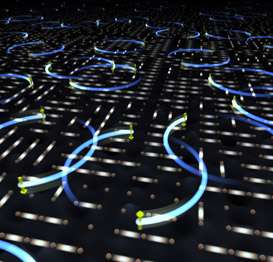
This image shows two states of a cuprate high-temperature superconductor simultaneously: Each circle represents the two electrons of a Cooper pair, which exist at relatively low energy and can carry current with no resistance. In this image, the superconducting Cooper-pair state is superimposed on a dashed pattern that indicates the static positions of electrons caught in a quantum "traffic jam" at higher energy - when the material acts as a Mott-insulator incapable of carrying current.

(PhysOrg.com) -- Scientists at the U.S. Department of Energy's Brookhaven National Laboratory, in collaboration with colleagues at Cornell University, Tokyo University, the University of California, Berkeley, and the University of Colorado, have uncovered the first experimental evidence for why the transition temperature of high-temperature superconductors -- the temperature at which these materials carry electrical current with no resistance -- cannot simply be elevated by increasing the electrons' binding energy. The research -- to be published in the August 28, 2008, issue of Nature -- demonstrates how, as electron-pair binding energy increases, the electrons' tendency to get caught in a quantum mechanical "traffic jam" overwhelms the interactions needed for the material to act as a superconductor -- a freely flowing fluid of electron pairs.

"We've made movies to show this traffic jam as a function of energy. At some energies, the traffic is moving and at others the electron traffic is completely blocked," said physicist J.C. Seamus Davis of Brookhaven National Laboratory and Cornell University, lead author on the paper. Davis will be giving a Pagels Memorial Public Lecture to announce these results at the Aspen Center for Physics on August 27.

Understanding the detailed mechanism for how quantum traffic jams (technically referred to as "Mottness" after the late Sir Neville Mott of Cambridge, UK) impact superconductivity in cuprates may point scientists toward new materials that can be made to act as superconductors at significantly higher temperatures suitable for real-world applications such as zero-loss energy generation and transmission systems and more powerful computers.

The idea that increasing binding energy could elevate a superconductor's transition temperature stems from the mechanism underlying conventional superconductors' ability to carry current with no resistance. In those materials, which operate close to absolute zero (0 kelvin, or -273 degrees Celsius), electrons carry current by forming so-called Cooper pairs. The more strongly bound those electron pairs, the higher the transition temperature of the superconductor.

But unlike those metallic superconductors, the newer forms of high-temperature superconductors, first discovered some 20 years ago, originate from non-metallic, Mott-insulating materials. Elevating these materials' pair-binding energy only appears to push the transition temperature farther down, closer to absolute zero rather than toward the desired goal of room temperature or above.

"It has been a frustrating and embarrassing problem to explain why this is the case," Davis said. Davis's research now offers an explanation.

In the insulating "parent" materials from which high-temperature superconductors arise, which are typically made of materials containing copper and oxygen, each copper atom has one "free" electron. These electrons, however, are stuck in a Mott insulating state -- the quantum traffic jam -- and cannot move around. By removing a few of the electrons — a process called "hole doping" -- the remaining electrons can start to flow from one copper atom to the next. In essence, this turns the material from an insulator to a metallic state, but one with the startling property that it superconducts -- it carries electrical current effortlessly without any losses of energy.

"It's like taking some cars off the highway during rush hour. All of a sudden, the traffic starts to move," said Davis.

The proposed mechanism for how these materials carry the current depends on magnetic interactions between the electrons causing them to form superconducting Cooper pairs. Davis's research, which used "quasiparticle interference imaging" with a scanning tunneling microscope to study the electronic structure of a cuprate superconductor, indicates that those magnetic interactions get stronger as you remove holes from the system. So, even as the binding energy, or ability of electrons to link up in pairs, gets higher, the "Mottness," or quantum traffic-jam effect, increases even more rapidly and diminishes the ability of the supercurrent to flow.

"In essence, the research shows that what is believed to be required to increase the superconductivity in these systems — stronger magnetic interactions -- also pushes the system closer to the 'quantum traffic-jam' status, where lack of holes locks the electrons into positions from which they cannot move. It's like gassing up the cars and then jamming them all onto the highway at once. There's lots of energy, but no ability to go anywhere," Davis said.

With this evidence pointing the scientists to a more precise theoretical understanding of the problem, they can now begin to explore solutions. "We need to look for materials with such strong pairing but which don't exhibit this Mottness or 'quantum traffic-jam' effect," Davis said.

Scientists at Brookhaven are now investigating promising new materials in which the basic elements are iron and arsenic instead of copper and oxygen. "Our hope is that they will have less 'traffic-jam' effect while having stronger electron pairing," Davis said. Techniques developed for the current study should allow them to find out.

Provided by Brookhaven National Laboratory


print this article email this article download pdf blog this article bookmark this article     Stumble it Digg this share on Facebook retweet share on Reddit add to delicious
Rate this story - 4.6 /5 (35 votes)

Rank Filter

Move the slider to adjust rank threshold, so that you can hide some of the comments.


Display comments: newest first

  • Alizee - Aug 27, 2008
    • Rank: 2.3 / 5 (3)
    ....this turns the material from an insulator to a metallic state, but one with the startling property that it superconducts....
    This still doesn't explain, why hole doping leads to the superconductivity at the case of cuprates, while it leads to the normal conductivity at the case of silicon. It means, why cuprates have no traffic jam with compare to silicon. Which makes the insight presented somewhat naive in my eyes.
  • johanfprins - Aug 28, 2008
    • Rank: 3.7 / 5 (3)
    A metallic state can NEVER superconduct because its charge-carriers can ALWAYS be accelerated. The concomitant kinetic energy has to dissipate resistively: Even if this does NOT happen within the material, it will have to dissipate outside the material. This will still register as a resistance of the material just as the electrons moving through a vacuum-diode registers a "vacuum-resitance". A superconductor is an insulator which consists of localised states. The "orbitals" of these states are able to convey a supercurrent by cyclic movement when allowed by Heisenberg's uncertainty relationship to borrow enough energy to effect movement from one anchor-position to the next. During this movement the concomitant kinetic energy is on loan: Therefore, no kinetic energy is generated which requires dissipation: AND therefore superconduction is possible. The same mechanism (Heisenberg uncertainty) is responsible for superconduction in all materials.
  • Alizee - Aug 28, 2008
    • Rank: 3.7 / 5 (3)
    ..a metallic state can NEVER superconduct because its charge-carriers can ALWAYS be accelerated...
    How do you explain, after then, the first discovered superconductors were all metals? How is it possible, the post of yours has obtained rank 5/5 after 2 votes for such BS already?
  • johanfprins - Aug 28, 2008
    • Rank: 3 / 5 (2)
    Thank you! Wonderful incisive question! Keep up your clarity of thinking and you will win the Nobel Prize!!
    The original superconductors are all semi-metals. REAL metals, with spherical Fermi-surfaces, do NOT superconduct. Semi-metals have gaps in their valence-electron spectra. Wigner already predicted in 1938 that thes metals will undergo a metal-insulator transition at low temperatures by forming a "Wigner-crystal". He was a genius; because it is exactly this metal-insulator transition which causes superconduction.
  • johanfprins - Aug 28, 2008
    • Rank: 3 / 5 (2)
    Dear Alizee,
    I just noticed what BCS without the C implies. Thanks for noticing that it is BS!!
  • Alizee - Aug 28, 2008
    • Rank: 3 / 5 (2)
    BCS theory has nothing to do with metal-insulator transition (can you show us some evidence of it, please?). In addition, high pressure superconductivity (i.e. the superconductivity induced by high pressure) violates the metal-insulator transition mechanism just because many semiconductors are obtaining a metal conductivity under such circumstances.
  • Alizee - Aug 28, 2008
    • Rank: 3 / 5 (2)
    Wigner predicted, that when the electron density is low enough, the electron gas will freeze into a lattice with ferromagnetic properties. This doesn't correspond the pressure induced superconductivity of alkali metals, where the pressure just increases the electron density, instead. The Type I superconductors aren't ferromagnets bellow transition temperature = metal-insulator transition has nothing to do with superconductivity or BCS theory.
  • johanfprins - Aug 29, 2008
    • Rank: 3 / 5 (2)
    I know BCS theory has nothing to do with a metal-insulator transition. This is so because BCS theory cannot explain the most fundamental aspect of superconduction: namely the cancellation of an applied conservative electric field between two contacts when a supercurrent starts to flow. A conservative electric field can ONLY be cancelled by dielectric polarisation. BCS does not give such a dielectric mechanism. In fact, it is highly unlikely that Cooper pairs even exist: BCS without C!! Wigner did not predict a ferromagnet. He predicted an array of Gaussian "zero-point" obitals. There is no reason why their spins should align. Furthermore, not all the valence electrons form such orbitals. They are only formed when the valence electrons cannot screen all the positive charges: i.e. in materials that have Kohn-anomalies. Superconduction only kicks in when the distances between adjacent orbitals become smaller than a critical coherence-distance. In the Alkali-metals the pressure deforms the Fermi-surface making the formation of a Wigner array possible. (By the way, you cannot compare the behaviour of a metal under pressure direcvtly with that of a semiconductor). Furthermore pressure decreases the inter-orbital distances thus making the onset of superconduction possible. It is for the same reason that pressure also increases the critical temperature for certain ceramic superconductors. I hope this is of help.
  • johanfprins - Aug 29, 2008
    • Rank: 3 / 5 (2)
    Another point: Each otrbital can exist of two electrons and thus have zero spin.
  • Alizee - Aug 29, 2008
    • Rank: 3 / 5 (2)
    ..BCS theory cannot explain the most fundamental aspect of superconduction: namely the cancellation of an applied conservative electric field between two contacts when a supercurrent starts to flow....
    It can - it considers the presence of superconductive gap, which generates the zone of volume charge by the same way, like the semiconductor gap in semiconductors.
  • johanfprins - Aug 30, 2008
    • Rank: 3 / 5 (2)
    Really!? So the voltage also becomes zero when a current flows through a semiconductor? Please be more specific! Furthermore, in a superconductor the electric-field must also be cancelled at the position of each and every charge-carrier WHILE a supercurrent is flowing. If not, the voltage will not fall to zero.

    Your explanation is just hand-waving and utterly wrong! The only way in which the electric-field can go to zero is when the kinetic-energy with which the charge-carriers move "disappears into thin air" after it has been used to effect motion. If this kinetic-energy does not "disappear" it will have to dissipate and a resistance will then be measured.This is why the kinetic-energy must be "on loan" by borrowing it from the "vacuum-energy", and then giving it back. In other words, superconduction is driven by quantum-fluctuations. This is the only reason why superconduction is at all possible! After all, superconduction is nothing else than "perpetual motion": Thermodynamics tells us that "perpetual motion" is only possible if energy from a source is turned into work and the total amount of work is then again turned into energy and given back to the source. In the case of superconduction the source is "the vacuum". There is no other microscopic mechanism that can explain superconduction.
  • johanfprins - Aug 30, 2008
    • Rank: 3 / 5 (2)
    BCS theory has nothing to do with metal-insulator transition (can you show us some evidence of it, please?).

    It can - it considers the presence of superconductive gap, which generates the zone of volume charge by the same way, like the semiconductor gap in semiconductors.

    So suddenly there is an insulating gap involved: I thought that BCS had NOTHING to do with a metal-insulator transition. Unfortunately however, the "gap" caused by Cooper pairs is equal to ZERO at the onset of superconduction. So how is the field then cancelled by Cooper-pairs when superconsduction initiates? BCS=BS

  • johanfprins - Aug 31, 2008
    • Rank: 5 / 5 (1)
    Dear Alizee,

    Instead of trying to vote me down, how about trying to argue physics? It seems that your knowledge of physics is a bit rusty, if you ever did know some of it!

August 27, 2008 all stories

Comments: 13

4.6 /5 (35 votes)
  • Stumble this up

  • Digg this

  • share this

  • hide
  • Related Stories

  • Science Begins at the World's Most Powerful X-ray Laser (w/ Video)
    created Nov 02, 2009 | popularity not rated yet | comments 0
  • Danish nanowires have great potential
    created Nov 02, 2009 | popularity not rated yet | comments 0
  • Smart drug delivery system -- Gold nanocage covered with polymer (w/ Video)
    created Nov 01, 2009 | popularity not rated yet | comments 0
  • Micro Sparky: Engineering the tiniest Sun Devil
    created Oct 30, 2009 | popularity not rated yet | comments 0
  • Pinning Down Superconductivity to a Single Layer
    created Oct 29, 2009 | popularity not rated yet | comments 0


  • hide
  • Relevant PhysicsForums posts

  • Photoelectric effect
    created 2 hours ago
  • Ranges of coherence lengths for......
    created 4 hours ago
  • Has einsteins experient with time been proven, why hasn't it been applied or used
    created 6 hours ago
  • Drop of Water
    created 6 hours ago
  • Generalized Coordinate Systems
    created 7 hours ago
  • Electromagnet design
    created 9 hours ago
  • More from Physics Forums - General Physics

Other News

Stars Fueled by Dark Matter Could Hold Secrets to the Universe

Stars Fueled by Dark Matter Could Hold Secrets to the Universe

Physics / General Physics

created Nov 03, 2009 | popularity 4.5 / 5 (51) | comments 41

(PhysOrg.com) -- The first stars in the universe may have been very different from the stars we see today, yet they may hold clues to understanding some of the mysterious features of the universe. These "dark ...


Second Law of Thermodynamics May Explain Economic Evolution

Second Law of Thermodynamics May Explain Economic Evolution

Physics / General Physics

created Nov 02, 2009 | popularity 4.3 / 5 (31) | comments 28

(PhysOrg.com) -- Terms such as the "invisible hand," laissez-faire policy, and free-market principles suggest that economic growth and decline in capitalist societies seem to be somehow self-regulated. Now, ...


High-performance plasmas may make reliable, efficient fusion power a reality

High-performance plasmas may make reliable, efficient fusion power a reality

Physics / Plasma Physics

created Nov 02, 2009 | popularity 4.7 / 5 (40) | comments 34

In the quest to produce nuclear fusion energy, researchers from the DIII-D National Fusion Facility have recently confirmed long-standing theoretical predictions that performance, efficiency and reliability ...


'Teapot effect' solved

Solving Teapot Effect

Physics / General Physics

created Nov 02, 2009 | popularity 4.9 / 5 (11) | comments 10

(PhysOrg.com) -- A team of scientists from France have worked out why teapots dribble at low flow rates, and how to stop them. The effect is called the "teapot effect", and solving it could finally put an ...


Laser accelerated protons to the highest energies so far

Researchers use trident laser to accelerate protons to record energies

Physics / General Physics

created Nov 02, 2009 | popularity 4.7 / 5 (6) | comments 10

An international team of physicists at Los Alamos National Laboratory has succeeded in using intense laser light to accelerate protons to energies never before achieved. Using this technique, scientists can ...