Brain physiology of prenatal alcohol exposure uncovered
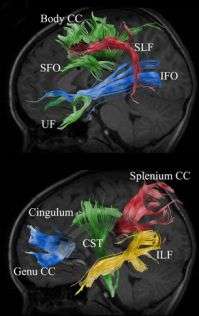
(PhysOrg.com) -- University of Alberta researchers have identified several regions of the brain that appear to be altered in children with Fetal Alcohol Spectrum Disorder.
Under the leadership of Christian Beaulieu, professor in the Department of Biomedical Engineering, researchers in the U of A's In Vivo NMR Centre used an advanced form of magnetic resonance imaging to identify several white matter regions as well as deep gray matter areas of the brain that appear sensitive to prenatal alcohol exposure.
Fetal Alcohol Spectrum Disorder (FASD) is the umbrella term used to describe developmental disorders associated with maternal alcohol use during pregnancy that are said to affect up to 10 per 1,000 live births in North America.
While scientists know that children with FASD often have structural brain damage, little was known about how white matter connections and deep gray matter structures, were affected.
The white matter refers to the brain's wiring, or the little the bundles of nerve fibres that form connections between different parts of the brain that appear white because of the myelin sheath that insulates the bundles. Deep gray matter structures on the other hand, are linked to one another by the white matter and act as relay stations to integrate incoming sensory and motor input before it passes to the cortex.
The research team used diffusion tensor imaging to look at structural brain differences between 24 children, ages five to 13, suffering from FASD, and 95 healthy children from the same age range. Diffusion tensor imaging measures the distance water moves through cell membranes and other tissue in the brain. In the case of degraded or malformed tissue structure, the water runs into fewer obstructions and thus travels further.
This technique is used to assess 10 white matter pathways and four gray matter structures to attain fairly conclusive proof that there was a difference between the groups of children studied, said Catherine Lebel, a doctoral student working on the project.
"We found abnormalities in seven of 10 white matter tracts and three of four gray matter structures in kids with FASD," said Lebel. "There were differences throughout the brain, but in particular, white matter connections to the temporal lobe, a region involved in speech, memory, and hearing, were especially affected."
Lebel said these abnormalities likely underlie the cognitive, motor, behavioural and emotional difficulties that are associated with FASD.
"Hopefully this will help lead to a better understanding of the structural abnormalities and how they relate to the behavioural and cognitive abnormalities, and hopefully lead to earlier detection, earlier treatment and more effective treatment."
The results will be published in the October issue of Alcoholism: Clinical & Experimental Research. The research was funded by the Canadian Language and Literacy Research Network (CLLRNet).
Provided by University of Alberta


