Sleight of hand and sense of self
August 27, 2008 Sleight of hand and sense of self

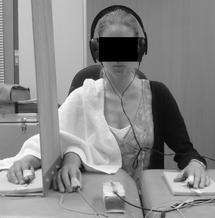
Participants had a rubber hand placed in their field of vision and their real hand concealed behind a partition.

(PhysOrg.com) -- An illusion that tricks people into believing a rubber hand belongs to them isn’t all in the mind, Oxford University researchers have found. They have observed a physical response as well, a finding that offers insight into conditions which affect a patient’s sense of self and body ownership, such as stroke, schizophrenia, autism, or eating disorders.

The rubber-hand illusion involves placing a rubber hand in front of the participant in their field of vision and near to their real hand. The real hand is then concealed behind a partition. If the real hand and the rubber hand are touched or stroked in the same way and at the same time, the participant tries to co-ordinate what they are feeling (their own hand being stroked) and seeing (the rubber hand being stroked). They can experience a shift in where they believe their hand is to the position of the rubber hand.

‘People experience this weird illusion,’ says Dr G Lorimer Moseley of the Department of Physiology, Anatomy and Genetics at the University of Oxford. ‘They will say things like, “I feel like I own the rubber hand”.’

Dr Moseley, along with Professor Charles Spence of the Department of Experimental Psychology and researchers in Italy and The Netherlands, report in the journal PNAS that incorporating the rubber hand into our sense of self comes at a physical cost. It is as though they are ‘disowning’ the real hand, resulting in a measurable temperature drop in that hand.

‘The rubber-hand illusion is a beautiful device to manipulate our sense of self,’ Dr Moseley says. ‘It tells us that our sense of our bodies, our sense of who we are, is labile.’

Body ownership is a fundamental aspect of self-awareness – the feeling that your body belongs to you and is constantly there. This important sense of self is disrupted in a range of different neurological, psychiatric and psychological conditions, such as after a stroke, in autism, epilepsy, anorexia, and bulimia.

People suffering from complex regional pain syndrome can experience significant distortion in their sense of their physical self. They can disown a limb, feeling that it does not belong to them or that a limb is bigger than it really is.

Many conditions characterised by distortions of body image or ownership are also characterised by a disruption of temperature in one side of the body or a single limb.

‘We wanted to see if we could replicate any of this experience. We wanted to see if we could manipulate our sense of ownership of our bodies and reproduce a temperature disruption,’ says Dr Moseley. ‘That is exactly what we saw.’

‘Our sense of our physical self comes from what we’re born with and the constant messages the brain receives from all parts of our bodies. We’ve now shown that this is a two-way street. The mind can also influence the body’s tissues. We have demonstrated that the mind can control a specific body part.’

Provided by Oxford University


print this article email this article download pdf blog this article bookmark this article     Stumble it Digg this share on Facebook retweet share on Reddit add to delicious
Rate this story - 4.9 /5 (23 votes)

Rank Filter

Move the slider to adjust rank threshold, so that you can hide some of the comments.


Display comments: newest first

  • Icester - Aug 27, 2008
    • Rank: 5 / 5 (2)
    I wonder if the people tested show reduced sensation in their real hand over time? Also, I wonder if this disowning effect would be stronger for a less sensitive extremity, say the foot for instance.
  • gmurphy - Aug 28, 2008
    • Rank: 3 / 5 (2)
    good question lcester, I find it astounding that the mind can adapt so quickly to these new circumstances. Artificial Intelligence systems are notoriously rigid once they have been "trained". Maybe it's due to our perceptual system generating candidates to explain our environment. When our mind perceives the rubber arm in an anatomically probable position, it simply projects its established concept of "my hand" onto that artificial stimulus
  • ShadowRam - Aug 28, 2008
    • Rank: 4 / 5 (1)
    Whoa.. so long time exposure to VR could drop the temperature of your body/limbs??

    I wonder if anyone has had pain feelings for their prosthetic? do you get a feeling of ownership of a prosthetic after a long time, that if someone smashes it with a hammer, you feel physical pain?
  • CaptSpaulding - Aug 28, 2008
    • Rank: not rated yet
    @ShadowRam: I don't know how deep it goes, but I do know that there are massive problems associated with "phatom" limbs after amputations. Often times, people that have an amputation will suddenly "feel" someone sitting on them when someone is on top of the location that their former limb would have occupied. This feeling is strong enough that they will believe that the limb is still there even though they are also aware that they have had an amputation. I wouldn't be surprised to see someone having a visual stimulus induced false pain from seeing their prosthetic "hurt". However, I would only expect this to occur in the early stages before they can retrain their brain to accept the reality of the situation.

August 27, 2008 all stories

Comments: 4

4.9 /5 (23 votes)
  • Stumble this up

  • Digg this

  • share this

  • hide
  • Related Stories

  • Time to clean up your digital closet
    created Aug 05, 2009 | popularity not rated yet | comments 0
  • Perceiving touch and your self outside of your body
    created Aug 05, 2009 | popularity not rated yet | comments 0
  • When virtual reality feels real (w/Video)
    created May 11, 2009 | popularity not rated yet | comments 0
  • A Massive Explosion on the Sun
    created Apr 25, 2007 | popularity not rated yet | comments 0
  • Mirrors in the mind: New studies elucidate how the brain reflects onto itself the actions of others
    created Sep 18, 2006 | popularity not rated yet | comments 0


  • hide
  • Relevant PhysicsForums posts

  • nesfatin
    created 10 hours ago
  • Obsessive Compulsive Disorder
    created Nov 20, 2009
  • West's zone 2 starling resistor respiratory physiology
    created Nov 18, 2009
  • 50-0-50 rule
    created Nov 18, 2009
  • More from Physics Forums - Medical Sciences

Other News

New cancer target for non-Hodgkin's lymphoma

Medicine & Health / Cancer

created 10 hours ago | popularity 5 / 5 (1) | comments 0

Physician-scientists from Weill Cornell Medical College have discovered a molecular mechanism that may prove to be a powerful target for the treatment of non-Hodgkin's lymphoma, a type of cancer that affects lymphocytes, ...


Surface bacteria maintain skin's healthy balance

Medicine & Health / Research

created 11 hours ago | popularity 5 / 5 (4) | comments 0

On the skin's surface, bacteria are abundant, diverse and constant, but inflammation is undesirable. Research at the University of California, San Diego School of Medicine now shows that the normal bacteria living on the ...


Gene mismatch influences success of bone marrow transplants

Medicine & Health / Genetics

created 10 hours ago | popularity 4 / 5 (1) | comments 0

A commonly inherited gene deletion can increase the likelihood of immune complications following bone marrow transplantation, an international team of researchers reports in the November 22 advance online issue of Nature Ge ...


New understanding about mechanism for cell death after stroke leads to possible therapy

Medicine & Health / Research

created 11 hours ago | popularity not rated yet | comments 0

Scientists at the Brain Research Centre, a partnership of the University of British Columbia Faculty of Medicine and Vancouver Coastal Health Research Institute, have uncovered new information about the mechanism by which ...


Cancer metabolism discovery uncovers new role of IDH1 gene mutation in brain cancer

Medicine & Health / Cancer

created 11 hours ago | popularity not rated yet | comments 0

Agios Pharmaceuticals today announced that its scientists have established, for the first time, that the mutated IDH1 gene has a novel enzyme activity consistent with a cancer-causing gene, or oncogene. This breakthrough ...