Big step in tiny technology
August 27, 2008 Big step in tiny technology

Enlarge

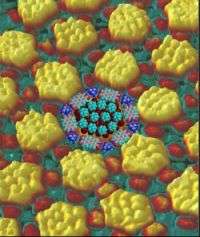
The honeycomb like structure (photo: Manfred Buck)

(PhysOrg.com) -- A crucial step in developing minuscule structures with application potential in sophisticated sensors, catalysis, and nanoelectronics has been developed by Scottish researchers.

Dr Manfred Buck and his team at the University of St Andrews have accomplished one of the big quests in nanotechnology, opening up an exciting new development in tiny technology.

The St Andrews researchers have developed a way of forming an easily modified network of molecules over a large area - the chemical technique provides an advantageous alternative to traditional methods which become increasingly cumbersome at the ultrasmall length scale.

The key to the development lies in the creation of robust and versatile surface - self-assembling structures just one molecule thick which can be exploited for further control and manipulation of nanostructures.

Dr Manfred Buck, of the University¿s School of Chemistry, explained, "One of the central issues in nanotechnology is the development of simple and reliable methods to precisely arrange molecules and other nanoscopic objects. One promising route intensively investigated by scientists around the world involves the ability of molecules to spontaneously assemble onto a surface. What we have done is successfully combined two strategies which are complementary but, so far, have been explored independently, and it is this combination which opens up unprecedented opportunities for accessing the ultrasmall length scale."

"The potential of this approach lies in its flexibility on a scale, about 1/10000 of the diameter of a human hair. Using molecules as building units, the features of our structures are less than 5 nanometres in size, which enables us to control structures and materials at dimensions where new properties emerge."

One of the advantages of the technique is that it works under ambient conditions. Since no sophisticated equipment or special environment - such as a high vacuum - is required, it is easily accessible and adaptable for a wide range of applications. The chemical method provides an alternative route to nanostructures created by conventional lithography, which inscribes patterns into surfaces but struggles to be precise on a scale of a few nanometres.

Dr Buck's solution-based chemistry works by assembling molecules into tiny dimples, themselves created when molecules self-assemble into a honeycomb-shaped network on a gold surface. Such a so-called supramolecular network is held together by hydrogen bonds -a type of bonding also essential for DNA - and acts as a template to control the arrangement of other molecules.

He continued, "We are just at the beginning of the exploration of a very exciting new area. Ongoing and future work will investigate changes in the dimensions and geometry of the network, where the aim is to get exact control over the arrangement of molecules, ultimately at the level of single molecules."

"In the short term, this development provides us with an easily accessible platform for fundamental studies of phenomena on the ultrasmall scale," Dr Buck explained.

"In the future, we might be able to use this technology for the assembly of 'nanomachines', molecular devices used to transport and manipulate molecules and nanometer sized objects," he concluded.

The research is published by the journal Nature.

Provided by University of St Andrews


Rate this story - 4.6 /5 (46 votes)

Rank Filter

Move the slider to adjust rank threshold, so that you can hide some of the comments.


Display comments: newest first

  • earls - Aug 27, 2008
    • Rank: 5 / 5 (3)
    I fail to grasp how this process works.
  • maoqiukun - Aug 27, 2008
    • Rank: 5 / 5 (1)
    I fail to grasp how this process works.

    exactly
  • Arikin - Aug 27, 2008
    • Rank: 2 / 5 (2)
    Looks like nature still knows the best way to deal with molecules. Cells process molecules at this level all the time.

    Nano Bio technology idea: cells use proteins to connect to what they need and transport it. Could synthetic proteins be used to lead molecules into the desired positions?
  • makotech222 - Aug 28, 2008
    • Rank: 4 / 5 (1)
    ^^ yes they can. its just hard to make proteins that are the correct "shape" that fit into receptor proteins on cell surfaces. at least, as far as i know its hard...
  • superhuman - Aug 28, 2008
    • Rank: 5 / 5 (1)
    I fail to grasp how this process works.


    No wonder if all the explanation is " Dr Buck's solution-based chemistry works by assembling molecules into tiny dimples, themselves created when molecules self-assemble into a honeycomb-shaped network on a gold surface."

    cells use proteins to connect to what they need and transport it. Could synthetic proteins be used to lead molecules into the desired positions?


    Yes and no. Synthetic and natural proteins can be used but the problem is they don't transport molecules by themselves they use a complicated dynamic mesh of interlinked fibers - cellular skeleton (cytoskeleton) formed by many other proteins. Its a very intricate and complex machinery and its beyond our current abilities to reproduce it in vitro.

    What can be done now is taking one such cytoskeletal fiber (microtubule) adding proper transport protein with attached cargo and the protein will latch onto it and ferry the cargo along if it is provided with fuel molecule - ATP.

August 27, 2008 all stories

Comments: 5

4.6 /5 (46 votes)

  • hide
  • Related Stories


  • hide
  • Relevant PhysicsForums posts

  • Calculating decible increases
    created 3 hours ago
  • Coefficients of friction
    created 3 hours ago
  • Deduction of centripetal force
    created 4 hours ago
  • Touching both terminals of a battery
    created 4 hours ago
  • More from Physics Forums - General Physics

Other News

Nanoscale Structures with Superior Mechanical Properties Developed

Nanoscale Structures with Superior Mechanical Properties Developed

Nanotechnology / Nanomaterials

created 5 hours ago | popularity 5 / 5 (6) | comments 0 | with audio podcast

(PhysOrg.com) -- Researchers at the California Institute of Technology have developed a way to make some notoriously brittle materials ductile -- yet stronger than ever -- simply by reducing their size.


Spray-on liquid glass

Spray-on liquid glass is about to revolutionize almost everything

Nanotechnology / Nanomaterials

created Feb 02, 2010 | popularity 4.7 / 5 (239) | comments 93 | with audio podcast report

(PhysOrg.com) -- Spray-on liquid glass is transparent, non-toxic, and can protect virtually any surface against almost any damage from hazards such as water, UV radiation, dirt, heat, and bacterial infections. ...


IBM Scientists Demonstrate World's Fastest Graphene Transistor

IBM Scientists Demonstrate World's Fastest Graphene Transistor

Nanotechnology / Nanophysics

created Feb 05, 2010 | popularity 4.9 / 5 (38) | comments 25 | with audio podcast

(PhysOrg.com) -- In a just-published paper in the magazine Science, IBM researchers demonstrated a radio-frequency graphene transistor with the highest cut-off frequency achieved so far for any graphene device ...


Conductive eTextiles: Stanford finds a new use for cloth

Conductive eTextiles: Researchers move from making batteries from paper to making batteries from cloth

Nanotechnology / Nanomaterials

created Feb 05, 2010 | popularity 4.3 / 5 (7) | comments 4 | with audio podcast

(PhysOrg.com) -- Stanford researchers have moved from making batteries from paper to making batteries from cloth. Your-T-shirt could become a lighted, moving display.


Carbon Based Chips May One Day Replace Silicon Transistors

Carbon Based Chips May One Day Replace Silicon Transistors

Nanotechnology / Nanomaterials

created Feb 03, 2010 | popularity 4.7 / 5 (17) | comments 3 | with audio podcast weblog

(PhysOrg.com) -- IBM researchers are hopeful that, over the next decade, silicon-based transistors will be replaced by carbon-based transistors. IBM has already laid out the ground work for carbon-based transistors.