Ice Cold Sunrise on Mars
August 27, 2008 Ice Cold Sunrise on Mars

Enlarge

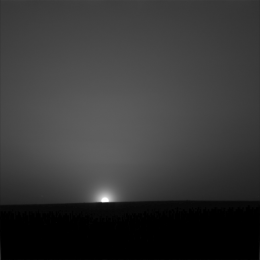
This red-filter image taken by the Phoenix landers Surface Stereo Imager shows the sun rising on the morning of sol 90 (Aug. 25), the last day of the Phoenix nominal mission. The Phoenix Mars mission has been extended through the end of September 2008. (NASA/JPL-Calech/University of Arizona/Texas A&M University)

(PhysOrg.com) -- From the location of NASA's Phoenix Mars Lander, above the Martian arctic circle, the sun does not set during the peak of the Martian summer.

This period of maximum solar energy is past – on Sol 86, the 86th Martian day after the Phoenix landing, the sun fully set behind a slight rise to the north for about half an hour.

The lander's Surface Stereo Imager took a red-filter image that shows the sun rising on the morning of sol 90 (Aug. 25), the last day of the Phoenix nominal mission.

The image was taken at 51 minutes past midnight local solar time during the slow sunrise that followed a 75 minute "night."

The skylight in the image is light scattered off atmospheric dust particles and ice crystals.

The setting sun does not mean the end of the mission. In late July, the mission was extended through September, rather than the 90-sol duration originally planned as the prime mission.

The Phoenix mission is led by Peter Smith from The University of Arizona with project management at the Jet Propulsion Laboratory and development partnership at Lockheed Martin, Denver. International contributions come from the Canadian Space Agency; the University of Neuchatel, Switzerland; the universities of Copenhagen and Aarhus in Denmark; the Max Planck Institute in Germany; and the Finnish Meteorological Institute. The California Institute of Technology in Pasadena manages JPL for NASA.

Provided by University of Arizona


print this article email this article download pdf blog this article bookmark this article     Stumble it Digg this share on Facebook retweet share on Reddit add to delicious
Rate this story - 4.6 /5 (9 votes)


August 27, 2008 all stories

Comments: 0

4.6 /5 (9 votes)
  • Stumble this up

  • Digg this

  • share this

  • hide
  • Related Stories

  • Frost-Covered Phoenix Lander Seen in Winter Images
    created Nov 05, 2009 | popularity not rated yet | comments 0
  • Gene linked to increasingly common type of blood cancer
    created Jul 20, 2009 | popularity not rated yet | comments 0
  • Phoenix Site on Mars May be in Dry Climate Cycle Phase
    created Dec 15, 2008 | popularity not rated yet | comments 0
  • Phoenix Lander Winds Up Its Astonishing Summer On Mars
    created Nov 25, 2008 | popularity not rated yet | comments 0
  • Phoenix Mars Mission Faces Survival Challenges
    created Oct 29, 2008 | popularity not rated yet | comments 0


  • hide
  • Relevant PhysicsForums posts

  • Consistency of Meteor Shower Dates (i.e. the peak of Perseids always on Aug 13th)
    created Nov 10, 2009
  • Favourite Astronomy Book?
    created Nov 10, 2009
  • dark energy
    created Nov 10, 2009
  • The shape of our solar system's orbits.
    created Nov 07, 2009
  • More from Physics Forums - General Astronomy

Other News

Exoplanets Clue to Sun's Curious Chemistry

Exoplanets Clue to Sun's Curious Chemistry

Space & Earth / Astronomy

created 15 hours ago | popularity 4.7 / 5 (15) | comments 12

(PhysOrg.com) -- A ground-breaking census of 500 stars, 70 of which are known to host planets, has successfully linked the long-standing "lithium mystery" observed in the Sun to the presence of planetary systems. ...


A bubbling ball of gas

A bubbling ball of gas (w/ Video)

Space & Earth / Space Exploration

created 16 hours ago | popularity 4.9 / 5 (15) | comments 5

The Sun is a bubbling mass. Packages of gas rise and sink, lending the sun its grainy surface structure, its granulation. Dark spots appear and disappear, clouds of matter dart up - and behind the whole thing ...


Earth's early ocean cooled more than a billion years earlier than thought: Stanford study

Earth's early ocean cooled more than a billion years earlier than thought (w/ Video)

Space & Earth / Earth Sciences

created 14 hours ago | popularity 4.6 / 5 (9) | comments 1

(PhysOrg.com) -- The scalding-hot sea that supposedly covered the early Earth may in fact never have existed, according to a new study by Stanford University researchers who analyzed isotope ratios in 3.4 ...


A Tale of Planetary Woe

A Tale of Planetary Woe (w/ Video)

Space & Earth / Space Exploration

created 11 hours ago | popularity 4.3 / 5 (8) | comments 4

Once upon a time — roughly four billion years ago — Mars was warm and wet, much like Earth. Liquid water flowed on the Martian surface in long rivers that emptied into shallow seas. A thick atmosphere blanketed ...


Researchers Discover Use for Carbon Dioxide in Conversion of Biomass Into Biofuel

Researchers Discover Use for Carbon Dioxide in Conversion of Biomass Into Biofuel

Space & Earth / Environment

created 12 hours ago | popularity 4 / 5 (9) | comments 1

(PhysOrg.com) -- Researchers at Columbia University have successfully discovered a beneficial use for carbon dioxide in the conversion of organic materials, such as grass and bark, into fuel. Their findings ...