Study says eyes evolved for X-Ray vision
August 28, 2008
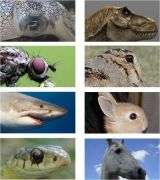
Most animals have sideways-facing eyes that allow for a panoramic view of nearly all that's around them, both in front and behind. Credit: Rensselaer/Changizi
The advantage of using two eyes to see the world around us has long been associated solely with our capacity to see in 3-D. Now, a new study from a scientist at Rensselaer Polytechnic Institute has uncovered a truly eye-opening advantage to binocular vision: our ability to see through things.
Most animals fish, insects, reptiles, birds, rabbits, and horses, for example exist in non-cluttered environments like fields or plains, and they have eyes located on either side of their head. These sideways-facing eyes allow an animal to see in front of and behind itself, an ability also known as panoramic vision.

Image A: the diagram on the left illustrates the skull of an animal with nearly sidways-facing eyes. The two orange semicircles show the visual fields of each eye, and the darker orange triangle indicates the small binocular region in front. The diagram on the right illustrates the regions within which the animal is capable of recognizing objects in a cluttered environment. Image B represents the visual field and binocular region for an animal with nearly forward-facing eyes. Credit: Rensselaer/Changizi
Humans and other large mammals primates and large carnivores like tigers, for example exist in cluttered environments like forests or jungles, and their eyes have evolved to point in the same direction. While animals with forward-facing eyes lose the ability to see what's behind them, they gain X-ray vision, according to Mark Changizi, assistant professor of cognitive science at Rensselaer, who says eyes facing the same direction have been selected for maximizing our ability to see in leafy environments like forests.All animals have a binocular region parts of the world that both eyes can see simultaneously which allows for X-ray vision and grows as eyes become more forward facing.
Demonstrating our X-ray ability is fairly simple: hold a pen vertically and look at something far beyond it. If you first close one eye, and then the other, you'll see that in each case the pen blocks your view. If you open both eyes, however, you can see through the pen to the world behind it.
To demonstrate how our eyes allow us to see through clutter, hold up all of your fingers in random directions, and note how much of the world you can see beyond them when only one eye is open compared to both. You miss out on a lot with only one eye open, but can see nearly everything behind the clutter with both.
"Our binocular region is a kind of 'spotlight' shining through the clutter, allowing us to visually sweep out a cluttered region to recognize the objects beyond it," says Changizi, who is principal investigator on the project. "As long as the separation between our eyes is wider than the width of the objects causing clutter as is the case with our fingers, or would be the case with the leaves in the forest then we can tend to see through it."
To identify which animals have this impressive power, Changizi studied 319 species across 17 mammalian orders and discovered that eye position depends on two variables: the clutter, or lack thereof in an animal's environment, and the animal's body size relative to the objects creating the clutter.
Changizi discovered that animals in non-cluttered environments which he described as either "non-leafy surroundings, or surroundings where the cluttering objects are bigger in size than the separation between the animal's eyes" (think a tiny mouse trying to see through 6-inch wide leaves in the forest) tended to have sideways-facing eyes.
"Animals outside of leafy environments do not have to deal with clutter no matter how big or small they are, so there is never any X-ray advantage to forward-facing eyes for them," says Changizi. "Because binocular vision does not help them see any better than monocular vision, they are able to survey a much greater region with sideways-facing eyes."
However, in cluttered environments which Changizi defined as leafy surroundings where the cluttering objects are smaller than the separation between an animal's eyes animals tend to have a wide field of binocular vision, and thus forward-facing eyes, in order to see past leaf walls.
"This X-ray vision makes it possible for animals with forward-facing eyes to visually survey a much greater region around themselves than sideways-facing eyes would allow," says Changizi. "Additionally, the larger the animal in a cluttered environment, the more forward facing its eyes will be to allow for the greatest X-ray vision possible, in order to aid in hunting, running from predators, and maneuvering through dense forest or jungle."
Changizi says human eyes have evolved to be forward facing, but that we now live in a non-cluttered environment where we might actually benefit more from sideways-facing eyes.
"In today's world, humans have more in common visually with tiny mice in a forest than with a large animal in the jungle. We aren't faced with a great deal of small clutter, and the things that do clutter our visual field cars and skyscrapers are much wider than the separation between our eyes, so we can't use our X-ray power to see through them," Changizi says. "If we froze ourselves today and woke up a million years from now, it's possible that it might be difficult for us to look the new human population in the eyes, because by then they might be facing sideways."
Changizi's research was completed in collaboration with Shinsuke Shimojo at the California Institute of Technology, and is published online in the Journal of Theoretical Biology.
Source: Rensselaer Polytechnic Institute


Prey animals have their eyes on either side so they can see what's comming for them, while predators have forward facing eyes so they can see their target with greater accuity.
Examples: birds of prey have forward facing eyes while non predatory birds have eyes on either side of their head.
And birds evolved for the least cluttered environment you can have, open sky.
This article was such a stretch. Our eyes aren't far enough apart to really see around things that aren't already in our face, and, for a primal predator, what use is this if chances are we are chasing something? What benefit is there to an animal that doesn't use tools to be able to see around something within a few feet of them?
I would argue that jungles and 'leafy environments' are extremely predator/prey oriented, while open fields are more grazing and relaxed. Your focus would have to adjust accordingly.
Agreed except for on one point. Look at the predatory savannah animals. Dogs, big cats and the like. All forward facing eyes. Look at the prey animals: bovines, equines, etc. All well spaced out eyes.
The paradigm holds true regardless of the environment in regard to most animals. There are very few exceptions but typically they're blind hunters, or more highly adapted to have independant control of both eyes with capability for binocular vision, like alligators, crocs, snakes, etc.
I tried putting an object as thick as a small tree branch a few feet away and the eye separation does indeed let one see past which would be handy if you were hiding in mild cover, watching something at a distance. But I don't know if one can say that that advantage is a better explanation for binocular vision than other explanations.
While the "x-ray" term might be a little misleading for a headline, I think it represents an acceptable metaphor since it does appear in the visual experience that you are seeing "through" the object.
Not just the article for reference to X-ray but also the study itself.
I am not sure if the authors of the article were making some kind of joke or if they are serious.
Yes it is handy to see around things with binocular vision but depth of field and range finding is far more important in terms of evolution (as a quick look at predators in the African Savannah will confirm).
Also, the relative importance of these different types of vision can be easily determined by looking at animals in the forest that do not have binocular vision.
One has to ask, why not? and the answer is obvious that it is easier for them to survive without binocular vision than it is with binocular vision.
And so I could go on but it has already been done before, by proper scientists.
So I guess I am criticising the following: Changizi's research was completed in collaboration with Shinsuke Shimojo at the California Institute of Technology.
A sound comment btw, Sean W. Good to see that someone writes sensibly here.
There's also no mention of side-effects of eye placement relative to co-evolution of independent pupil tracking and head/neck flexibility. Animals living in "cluttered" environments such as owls (no pupil motion, but excellent head motion) and chamillions (indep. full-range pupil motion with limited head motion) contradict these findings.
Regarding the use of "X-Ray", the article author should have properly characterized the loose use of the term in the first paragraph as having a larger depth-of-field at a given focal length and increased noise rejection due to the overlapping sight picture occluding both eyes. It's not just about binocular vision.
The article is very sub-par and inaccurate.
And many -- most -- predators have sideways facing eyes. Fish, snakes, most birds, large predatory marine mammals. And even many of the smaller land mammal predators.
This predator/prey theory is a popular idea with little or no empirical evidence. But the idea has pervaded the culture -- a persistent meme.
Link please
I would argue that the most successful predator ever is a primate. I would know, I'm one of them.
If you notice that you suggest there are many animals that do not have forward facing eyes like whales, snakes, fish. The reason, as I stated above, is because they are blind hunters. They don't use vision to hunt they use changes in temperature or smell (fish, sharks, dolphins, whales) or hearing like sonar, (bats, whales, dolphins). If an animal evolved to not use it's eyes then the placement of the eyes would be of no consequence. Thus making your statement of no empirical evidence rather useless in the cases you suggested.
Early primates have been argued to eat mainly fruit in http://www.scienc...598/1606 . And, even if the ancestor was a predator, there has been *plenty* of time for primates to change their eye placement since then, given that most primates are entirely non-predatory, and no primate is entirely predatory.
Most fish are not blind hunters. They are not entirely reliant on vision, sure, but neither are even large mammalian carnivores. Many of the smaller mammalian carnivores have sideways-facing eyes, approaching that of rodents. Nearly all birds are sideways-facing, and even the forward-facing ones are only forward-facing compared to other birds, still having more sideways-facing eyes than sideways-facing eyed mammals.
So, the most forward-facing eyed animals are not particularly strong examples of predators (especially compared to lots of full-time predators like carnivores), and many full-time predators do not have forward-facing eyes. Only the large mammalian carnivores have forward-facing eyes getting close to that of some of us primates, and they just happen to be the animals everyone knows about (lions, tigers and bears).
Other than armchair evidence, where is the citation to a study that shows, with comparative data, that forward-facing eyes is explained by the predator/prey/stereo hypothesis? (And Wikipedia doesn't count.)
The same could be said of all animals. There are very few animals that are purely predatory however, all animals that are a-typical predators have forward facing eyes.
Which is exactly why their eyes remain on the sides of their head. If their vision is not used for hunting (which could be exampled by putting out a fish's eyes and seeing it if can eat still hunt, which it can) can be argued to show that fish haven't made the FF eye change due to no evolutionary need. Which ones? And please don't confuse scavengers with predators. A scavenger can be a carnivore without predatory ability.
and most birds are not predatory by your definition. Also realize that FF eyes have a greater convergence factor in most cases. There are some cases in current animals, and in fossil remains showing a large FF vision correlation but also showing SF eyes with great forward convergence, as in the case of larger predatory dinosaurs.
You're ignoring 1/2 the reptile kingdom, all purely carnivorous birds (falcons, hawks, eagles), some specialized predatory fish which hunt above water prey such as spitter fish.
There are thousands of them, fire up google and pick one.
http://books.goog...W6lSFdMC&pg=PA20&lpg=PA20&dq=predator eye positioning&source=web&ots=fs4K8FtFrC&sig=AStPHcBpcZpYpNLrgom6vDuXTYk&hl=en&sa=X&oi=book_result&resnum=10&ct=result#PPA19,M1
This article is misleading, inaccurate, and sensationalized.
As for the article, it's true of course, but this is more a feature of the brain than a feature of the eyes since the signal is patched in the brain to create a complete picture. Similar feature is the completing of missing parts of the signal by the brain.
http://tothefutur...spot.com