Cluster watches Earth's leaky atmosphere
August 28, 2008
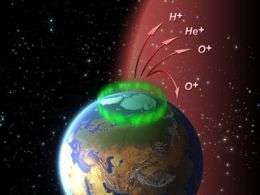
This artist's impression shows electrically charged oxygen, hydrogen and helium atoms (ions) leaking into space from the Earth atmosphere, over the poles. ESA's Cluster mission discovered that this accelerated escape is driven by changes in direction of the Earth own magnetic field. Credits: NASA/ESA
Oxygen is constantly leaking out of Earth’s atmosphere and into space. Now, ESA’s formation-flying quartet of satellites, Cluster, has discovered the physical mechanism that is driving the escape. It turns out that the Earth’s own magnetic field is accelerating the oxygen away.
The new work uses data collected by Cluster from 2001 to 2003. During this time, Cluster amassed information about beams of electrically charged oxygen atoms, known as ions, flowing outwards from the polar regions into space. Cluster also measured the strength and direction of the Earth’s magnetic field whenever the beams were present.
Hans Nilsson, Swedish Institute of Space Physics, headed a team of space scientists who analysed the data. They discovered that the oxygen ions were being accelerated by changes in the direction of the magnetic field. “It is a bit like a sling-shot effect,” says Nilsson.
Having all four Cluster spacecraft was essential to the analysis because it gave astronomers a way to measure the strength and direction of the magnetic field over a wide area. “Cluster allowed us to measure the gradient of the magnetic field and see how it was changing direction with time,” says Nilsson.
Before the space age, scientists believed that Earth’s magnetic field was filled only with particles from the solar wind, the constant sleet of particles that escapes from the Sun. They thought this formed a large cushion that protected the Earth’s atmosphere from direct interaction with the solar wind.
“We are beginning to realise just how many interactions can take place between the solar wind and the atmosphere,” says Nilsson. Energetic particles from the solar wind can be channelled along the magnetic field lines and, when these impact the atmosphere of the Earth, they can produce aurorae. This occurs over the poles of Earth. The same interactions provide the oxygen ions with enough energy to accelerate out of the atmosphere and reach the Earth’s magnetic environment.
The Cluster data were captured over the poles with the satellites flying at an altitude of anywhere between 30,000 and 64,000 kilometres. Measurements taken by earlier satellites during the 1980s and 1990s showed that the escaping ions were travelling faster the higher they were observed. This implied that some sort of acceleration mechanism was involved and several possibilities were proposed. Thanks to this new Cluster study, the mechanism accounting for most of the acceleration has now been identified.
At present, the escape of oxygen is nothing to worry about. Compared to the Earth’s stock of the life-supporting gas, the amount escaping is negligible. However, in the far future when the Sun begins to heat up in old age, the balance might change and the oxygen escape may become significant. “We can only predict these future changes if we understand the mechanisms involved,” says Nilsson.
For now, Cluster will continue collecting data and providing new insights into the complex magnetic environment surrounding our planet.
An assessment of the role of the centrifugal acceleration mechanism in high altitude polar cap oxygen ion outflow by H. Nilsson, M. Waara, O. Marghitu, M. Yamauchi, R. Lundin, H. Rème, J-A. Sauvaud, I. Dandouras, E. Lucek, L. M. Kistler, B. Klecker, C. W. Carlson, M. B. Bavassano-Cattaneo, and A. Korth, is published in the journal Annales Geophysicae, 26, 145-157, 2008.
Provided by ESA
-
Cosmic particle accelerators get things going
Nov 17, 2011 |
5 / 5 (4) |
0
-
NASA's Fermi finds youngest millisecond pulsar, 100 pulsars to date
Nov 04, 2011 |
4.3 / 5 (6) |
2
-
Biography of a star
Nov 03, 2011 |
5 / 5 (4) |
4
-
Millisecond pulsar in spin mode
Nov 03, 2011 |
4.6 / 5 (5) |
8
-
STEREO mission celebrates five incredible years of science
Oct 27, 2011 |
not rated yet |
1
-
Engineers build first sub-10-nm carbon nanotube transistor
Feb 01, 2012 |
4.9 / 5 (30) |
30
-
Something old, something new: Evolution and the structural divergence of duplicate genes
Jan 31, 2012 |
4.6 / 5 (7) |
1
-
The hidden nanoworld of ice crystals: Revealing the dynamic behavior of quasi-liquid layers
Jan 30, 2012 |
5 / 5 (3) |
1
-
Stock market network reveals investor clustering
Jan 27, 2012 |
3.9 / 5 (23) |
8
-
Of microchemistry and molecules: Electronic microfluidic device synthesizes biocompatible probes
Jan 26, 2012 |
5 / 5 (1) |
0
-
Discrepancy between oxygen and carbon-dioxide levels
9 hours ago
-
where gems are found in the world
13 hours ago
-
Wind Waves in Reservoir ~ Wind run-up and Wind set-up
Feb 08, 2012
-
Balance of oxygen in the atmosphere
Feb 01, 2012
-
The case for a methanol-based economy
Jan 30, 2012
-
Weather in a rotating cylinder
Jan 25, 2012
- More from Physics Forums - Earth
More news stories
Humans may have helped the decline of African rainforests 3000 years ago
(PhysOrg.com) -- Large areas of rainforests in Central Africa mysteriously disappeared over three thousand years ago, to be replaced by savannas. The prevailing theory has been that the cause was a change ...
NASA budget will axe Mars deal with Europe: scientists
US President Barack Obama's budget proposal to be submitted next week for 2013 will cut NASA's budget by 20 percent and eliminate a major partnership with Europe on Mars exploration, scientists said Thursday.
Space & Earth / Space Exploration
1 hour ago |
5 / 5 (1) |
2
Black holes and star formation
(PhysOrg.com) -- It has long been recognized that galaxy mergers or even close interactions can play a vital role in shaping the morphology of galaxies. One way they can do so, it is thought, is by triggering ...
23 hours ago |
4.1 / 5 (7) |
5
|
Ocean microbe communities changing, but long-term environmental impact is unclear
As oceans warm due to climate change, water layers will mix less and affect the microbes and plankton that pump carbon out of the atmosphere but researchers say it's still unclear whether these processes ...
Space & Earth / Earth Sciences
18 hours ago |
5 / 5 (2) |
2
|
Deconstructing a mystery: What caused Snowmaggedon?
In the quiet after the storms, streets and cars had all but disappeared under piles of snow. The U.S. Postal Service suspended service for the first time in 30 years. Snow plows struggled to push the evidence ...
Space & Earth / Earth Sciences
16 hours ago |
3.8 / 5 (4) |
1
|
New error-correcting codes guarantee the fastest possible rate of data transmission
Error-correcting codes are one of the triumphs of the digital age. Theyre a way of encoding information so that it can be transmitted across a communication channel such as an optical fiber o ...
High school students test best with 7 hours' rest
(Medical Xpress) -- Whether or not you know any high school students that actually get nine hours of sleep each night, thats what federal guidelines currently prescribe.
Soccer -- the link between managers and captains
Soccer managers regard their captains as an extension of themselves, according to new research from Northumbria University, which could explain why Fabio Capello quit as England manager following the FA row ...
Using economic evaluations for drug reimbursement decisions - what have we achieved?
Researchers at the University of York perform evaluations of the clinical and cost-effectiveness of drugs for the National Institute for Health and Clinical Excellence (NICE).
Japan scientist makes 'Avatar' robot
A Japanese-developed robot that mimics the movements of its human controller is bringing the Hollywood blockbuster "Avatar" one step closer to reality.
Protein libraries in a snap
(PhysOrg.com) -- A Rice University undergraduate will depart with not only a degree but also a possible patent for his invention of an efficient way to create protein libraries, an important component of biomolecular ...
Aug 29, 2008
Rank: 3.3 / 5 (7)
Aug 29, 2008
Rank: 1.3 / 5 (4)
Aug 29, 2008
Rank: not rated yet
Aug 29, 2008
Rank: 1 / 5 (4)
Aug 29, 2008
Rank: 2 / 5 (4)
Lets hope the media doesn't hear about this... We will have to figure out how to stop the leak if they do.
Aug 29, 2008
Rank: 1 / 5 (1)
Anyone know what is actually new about this?
Sep 01, 2008
Rank: 1 / 5 (1)
that was a prediction of the electric universe theory.
it would also be news that particles of that which leaks from the earth are also microbes and bacterial spores. thats a prediction of Cosmic Ancestry/Panspermia theory.
But these two have not be considered by the authors of the article nor those that wrote the physorg text.
Sep 07, 2008
Rank: not rated yet