Philips Research reveals ultra-thin backlight technology for TVs
August 28th, 2008 Philips Research reveals ultra-thin backlight technology for TVs

Enlarge

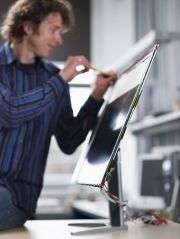
In the Future Zone of this year’s IFA trade fair in Berlin, Philips Research will demonstrate its thinnest 32’’ liquid crystal display (LCD) prototype on show. With a 1mm light guide, Philips Research has created a display prototype of only 8mm. When incorporated into a TV set, Philips expects that this ultra-thin LCD will tap into consumers’ desire to easily hang their flat-screen TVs on the wall – just as they would do with a painting.

The ultra-thin backlight technology reflects the general design trend and enables consumers to use their TV as a piece of art rather than a piece of electronics. People want to be able to hang their TVs on the walls, just as if they were paintings.

The latest product developments enabled the launch of Essence, a stylish 42" slim display that is only 38mm thick. Now, the backlight technology of Philips Research takes it a step further and brings the ultra-thin trend to a next level.

“At just 8mm thick, our ultra-thin display concept will enable the thinnest 32” LCD-TV,” says Fred Boekhorst, Senior Vice-President Philips Research and Program Manager Lifestyle. “Our concept is also very light – around 5 kg – enabling a 32” LCD-TV that is around 10 kg lighter than existing comparable TV sets. As a result, hanging such an LCD-TV becomes simple and easy.”

Philips Research has based this ultra-thin design on its extensive expertise in optical design and backlighting technology. The novel technology involves a very thin light guide plate illuminated from the top and bottom by high-power, energy-efficient LEDs.

Using Philips’ patented light in-coupling structure and a fine-tuned out-coupling pattern, light can be distributed over the whole display area in a uniform fashion.

“We’ve managed to cut the size of the light guide – which is the thickest part of an LCD – from around 25mm to just 1mm,” says Boekhorst. “Hence, the thickest part of the display has now become one of the thinnest parts, even thinner than the LC panel. This has been key in achieving the sleek ultra-thin design.”

Source: Philips


print this article email this article download pdf blog this article bookmark this article     Digg this Stumble it share on Facebook share on Reddit add to delicious save to Yahoo! bookmarks
4.6/5 after 20 votes

Rank Filter

Move the slider to adjust rank threshold, so that you can hide some of the comments.


Display comments: newest first


August 28th, 2008 all stories
Electronics / Hardware

Comments: 1
Rank: 4.6/5 after 20 votes

  • Stumble this up

  • Digg this

  • Share it:
  • share on Facebook
  • share on MySpace
  • share on Slashdot
  • rss-newsfeed
  • share on Google
  • share on Reddit
  • add to delicious
  • save to Yahoo! bookmarks
  • share on Windows Live
  • Add to Mixx!
Rating: 4.6/5 after 20 votes

  • Related Stories

  • Taiwan invited to light up Chinese cities
    created Jun 11, 2009 | popularity not rated yet | comments 0
  • Engineers unveil new lighting solutions
    created Jun 09, 2009 | popularity not rated yet | comments 0
  • Philips presents OLED-based interactive lighting concepts
    created Apr 23, 2009 | popularity not rated yet | comments 0
  • Light pollution offers new global measure of coral reef health
    created Nov 24, 2008 | popularity not rated yet | comments 0
  • Philips introduces light therapy device to offer quick relief from winter blues
    created Oct 31, 2008 | popularity not rated yet | comments 0


  • Physicists Demonstrate Quantum Memory with Matter Qubits
    Physicists Demonstrate Quantum Memory with Matter Qubits
    Physics / General Physics
    created Jul 03, 2009 | popularity 4.4 / 5 (16) | comments 1
  • 'Holey' Nanosheets for Wastewater Dye Removal
    Nanotechnology / Nanomaterials
    created Jul 01, 2009 | popularity 5 / 5 (5) | comments 1
  • Jellyfish Robot Swims Like its Biological Counterpart
    Jellyfish Robot Swims Like its Biological Counterpart
    Electronics / Robotics
    created Jun 26, 2009 | popularity 4.4 / 5 (8) | comments 1
  • Could Maxwell's Demon Exist in Nanoscale Systems?
    Could Maxwell's Demon Exist in Nanoscale Systems?
    Physics / General Physics
    created Jun 24, 2009 | popularity 4.4 / 5 (18) | comments 29
  • Living Safely with Robots, Beyond Asimov's Laws
    Living Safely with Robots, Beyond Asimov's Laws
    Electronics / Robotics
    created Jun 22, 2009 | popularity 4.6 / 5 (52) | comments 40
  • Other News

    Zenith Flash-Matic

    TV remotes to undergo big change

    Electronics / Consumer & Gadgets

    created Jul 01, 2009 | popularity 5 / 5 (1) | comments 4

    In 1955, Zenith introduced the first wireless TV remote control, the Flash-Matic, followed a year later by the Space Command.


    HP Introduces First Professional Workstation with Six-core AMD Opteron Processor

    Electronics / Hardware

    created Jul 01, 2009 | popularity 4.7 / 5 (3) | comments 3

    HP today announced the integration of the highly anticipated Six-Core AMD Opteron 2400 Series processor into its family workstations.


    Digital Entertainer brings PC content to big screen

    Electronics / Consumer & Gadgets

    created Jul 02, 2009 | popularity 1.5 / 5 (2) | comments 1

    So there you are with all those videos, photos and MP3 music files, and the only place you can play all that digital entertainment is on your computer. It's probably sequestered away somewhere in the room you've designated ...


    A group of students of robotics setup a football robot on the eve of the "RoboCup" the world largest robotic event

    Robots face off on football pitch, in kitchen at RoboCup 2009

    Electronics / Robotics

    created Jul 01, 2009 | popularity 5 / 5 (3) | comments 0

    RoboCup 2009, the world's largest robotics event, kicked off Wednesday in the southern Austrian city of Graz, with some 400 teams and 2,000 robots ready to compete in sports and rescue operations.


    Dell

    Dell Planning Pocket Web Gadget

    Electronics / Consumer & Gadgets

    created Jul 01, 2009 | popularity not rated yet | comments 0

    (PhysOrg.com) -- Dell engineers are in the process of developing a pocket handheld device for browsing the internet. Dell plans on using the Google Inc.'s Android software and may also use chips based on designed ...