Magmatically triggered slow earthquake discovered at Kilauea Volcano, Hawaii
August 29th, 2008 Magmatically triggered slow earthquake discovered at Kilauea Volcano, Hawaii

Enlarge

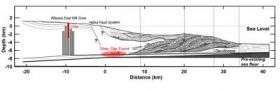
A schematic cross-section from north to south through Kilauea Volcano, showing the structure of the volcano and the mobile south flank. The June 17 dike intruded into the East Rift Zone and triggered the slow-slip event, that most likely occurred on the decollement fault between the volcano and the pre-existing sea floor, approx. 15 to 20 hours later. Image credit: James Foster, HIGP/SOEST

From June 17-19th 2007, Kilauea experienced a new dike intrusion, where magma rapidly moved from a storage reservoir beneath the summit into the east rift zone and extended the rift zone by as much as 1 meter.

Researchers from the University of Hawaii at Manoa (UHM), Scripps Institution of Oceanography at UC San Diego, and the U.S. Geological Survey (USGS) Hawaiian Volcano Observatory have now discovered that the 2007 dike intrusion was not the only action going on: the dike also triggered a "slow earthquake" on Kilauea's south flank, demonstrating how magmatism and earthquake faulting at Kilauea can be tightly connected. The research findings will be published in the Friday, August 29th edition of the prestigious journal Science.

Slow earthquakes are a special type of earthquake where fault rupture occurs too slowly (over periods of days to months) to produce any felt shaking. Slow earthquakes of magnitude 5.5-5.7 have been previously found to periodically occur on the flanks of Kilauea, and have been identified by ground motion data on Global Positioning System (GPS) stations. A general understanding of slow earthquake initiation, however, is still unresolved.

This new study is the first observation of slow earthquake that was triggered by a dike intrusion. A team lead by Associate Researcher Ben Brooks of the School of Ocean and Earth Science and Technology (SOEST) at UHM used a combination of satellite and GPS data to demonstrate that the 2007 slow earthquake began about 15-20 hours after the start of the dike intrusion, and that the slow earthquake was accompanied by elevated rates of small magnitude microearthquakes, a pattern identical to what has been seen from past slow earthquakes.

The authors also performed stress modeling to demonstrate how the processes associated with the volcanism at Kilauea contributes to the existence of the observed slow earthquakes. The results suggest that both extrinsic (intrusion-triggering on short time scales) and intrinsic (secular deformation on long time scales) processes produce slow earthquakes at Kilauea.

"Because of the large deformation signals from the dike intrusion, we needed to do some detailed detective work to prove the existence of this slow earthquake." says Brooks, an associate researcher in the Hawaii Institute for Geophysics and Planetology (HIGP) at UHM. "We used state-of-the-art InSAR satellite data to constrain the dike source and that allowed us to demonstrate the existence of the slow earthquake motions recorded by the GPS stations on Kilauea's flank."

To determine the presence of this slow earthquake, a multitude of measuring tools were required. "A dike intrusion could be seen with the seismic monitoring network, the tiltmeters and the GPS network, but these slow earthquakes can only be seen with the GPS network," says James Foster, an assistant researcher with HIGP, and a co-author in the study.

"These slow earthquakes are an interesting phenomenon that has only been studied within the last decade and we're still trying to figure out how they fall into the bigger picture of earthquakes, says Cecily Wolfe, also an associate professor in HIGP and another co-author. "They're definitely a part of the earthquakes cycle, and trying to understand how they relate to other earthquakes and how they may be generated and triggered will give us greater insights into how predicable earthquakes are."

Source: University of Hawaii at Manoa


print this article email this article download pdf blog this article bookmark this article     Digg this Stumble it share on Facebook share on Reddit add to delicious save to Yahoo! bookmarks
4.3/5 after 12 votes

Rank Filter

Move the slider to adjust rank threshold, so that you can hide some of the comments.


Display comments: newest first

  • Armando - Jan 02, 2009
    • Rank: not rated yet
    It was the 3.6 magnitude earthquake that took place last week has left the people in desperate need of extra cash. Fortunately, the only thing hurt was the drywall on the homes in the area and residents%u2019 pocketbooks, which they will have to compensate for come next payday. It seems the earthquake came in good timing for the supervisor for the Charleston county school district who was apparently trying to invest money into the local schools partly as a precautionary measures for future earthquakes. After this one, it appears he won%u2019t be having any more problems getting what he wants. Personally, I was not aware South Carolina is almost as bad as California when it comes to earthquakes. Hopefully this will serve as a wake-up call or a reminder that life is unpredictable %u2013 anything can happen.

    You can read the article called "Charleston Earthquake | Payday Will Be Spent Fixing Drywall," on http://personalmo...drywall/

August 29th, 2008 all stories
Space & Earth / Earth Sciences

Comments: 1
Rank: 4.3/5 after 12 votes

  • Stumble this up

  • Digg this

  • Share it:
  • share on Facebook
  • share on MySpace
  • share on Slashdot
  • rss-newsfeed
  • share on Google
  • share on Reddit
  • add to delicious
  • save to Yahoo! bookmarks
  • share on Windows Live
  • Add to Mixx!
Rating: 4.3/5 after 12 votes

  • Related Stories

  • Typhoons trigger earthquakes on Taiwan: scientists
    created Jun 10, 2009 | popularity not rated yet | comments 0
  • Fingerprinting slow earthquakes (w/Podcast)
    created Apr 23, 2009 | popularity not rated yet | comments 0
  • CSI: Pisco, Peru -- Study uncovers tectonic events behind earthquake
    created Apr 10, 2009 | popularity not rated yet | comments 0
  • New monitoring stations detect 'silent earthquakes' in Costa Rica
    created Feb 15, 2009 | popularity not rated yet | comments 0
  • Riding -- and reading -- the Earth tide
    created Jan 29, 2009 | popularity not rated yet | comments 0


  • Physicists Demonstrate Quantum Memory with Matter Qubits
    Physicists Demonstrate Quantum Memory with Matter Qubits
    Physics / General Physics
    created Jul 03, 2009 | popularity 4.4 / 5 (17) | comments 1
  • 'Holey' Nanosheets for Wastewater Dye Removal
    Nanotechnology / Nanomaterials
    created Jul 01, 2009 | popularity 5 / 5 (5) | comments 1
  • Jellyfish Robot Swims Like its Biological Counterpart
    Jellyfish Robot Swims Like its Biological Counterpart
    Electronics / Robotics
    created Jun 26, 2009 | popularity 4.4 / 5 (8) | comments 1
  • Could Maxwell's Demon Exist in Nanoscale Systems?
    Could Maxwell's Demon Exist in Nanoscale Systems?
    Physics / General Physics
    created Jun 24, 2009 | popularity 4.4 / 5 (18) | comments 29
  • Living Safely with Robots, Beyond Asimov's Laws
    Living Safely with Robots, Beyond Asimov's Laws
    Electronics / Robotics
    created Jun 22, 2009 | popularity 4.6 / 5 (52) | comments 40
  • Other News

    Forty years ago man first walked on the moon

    Space & Earth / Space Exploration

    created 19 hours ago | popularity 4.3 / 5 (4) | comments 2

    Forty years ago on July 20, 1969, American astronaut Neil Armstrong realized the oldest dream of human civilizations when he became the first man to walk on the moon.


    The least sea ice in 800 years

    The least sea ice in 800 years

    Space & Earth / Earth Sciences

    created Jul 01, 2009 | popularity 4.1 / 5 (63) | comments 59

    New research, which reconstructs the extent of ice in the sea between Greenland and Svalbard from the 13th century to the present indicates that there has never been so little sea ice as there is now. The ...


    Gas around young galaxy

    Intense heat killed the Universe's would-be galaxies, researchers say

    Space & Earth / Astronomy

    created Jul 01, 2009 | popularity 3.4 / 5 (21) | comments 27

    (PhysOrg.com) -- Our Milky Way galaxy only survived because it was already immersed in a large clump of dark matter which trapped gases inside it, scientists led by Durham University's Institute for Computational ...


    Scientists' Drill Hits Magma: Only Third Time on Record

    Scientists' Drill Hits Magma: Only Third Time on Record

    Space & Earth / Earth Sciences

    created Jun 29, 2009 | popularity 4.7 / 5 (22) | comments 19

    (PhysOrg.com) -- Scientists drilling a borehole deep into Iceland’s rocky crust to explore new methods of using geothermal energy hit a major roadblock on Thursday: Their drill ran into molten rock at a depth ...


    NASA manager pitches a cheaper return-to-moon plan

    Space & Earth / Space Exploration

    created Jun 30, 2009 | popularity 4.1 / 5 (8) | comments 18

    (AP) -- Like a car salesman pushing a luxury vehicle that the customer no longer can afford, NASA has pulled out of its back pocket a deal for a cheaper ride to the moon.