Integral locates origin of high-energy emission from Crab Nebula
August 29th, 2008 Integral locates origin of high-energy emission from Crab Nebula

Enlarge

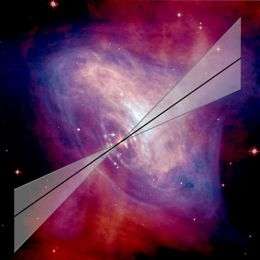
This image shows the direction of polarisation (alignement) of the high-energy radiation emitted by the Crab Nebula, as detected by ESA’s Integral gamma-ray observatory. The shaded part represents the error in the determination of this direction. This direction is remarkably aligned with the inner jets of the Crab. On their turn, these are aligned with the rotation axis of the pulsar located at the centre of the system. The Crab Nebula image in the background was obtained by combining an optical image by NASA/ESA’s Hubble Space Telescope and an X-ray image by NASA’s Chandra X-ray observatory. Credits: NASA/CXC/ASU/J. Hester et al.(for the Chandra image); NASA/HST/ASU/J. Hester et al. (for the Hubble image)

(PhysOrg.com) -- Thanks to data from ESA's Integral gamma-ray observatory, scientists have been able to locate where particles in the vicinity of the rotating neutron-star in the Crab Nebula are accelerated to immense energies.

The discovery, resulting from more than 600 individual observations of the nebula, put in place another piece of the puzzle in understanding how neutron stars work.
Rotating neutron-stars, or pulsars, are known to accelerate particles to enormous energies, typically one hundred times more than the most powerful accelerators on Earth, but scientists are still uncertain exactly how these systems work and where the particles are accelerated.

A step forward in this understanding is now accomplished thanks to a team of researchers from the UK and Italy, led by Professor Tony Dean of the University of Southampton, who studied high-energy polarised light emitted by the Crab Nebula – one of the most dramatic sights in deep space.

The Crab Nebula is the result of a supernova explosion which was seen from Earth on 4 July 1054. The explosion left behind a pulsar with a nebula of radiating particles around it. The pulsar contains the mass of the Sun squeezed into a volume of about 10 km radius, rotating very fast – about 30 times a second – thereby generating very powerful magnetic fields and accelerating particles. A highly collimated jet, aligned with the spin axis of the pulsar and a bright radiating ‘donut’ structure (or torus) around the pulsar itself, are also seen.

So, the Crab is known to accelerate electrons - and possibly other particles - to extremely high speed, and so produces high energy radiation. But where exactly are these particles accelerated?

Looking into the heart of the pulsar with Integral’s spectrometer (SPI), the researchers made a detailed study to assess the polarization – or the alignment - of the waves of high-energy radiation originating from the Crab.

They saw that this polarised radiation is highly aligned with the rotation axis of the pulsar. So they concluded that a significant portion of the electrons generating the high-energy radiation must originate from a highly-organised structure located very close to the pulsar, very likely directly from the jets themselves. The discovery allows the researchers to discard other theories that locate the origin of this radiation further away from the pulsar.

Professor Tony Dean of the University’s School of Physics and Astronomy commented that the discovery of such alignment – also matching with the polarisation observed in the visible band - is truly remarkable. “The findings have clear implications on many aspects of high energy accelerators such as the Crab,” he added.

"The detection of polarised radiation in space is very complicated and rare, as it requires dedicated instrumentation and an in-depth analysis of very complex data”, said Chris Winkler, Integral Project Scientist at ESA. “Integral’s ability to detect polarised gamma-radiation and, as a consequence, to obtain important results like this one, confirms it once more as a world-class observatory.”

Click here to listen to the audio file from Crab.

The results are published in the 29 August issue of the scientific journal Science, in a paper titled ‘Polarized gamma-ray emission from the Crab’, by: A. J. Dean, D.J. Clark, V.A.McBride, A.J.Bird, A.B.Hill and S.E.Shaw (University of Southampton’s School of Physics and Astronomy); J.B. Stephen and L. Bassani (INAF-IASF, Bologna); and A. Bazzano and P. Ubertini (INAF-IASF, Roma).

Provided by ESA


print this article email this article download pdf blog this article bookmark this article     Digg this Stumble it share on Facebook share on Reddit add to delicious save to Yahoo! bookmarks
4.1/5 after 8 votes


August 29th, 2008 all stories
Space & Earth / Astronomy

Comments: 0
Rank: 4.1/5 after 8 votes

  • Stumble this up

  • Digg this

  • Share it:
  • share on Facebook
  • share on MySpace
  • share on Slashdot
  • rss-newsfeed
  • share on Google
  • share on Reddit
  • add to delicious
  • save to Yahoo! bookmarks
  • share on Windows Live
  • Add to Mixx!
Rating: 4.1/5 after 8 votes

  • Related Stories

  • Fingers, Loops and Bays in the Crab Nebula
    created Nov 06, 2008 | popularity not rated yet | comments 0
  • Heart of the Crab Pulsar probed -- first direct look into the core of a neutron star
    created Jun 02, 2008 | popularity not rated yet | comments 0
  • White dwarf pulses like a pulsar
    created Jan 02, 2008 | popularity not rated yet | comments 0
  • Pulsar gives insight on ultra dense matter and magnetic fields
    created Dec 14, 2004 | popularity not rated yet | comments 0
  • The Mouse That Soared
    created Sep 27, 2004 | popularity not rated yet | comments 0


  • Physicists Demonstrate Quantum Memory with Matter Qubits
    Physicists Demonstrate Quantum Memory with Matter Qubits
    Physics / General Physics
    created Jul 03, 2009 | popularity 4.4 / 5 (17) | comments 1
  • 'Holey' Nanosheets for Wastewater Dye Removal
    Nanotechnology / Nanomaterials
    created Jul 01, 2009 | popularity 5 / 5 (5) | comments 1
  • Jellyfish Robot Swims Like its Biological Counterpart
    Jellyfish Robot Swims Like its Biological Counterpart
    Electronics / Robotics
    created Jun 26, 2009 | popularity 4.4 / 5 (8) | comments 1
  • Could Maxwell's Demon Exist in Nanoscale Systems?
    Could Maxwell's Demon Exist in Nanoscale Systems?
    Physics / General Physics
    created Jun 24, 2009 | popularity 4.4 / 5 (18) | comments 29
  • Living Safely with Robots, Beyond Asimov's Laws
    Living Safely with Robots, Beyond Asimov's Laws
    Electronics / Robotics
    created Jun 22, 2009 | popularity 4.6 / 5 (52) | comments 40
  • Other News

    Forty years ago man first walked on the moon

    Space & Earth / Space Exploration

    created 17 hours ago | popularity 4.3 / 5 (3) | comments 2

    Forty years ago on July 20, 1969, American astronaut Neil Armstrong realized the oldest dream of human civilizations when he became the first man to walk on the moon.


    The least sea ice in 800 years

    The least sea ice in 800 years

    Space & Earth / Earth Sciences

    created Jul 01, 2009 | popularity 4.2 / 5 (62) | comments 59

    New research, which reconstructs the extent of ice in the sea between Greenland and Svalbard from the 13th century to the present indicates that there has never been so little sea ice as there is now. The ...


    Gas around young galaxy

    Intense heat killed the Universe's would-be galaxies, researchers say

    Space & Earth / Astronomy

    created Jul 01, 2009 | popularity 3.4 / 5 (21) | comments 27

    (PhysOrg.com) -- Our Milky Way galaxy only survived because it was already immersed in a large clump of dark matter which trapped gases inside it, scientists led by Durham University's Institute for Computational ...


    Scientists' Drill Hits Magma: Only Third Time on Record

    Scientists' Drill Hits Magma: Only Third Time on Record

    Space & Earth / Earth Sciences

    created Jun 29, 2009 | popularity 4.7 / 5 (22) | comments 19

    (PhysOrg.com) -- Scientists drilling a borehole deep into Iceland’s rocky crust to explore new methods of using geothermal energy hit a major roadblock on Thursday: Their drill ran into molten rock at a depth ...


    NASA manager pitches a cheaper return-to-moon plan

    Space & Earth / Space Exploration

    created Jun 30, 2009 | popularity 4 / 5 (7) | comments 18

    (AP) -- Like a car salesman pushing a luxury vehicle that the customer no longer can afford, NASA has pulled out of its back pocket a deal for a cheaper ride to the moon.