Physicists Rule Out the Production of Dangerous Black Holes at the LHC
September 1, 2008 By Laura Mgrdichian Physicists Rule Out the Production of Dangerous Black Holes at the LHC

Enlarge

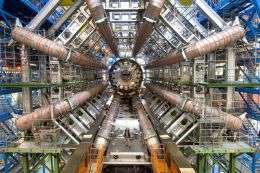
Image credit: Maximilien Brice, CERN

(PhysOrg.com) -- On August 8, the world's largest particle accelerator, the Large Hadron Collider near Geneva, Switzerland, began the process of slowly throttling to full power. When its proton beams are circling at full speed and collisions begin, scientists from around the world will finally be able to start collecting data.

LHC collisions may reveal new clues about the origin of the universe, new particles, new dimensions, and perhaps even new physics even theory doesn't predict. But will the collisions be powerful enough to create a tiny mass of particles with a gravitational pull so strong it can "eat" other matter -- a microscopic black hole? And if yes, could such a thing grow big enough to swallow Earth itself?

The fact is, the LHC could produce a tiny, extremely short-lived (read: harmless) black hole. It is an unlikely event, but one that physicists are nonetheless excited about. However, they discount the possibility of a stable black hole -- one with the chance to grow into something worth worrying about -- as much more science fiction than science.

Recently, two physicists took a close, practical look at the issue by examining known astrophysical phenomena, using what scientists already know about the universe to determine the likelihood that the LHC will produce stable black holes on Earth.

The physicists are Steven Giddings, of the University of California-Santa Barbara, and Michelangelo Mangano, of the European Organization of Nuclear Research (CERN), which built the LHC. In their paper, published in the August 18, 2008, online edition of Physical Review D, they examine the "extremely hypothetical scenario" in which black holes are created at the LHC, are stable, and become trapped within the Earth. Would we be doomed? The short answer is no.

Giddings told PhysOrg.com, "We went to great pains to thoroughly investigate possible risk in even some very outlandish proposals for black hole behavior, and found we could safely rule it out. The basic reason is simple: Nature has been performing this type of experiment for billions of years, not only on our planet and sun, but also on much denser objects, like neutron stars and white dwarfs. Their enormous age reassures us that physics doesn't exhibit the bizarre behavior that LHC opponents have suggested."

Giddings and Mangano's first argument against stable LHC-produced black holes is the fact that scientists almost universally agree that black holes evaporate, emitting particles called Hawking radiation, named for Stephen Hawking, who proposed the phenomenon and showed why it exists. A microscopic black hole would thus be very unstable, disappearing in the tiniest fraction of a second.

They also remind us (in an argument presented in the past) that collisions with the same power as those to be produced at the LHC—in the trillion electron volt range—happen all the time on Earth, when cosmic rays from deep space (protons with extremely high energies) collide with molecules in the atmosphere. The quick, logical conclusion is that such events, if they could produce dangerous, stable black holes, would have already done so.

But Giddings and Mangano consider two scenarios that aren't quite so simple: if a stable black hole created in the atmosphere carried a charge, or if it was neutral.

They calculate that a charged black hole produced by cosmic rays wouldn't be able to travel very far before it was drained of energy by the material of the Earth, or if very energetic, by the Sun. If charged black holes have ever been produced in our atmosphere, our existence is proof they are safe. At the LHC, a black hole would likely be charged because it would have been produced by collisions between quark pairs (quarks have charge).

But if the black hole was neutral, and if it was also stable, emitting no Hawking radiation, that could be troubling. Giddings and Mangano examine this scenario despite that the likelihood of it occurring is almost zero, since scientists believe that neutralization could not occur without the emission of Hawking radiation. Neutralization and Hawking radiation are intricately linked quantum processes; if one is occurring, the other should be, too.

Over pages of analysis, they show that there are two possible cases of stable, neutral black holes. Which of these cases could be true depends on which physics theory of extra dimensions (there are competing theories) is correct.

The first case is the slow growth of a neutral, stable microscopic black hole. If such a black hole were produced on Earth as a result of LHC collisions, its growth would take place on a time scale longer than the natural life of our sun. That means our star would burn out before we were in danger.

This leaves the second case, of growth faster than the sun's lifetime. Such stable, neutral black holes would also be created by cosmic-ray collisions. Because of this, Giddings and Mangano's paper shows that much denser objects than Earth and the sun, such as white dwarfs and neutron stars, which are already close to collapsing in on themselves, would be destroyed by such black holes. The simple fact that these stars still exist excludes this second case.

That leaves the first case as the only possibility in the case of stable, neutral black holes. And as Giddings reminds us, "The overwhelming majority of the scientific community agrees that the stable scenarios are crazy anyway."

Citation: Phys. Rev. D 78, 035009 (2008)

Copyright 2008 PhysOrg.com.
All rights reserved. This material may not be published, broadcast, rewritten or redistributed in whole or part without the express written permission of PhysOrg.com.


Rate this story - 4.3 /5 (93 votes)

Rank Filter

Move the slider to adjust rank threshold, so that you can hide some of the comments.


Display comments: newest first

  • gmurphy - Sep 01, 2008
    • Rank: 4.7 / 5 (18)
    energetic collisions far exceeding the amplitudes found in the LHC occur in the Sun and other stars all the time. If these kind of interactions could have caused black holes we wouldn't have a Sun.
  • seanpu - Sep 01, 2008
    • Rank: 1.3 / 5 (15)
    since black holes are a mathematical abstraction and don't actual exist (as in a very dense object) then we have nothing to fear.

    "The overwhelming majority of the scientific community agrees that the stable scenarios are crazy anyway."

    Crazy are that black holes actual exist! bonkers!
  • kniedzius - Sep 01, 2008
    • Rank: 2.3 / 5 (6)
    Let's way for Alizee to come and comment on this. I believe that he/she has something to say on this!
  • gopher65 - Sep 01, 2008
    • Rank: 3.8 / 5 (4)
    This paper (and for once a decent article describing it) describes some thoughts that I've had for some time. Even if a stable micro blackhole were created, it would take such a long time to accumulate a dangerous amount of mass that we would be in no danger. Even the simplistic back-of-a-cocktail-napkin calculations that I can do should have indicated that to the anti-LHC crowd.

    But they're too good for, you know, logic, I guess.
  • Yes - Sep 01, 2008
    • Rank: 4.9 / 5 (7)
    The problem is that we are speculating about that we think we know what is going to happen. If we would know the outcome at forehand, then we would not be experimenting. And if we don't know the outcome (that is why we are experimenting) then we take the risk that the outcome is complete destruction. Its just that we don't know.
    Then if we decide to not to do the experiment because something can go wrong then I suggest to stop changing lightbulbs at home too. You may fall from the ladder and drop dead, or a lightning may strike in the electricity pole while changing the bulb, and hit you.
    Do not confuse experimenting the unknown where you are quite sure that there is no harm, with experimenting with nuclear bombs, while the calculations were done for destruction.

    Anyway if we were wrong, then.... nothing matters anymore anyway.
  • ruebi - Sep 01, 2008
    • Rank: 1.8 / 5 (9)
    why everytime i say lhc in my head it comes out "Large Hardon Collider".
  • Jackbzb - Sep 01, 2008
    • Rank: 4.1 / 5 (7)
    "The overwhelming majority of the scientific community agrees that the stable scenarios are crazy anyway."

    Ironic that this incredibly naive and pompous sort of ignorant assurance has also been stated arguing against an expanding universe, relativity, a spherical Earth, galaxies, dark matter, DNA, and countless other now-proven aspects of reality. Reminds me of the fact that when they first tested the H-bomb, qualified opinion existed warning that there was arguably real risk of the event igniting the entire atmosphere, instantly extinguishing all life on Earth. Now, if you will, ponder your current opinion of the state of technical knowledge about nuclear physics and fundamental particle behavior at that time (1950's) and retrospectively ponder the immensity of the risk these people blindly took on - the eradication of all life vs. a little simple fusion weaponry technology. I have a hunch I'll look back at the start-up of LHC 40 years from now (assuming we still exist), shake my head and await the next pseudo-scientific assurance of our safety adjacent to the next generation ultra-high energy playground. As a side-note, we may be looking at the explanation as to why we have not ever encountered any indication of any other technologically species. This might be the literally existential litmus test. Fail it and your planet winks out of existence.
  • superhuman - Sep 01, 2008
    • Rank: 3.8 / 5 (5)
    Maybe it won't be all that bad inside a black hole
  • Burt - Sep 01, 2008
    • Rank: 2 / 5 (2)
    Jackbzb just said it all, scientist seem so sure of the models yet get so much wrong in predictions of how our universe works.
    I mean this quote from the story above worries me the most
    'Which of these cases could be true depends on which physics theory of extra dimensions (there are competing theories) is correct.!'
    We drive forward and i 'hope' life stays as lush for us all.
  • NeilFarbstein - Sep 01, 2008
    • Rank: 2 / 5 (3)
    what a relief! Of course if the physicists are wrong we're all dead of a graivtational collapse.
  • madmortigan - Sep 01, 2008
    • Rank: 3 / 5 (1)
    But, what if a really big number of microscopic black holes are created?
  • Roj - Sep 01, 2008
    • Rank: 4 / 5 (1)
    Over pages of analysis, they show that there are two possible cases of stable, neutral black holes. ..depends on which physics theory is correct.


    Does this analysis also suggest an empirical test between those two competing theories of physics?

    ..That leaves the first case as the only possibility ..


    Would the physicists opposed to the first case theory agree?
  • Alizee - Sep 01, 2008
    • Rank: 1 / 5 (3)
    ..since black holes are a mathematical abstraction and don't actual exist (as in a very dense object) then we have nothing to fear....
    Crazy are that black holes actual exist!..


    The preparation of black holes is well established part of LHC experimental program. The scientists KNOWS, the formation of black holes was reported already at much lower energies in RHIC, so they can planned it seriously by using LHC.
    http://www.newsci...d=dn7145
    http://news.bbc.c...7613.stm
    http://unisci.com...1012.htm

    The main point of Dr. Otto Rössler's objections was, the occasionally charged black hole or strangelet can swallow the matter of Earth faster, then the CERN security analysis has ever considered. This is quite relevant point and I cannot understand, why it wasn't considered in existing safety analysis.

    http://www.lhcfacts.org

    My additional point is, the occasionally formed dense matter particle can be stabilized by its surface tension against decomposition, which is another new effect, which the CERN security analysis never considered. As we know, the pressure inside of tiny water droplets of micrometer size is similar to hydrostatic pressure in 150 meter depth because of their surface tension. The neutrons and quarks can be stabilized by external pressure - after all, this is what makes the atom nuclei stable. The evidence of pentaquark and tetraneutronium states makes this hypothesis relevant. You can imagine the consequences at the case of more dense quark matter for yourself: this effect can prolong the life-time of such matter, so it can interact with Earth a much better, then CERN security analysis has considered. How we can consider such safety analysis seriously, if they doesn't involve even such trivial connections?

    It's alarming, such large scale experiments are started without thorough analysis and persons responsible for its actualization, whenever new risk factors appears.
  • NewDimension - Sep 01, 2008
    • Rank: 1 / 5 (4)
    On one side they claim that they successful cooled down the LHC below the temperature of space but on the other side they say that events like this happen in nature all the time.
    So according to the Ph.D. and Prof's temperature doesn't matter. Guess they should once stick there hand's in a Ice bucket and then into a pot of boiling water. First feels the same but they may discover the difference afterwords.
    So I look really forward when they start and maybe they proof the sun is circling the earth.
    If somebody would have told a 17th century physicist to take 2 parts of this metal and clump them together it will make a big bumm they wouldn't believed it either. Oppenheimer proofed this 17th century fools wrong so I think the game here is still open if today's physics are right or .. we see :)
    Looking forward to when they push the button.
  • Alizee - Sep 01, 2008
    • Rank: 1 / 5 (3)
    energetic collisions far exceeding the amplitudes found in the LHC occur in the Sun and other stars all the time. If these kind of interactions could have caused black holes we wouldn't have a Sun.
    This is not true from two-three simple reasons. At first, the highly energetic collisions comming from Universe are always formed by the single accelerated particle, not by whole compact beam of protons - this changes the situation a lot. At second, such particle collides with solar corona, the density of which increases gradually and rather slowly: if some metastable products are temporarily created by such collisions, they're formed in rather sparse environment, where they cannot grow & to propagate at distance. At third, the highly energetic particles from Universe are moving so fast, they cannot interact with matter of Sun for very prolonged time. While in LHC the products of head-to-head beam collisions can obtain the zero momentum towards the Earth, so they would have enough time to interact with it with full consequences. And at the very end: we don't know about true reason of occasional solar corona flares and magnetic storms. Maybe they're really initiated by strangelet impacts - why not?
  • Alizee - Sep 01, 2008
    • Rank: 1 / 5 (4)
    By my opinion, it's a big mistake to consider, only ultradense state of matter (a black hole) can become dangerous for Earth existence. Or to believe, such BH cannot interact with Earth fast. For example, the danger of strangelet is based on the assumption, it can react with ordinary matter under formation of another strangelets by avalanche-like, explosive mechanisms.

    But by my understanding, even the simple compact droplet of rather common particles, like the neutrons can become dangerous for Earth. Such dense neutron fluid would expell the protons and electrons from atom nuclei, thus changing them into another droplets of free neutrons, stabilized by their surface tension. Such droplets cannot grow too much, but they can replicate by mutual collisions.

    Such reaction will simply create a cloud of tiny neutron stars, which will propagate through Earth like nuclear explosion. Even at the case, only subtle amount of Earth's matter would convert itself into its more dense state, such accident will be disastrous, because of extreme energy densities of such transmutation. We are playing with the forces, which we don't know at all, we have no simulation for such scenarios, because the theorists simply NEVER CONSIDERED THEM seriously.
  • Alizee - Sep 02, 2008
    • Rank: 1 / 5 (4)
    Review of Speculative "Disaster Scenarios" at RHIC
    http://arxiv.org/.../9910333

    On the potential catastrophic risk from metastable quantum-black holes produced at particle colliders
    http://arxiv.org/...8.1415v1

    On the Stability of Black Holes at the LHC
    http://arxiv.org/abs/0808.2631

    A non-QCD theory predicts an increased LHC cross-section
    http://www.tau.ac.../LHC.pdf

    For further reading...
    http://www.lhcfac.../?cat=53
  • E_L_Earnhardt - Sep 02, 2008
    • Rank: 3 / 5 (2)
    Why don't you bright boys turn your wisdom to the elimination of cancer??? The chemists have failed the 1000-year test!
  • Alizee - Sep 02, 2008
    • Rank: 2 / 5 (4)
    Because we can stop the LHC experiments tomorrow evening without problem. Or at least we could elaborate a more thorough safety analysis.
  • Alizee - Sep 02, 2008
    • Rank: 1 / 5 (3)
    For me is completelly irrelevant, if the scientists will consider Aether theory seriously or not - I cannot expect Nobel price for it, I don't want to spend my time in conferencies and lectures - everything important can be found about it on the web already and even laymans can learn from it. Frankly, I need the scientific community for anything in my life.

    But the risk of LHC disaster is somewhat different problem, as the obstinate childish ignorance of important connections can become dangerous for whole terresterial life.
  • Zero - Sep 05, 2008
    • Rank: not rated yet
    kniedzius you just had to say it didn't you! Alizee is all over this damn article.

    Hey Alizee it's prize, the NOBEL PRIZE! And you're gonna die sooner or later so why not along with the rest of us when the LHC blows the world up or sucks it into a black hole. Even if relativity is wrong, Einstein was right about one thing

    "Only two things are infinite, the universe and human stupidity, and I'm not so sure about the former" -Einstein

    I think we've defiantly seen proof here of the latter.
  • Alizee - Sep 06, 2008
    • Rank: not rated yet
    ..it's prize, the NOBEL PRIZE!..
    It's sort of proffessional evaluation, something like Oscar prize (Annual Academy of Motion Picture Arts Award). You cannot get the Nobel prize, if you're not scientist by the same way, like you cannot get the Oscar prize, until you're not actor.
  • SineQuaNon - Sep 06, 2008
    • Rank: not rated yet
    In order to swallow an atom, surely the (currently theoretical) black hole would need a minimum diameter in excess of that of a hydrogen atom. Otherwise its "jaws" just wouldn't be big enough to eat anything and its short (read barely discernable) duration of existence is assured. Faulty logic? Please correct me.
  • Claus - Sep 06, 2008
    • Rank: 1 / 5 (1)
  • kro - Sep 10, 2008
    • Rank: not rated yet
    i am very new to this stuff so if i sound like i dont know what im talking about its probably because i dont! but i am very curious and eager to learn as much as possible and i am hoping someone can help me to understand despite my obvious ignorance lol

    with that said my question is ..

    how can a comparison be made to the conditions of and what goes on in space v.s. the conditions of and what goes on here on earth?.. it would seem to me that the natural occurrences that take place out there would differ than from here on earth!.. i.e. the atmosphere, temperature, matter, density and stuff like that.

    would the outcome be the same and if so why?
  • kro - Sep 12, 2008
    • Rank: not rated yet
    100% theories, opinions, and guesses

    according to other physicists it indeed may be possible. all great minds on both sides. but neither 100% sure what will happen..

    quote:
    [If these exotic particles evaporate or grow extremely slowly, then there would be no problem. However several PHDs in Math and Physics and other theoretical sciences (I can provide quotes and links) believe that BOTH might be false. Micro black holes may likely NOT evaporate and they likely might grow relatively QUICKLY.
    That might mean that in a matter of just perhaps a few years or decades a single micro black hole could grow so large that it might actually collapse the entire Earth into it.]

    who do you believe? who is wrong and who is right? the one who makes the most sense? the one with a higher degree?
    how can u tell who has a better understanding?

    and once you figure it out and decide will it really make a difference or change anything?

    its seems to me the possibilities of any one of these things happening.. (good or bad) is very real!.. no matter how far out it seems or sounds.

    without 100% certainty.. how can anything be dismissed?

September 1, 2008 all stories

Comments: 26

4.3 /5 (93 votes)

  • hide
  • Related Stories

  • New study confirms exotic electric properties of graphene
    created Nov 17, 2009 | popularity not rated yet | comments 0
  • Stars Fueled by Dark Matter Could Hold Secrets to the Universe
    created Nov 03, 2009 | popularity not rated yet | comments 0
  • Huge telescope opens in Spain's Canary Islands
    created Jul 24, 2009 | popularity not rated yet | comments 0
  • Black holes are the rhythm at the heart of galaxies
    created Nov 18, 2008 | popularity not rated yet | comments 0
  • Gravity waves could hold key to supersymmetry
    created Nov 05, 2008 | popularity not rated yet | comments 0


  • hide
  • Relevant PhysicsForums posts

  • Interception angle
    created 3 hours ago
  • Pressure created by clamping base and cover
    created 3 hours ago
  • How to find static friction
    created 9 hours ago
  • Calculating decible increases
    created 16 hours ago
  • Coefficients of friction
    created 16 hours ago
  • Deduction of centripetal force
    created 17 hours ago
  • More from Physics Forums - General Physics

Other News

Extra large carbon

Extra large carbon

Physics / General Physics

created 16 hours ago | popularity 4.7 / 5 (13) | comments 7 | with audio podcast

An exotic form of carbon has been found to have an extra large nucleus, dwarfing even the nuclei of much heavier elements like copper and zinc, in experiments performed in a particle accelerator in Japan. ...


Scientist explore future of high-energy physics

Scientist explore future of high-energy physics

Physics / General Physics

created 22 hours ago | popularity 4.9 / 5 (12) | comments 8 | with audio podcast

In a 1954 speech to the American Physical Society, the University of Chicago's Enrico Fermi fancifully envisioned a particle accelerator that encircled the globe. Such would be the ultimate theoretical outcome, ...


Leaf veins inspire a new model for distribution networks (w/ Video)

Physics / General Physics

created 19 hours ago | popularity 5 / 5 (3) | comments 0 | with audio podcast

(PhysOrg.com) -- Following the straight and narrow may be good moral advice, but it’s not a great design principle for a distribution network. In new research, a team of biophysicists describe a complex netting of interconnected ...


New magnetic tuning method enhances data storage

New magnetic tuning method enhances data storage

Physics / General Physics

created 22 hours ago | popularity 4.2 / 5 (5) | comments 0 | with audio podcast

Researchers in Chicago and London have developed a method for controlling the properties of magnets that could be used to improve the storage capacity of next-generation computer hard drives.


High-performance microring resonator developed by INRS researchers

Physics / Optics & Photonics

created 14 hours ago | popularity 1.5 / 5 (2) | comments 0

A new, more efficient low-cost microring resonator for high speed telecommunications systems has been developed and tested by Professor Roberto Morandotti's INRS team in collaboration with Canadian, American, and Australian ...