Neighbour's aid for jobless nerve cells
(PhysOrg.com) -- One of the laws of nature states that empty spaces don’t stay empty for long. Be it the flowerbed, which is overgrown with weeds in no time, or the gap in your appointment calendar, which colleagues love to fill with meetings. However, something which we occasionally find annoying is now giving neurobiologists cause for amazement.
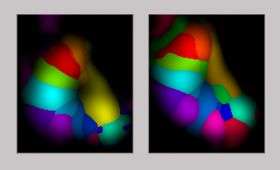
Because a similar thing occurs in the brain: Nerve cells, which are no longer receiving information from their original partner cells are taken over by neighbouring cells, thus compensating, to some extent, for failures. Researchers at the Max Planck Institute of Neurobiology and the Ruhr -Universität Bochum have shown how comprehensively this occurs, even in the adult brain. (Nature Neuroscience, August 31, 2008)
The human brain consists of some hundred billion nerve cells. And this is only the beginning: Each of these cells is connected to its neighbouring cells via 10,000 to 20,000 contacts. Only this highly complex network makes it at all possible to absorb and process impressions and sensations. But what happens in the brain when suddenly no information is forthcoming from one of the sense organs?
This can occur when, for example, an accident destroys the tactile cells in the skin, when hair cells in the ear fall out or when the retina in the eye is damaged. In all of these cases, the nerve cells in the brain, which are responsible for the damaged area, no longer receive any information - they are, so to speak, jobless. Do these cells then wither away?
They most certainly do not, as researchers at the Max Planck Institute of Neurobiology and Ulf Eysel at the Ruhr-Universität Bochum have now reported in the prestigious journal Nature Neuroscience. Because even in the brain, the rule is: Free capacity is not wasted. However, the thoroughness with which the nerve cells take this principle to heart is now amazing scientists.
The researchers have been able to demonstrate that, following a small punctiform lesion of the retina, there is a complete "rewiring" of the nerve cells that were previously responsible for this area. Even after just a few days, the nerve cells, which were now no longer receiving information from "their" retina cells, developed three times as many extensions as neighbouring cells that were not affected. The nerve cells use such extensions to find and contact neighbouring cells that are suitable partners for the exchange of data.
After less than two months, the scientists had reason to marvel at the result of this increased activity: The nerve cells had almost completely replaced their previous contacts, which had been rendered useless by the lesion with new contacts. "It is well known that young brains are adaptable," says Tara Keck about her results, "but the fact that rewiring on this scale occurs in the adult brain as well, took us all by surprise."
This massive restructuring of the cell contacts means that the nerve cells that had been jobless were able to process incoming signals from other parts of the retina, thus making it possible to some extent to compensate for the damage. The unexpected adaptability of the adult brain provides entirely new food for thought about possible regeneration when sense organs are damaged.
Citation: Tara Keck, Thomas D. Mrsic-Flogel, Miguel Vaz Alfonso, Ulf T. Eysel, Tobias Bonhoeffer, Mark Hübener; Massive restructuring of neuronal circuits during functional reorganization of adult visual cortex; Nature Neuroscience, August 31, 2008
Provided by Max Planck Society


