Mars Rover Opportunity Ascends to Level Ground
September 1, 2008
Mars Rover Opportunity Looks Back at Arena of Exploration

Enlarge

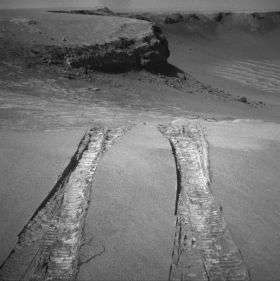
NASA's Mars Exploration Rover Opportunity climbed out of "Victoria Crater" following the tracks it had made when it descended into the 800-meter-diameter (half-mile-diameter) bowl nearly a year earlier. Image credit: NASA/JPL-Caltech

(PhysOrg.com) -- NASA's Mars Exploration Rover Opportunity has climbed out of the large crater that it had been examining from the inside since last September.

"The rover is back on flat ground," an engineer who drives it, Paolo Bellutta of NASA's Jet Propulsion Laboratory, announced to the mission's international team of scientists and engineers.

Opportunity used its own entry tracks from nearly a year ago as the path for a drive of 6.8 meters (22 feet) bringing the rover out over the top of the inner slope and through a sand ripple at the lip of Victoria Crater. The exit drive, conducted late Thursday, completed a series of drives covering 50 meters (164 feet) since the rover team decided about a month ago that it had completed its scientific investigations inside the crater.

"We're headed to the next adventure out on the plains of Meridiani," said JPL's John Callas, project manager for Opportunity and its twin Mars rover, Spirit. "We safely got into the crater, we completed our exploration there, and we safely got out. We were concerned that any wheel failure on our aging rover could have left us trapped inside the crater."

The Opportunity mission has focused on Victoria Crater for more than half of the 55 months since the rover landed in the Meridiani Planum region of equatorial Mars. The crater spans about 800 meters (half a mile) in diameter and reveals rock layers that hold clues to environmental conditions of the area through an extended period when the rocks were formed and altered.

The team selected Victoria as the next major destination after Opportunity exited smaller Endurance Crater in late 2004. The ensuing 22-month traverse to Victoria included stopping for studies along the route and escaping from a sand trap. The rover first reached the rim of Victoria in September 2007. For nearly a year, it then explored partway around the rim, checking for the best entry route and examining from above the rock layers exposed in a series of promontories that punctuate the crater perimeter.

Now that Opportunity has finished exploring Victoria Crater and returned to the surrounding plain, the rover team plans to use tools on the robotic arm in coming months to examine an assortment of cobbles -- rocks about fist-size and larger -- that may have been thrown from impacts that dug craters too distant for Opportunity to reach.

Provided by NASA

4.9 /5 (13 votes)  

Rank 4.9 /5 (13 votes)
Relevant PhysicsForums posts
  • Never ending outer space.....
    created15 hours ago
  • Neutron Star fragments?
    created17 hours ago
  • stationary or not?
    created21 hours ago
  • Scale of the Universe
    createdFeb 10, 2012
  • Titan's lack of impact craters
    createdFeb 09, 2012
  • Real pictures of black hole eating a star?
    createdFeb 08, 2012
  • More from Physics Forums - General Astronomy

More news stories

Salvage workers begin pumping fuel from Italian shipwreck

Salvage workers Sunday began pumping fuel from the shipwrecked Italian cruise liner Costa Concordia, a day ahead of schedule, officials said.

Space & Earth / Environment

created 1 hour ago | popularity not rated yet | comments 0

Latin America mining boom clashes with conservation

Latin America is experiencing a mining boom as prices rise fuelled by a hike in global demand, but the region is also being hit by a wave of violent protests, strikes and rallies by environmentalists.

Space & Earth / Environment

created 9 hours ago | popularity 5 / 5 (1) | comments 1

Political leaders play key role in how worried Americans are by climate change: study

More than extreme weather events and the work of scientists, it is national political leaders who influence how much Americans worry about the threat of climate change, new research finds.

Space & Earth / Environment

created Feb 06, 2012 | popularity 5 / 5 (6) | comments 73

NASA budget will axe Mars deal with Europe: scientists

US President Barack Obama's budget proposal to be submitted next week for 2013 will cut NASA's budget by 20 percent and eliminate a major partnership with Europe on Mars exploration, scientists said Thursday.

Space & Earth / Space Exploration

created Feb 10, 2012 | popularity 5 / 5 (3) | comments 55

Humans may have helped the decline of African rainforests 3000 years ago

(PhysOrg.com) -- Large areas of rainforests in Central Africa mysteriously disappeared over three thousand years ago, to be replaced by savannas. The prevailing theory has been that the cause was a change ...

Space & Earth / Environment

created Feb 10, 2012 | popularity 4.1 / 5 (14) | comments 20 | with audio podcast report


Lab study raises questions over nano-particle impact

Tests involving chickens have raised questions about the impact on health from engineered nano-particles, the ultra-fine grains commonly used in drugs and processed foods, scientists said on Sunday.

Iran blocks email, restricts net access: reports

Iran has further restricted access to the Internet and blocked popular email services for the past few days, in a move a top lawmaker said could "cost the regime dearly," media reports said on Sunday.

Scientists discover molecular secrets of 2,000-year-old Chinese herbal remedy

For roughly two thousand years, Chinese herbalists have treated Malaria using a root extract, commonly known as Chang Shan, from a type of hydrangea that grows in Tibet and Nepal. More recent studies suggest that halofuginone, ...

New method to examine batteries -- MRI from the inside

There is an ever-increasing need for advanced batteries for portable electronics, such as phones, cameras, and music players, but also to power electric vehicles and to facilitate the distribution and storage of energy derived ...

A mitosis mystery solved: How chromosomes align perfectly in a dividing cell

Although the process of mitotic cell division has been studied intensely for more than 50 years, Whitehead Institute researchers have only now solved the mystery of how cells correctly align their chromosomes during symmetric ...

Starve a virus, feed a cure? Findings show how some cells protect themselves against HIV

A protein that protects some of our immune cells from the most common and virulent form of HIV works by starving the virus of the molecular building blocks that it needs to replicate, according to research published online ...