Phoenix Mission Conducting Extended Activities on Mars
September 1st, 2008 Phoenix Mission Conducting Extended Activities on Mars

Enlarge

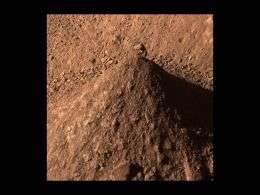
As NASA's Phoenix Mars Lander excavates trenches, it also builds piles with most of the material scooped from the holes. Image NASA/JPL-Caltech/University of Arizona/Texas A&M University

NASA's Phoenix Mars Lander, having completed its 90-day primary mission, is continuing its science collection activities. Science and engineering teams are looking forward to at least another month of Martian exploration.

Due to the spacecraft's sufficient power and experiment capacity, NASA announced on July 31 that the mission would continue operations through Sept. 30. Once the lander finishes collecting science data, the mission teams will continue the analysis of the measurements and observations.

"We have been successful beyond my wildest dreams, and we're not done yet learning from Mars about its secrets," said Peter Smith, Phoenix principal investigator from the University of Arizona, Tucson.

"We are still working to understand the properties and the history of the ice at our landing site on the northern plains of Mars. While the sun has begun to dip below the horizon, we still have power to continue our observations and experiments. And we're hoping to see a gradual change in the Martian weather in the next few weeks," he said.

Among the critical questions the Phoenix science team is trying to answer is whether the northern region of Mars could have been a habitable zone.

Phoenix has already confirmed the presence of water ice, determined the soil is alkaline and identified magnesium, sodium, potassium, chloride and perchlorate in the soil. Chemical analyses continue even as Phoenix's robotic arm reaches out for more samples to sniff and taste.

"It's been gratifying to be able to share the excitement of our exploration with the public through the thousands upon thousands of images that our cameras have taken. They have been available to the public on our web site as soon as they are received on Earth," Smith said. Phoenix's Surface Stereo Imager, Robotic Arm Camera and microscope have returned more than 20,000 pictures since landing day, May 25.

The mission's meteorological instruments have made daily atmospheric readings and have watched as the pressure decreases, signaling a change in the season. At least one ice water cloud has been observed and consistent wind patterns have been recorded over the landing site.

The team is currently working to diagnose an intermittent interference that has become apparent in the path for gases generated by heating a soil sample in the Thermal and Evolved-Gas Analyzer to reach the instrument's mass spectrometer. Vapors from all samples baked to high temperatures have reached the mass spectrometer so far, however data has shown that the gas flow has been erratic, which is puzzling the scientists.

Meanwhile, plans call for Phoenix to widen its deepest trench, called "Stone Soup," to scoop a fresh sample of soil from that depth for analysis in the wet chemistry laboratory of the Microscopy, Electrochemistry and Conductivity Analyzer (MECA). Stone Soup measures about 18 centimeters (7 inches) deep. The first attempt to collect a sample from Stone Soup, on Aug. 26, got 2 to 3 cubic centimeters (half a teaspoon) into the scoop. This was judged to be not quite enough, so delivering a sample was deferred.

In coming days the team also plans to have Phoenix test a revised method for handling a sample rich in water-ice. Two such samples earlier stuck inside the scoop.

Provided by NASA


print this article email this article download pdf blog this article bookmark this article     Digg this Stumble it share on Facebook share on Reddit add to delicious save to Yahoo! bookmarks
4/5 after 12 votes


September 1st, 2008 all stories
Space & Earth / Space Exploration

Comments: 0
Rank: 4/5 after 12 votes

  • Stumble this up

  • Digg this

  • Share it:
  • share on Facebook
  • share on MySpace
  • share on Slashdot
  • rss-newsfeed
  • share on Google
  • share on Reddit
  • add to delicious
  • save to Yahoo! bookmarks
  • share on Windows Live
  • Add to Mixx!
Rating: 4/5 after 12 votes

  • Related Stories

  • Phoenix Gets Bonus Soil Sample
    created Oct 20, 2008 | popularity not rated yet | comments 0
  • Phoenix Mars Lander Digs Deeper as Third Month Nears End
    created Aug 26, 2008 | popularity not rated yet | comments 0
  • Soil Studies Continue at Site of Phoenix Mars Lander
    created Aug 11, 2008 | popularity not rated yet | comments 0
  • Phoenix Mars Lander Working With Sticky Soil
    created Jul 29, 2008 | popularity not rated yet | comments 0
  • Phoenix Rasps Frozen Layer, Collects Sample
    created Jul 16, 2008 | popularity not rated yet | comments 0

Tags

stone soup

  • Physicists Demonstrate Quantum Memory with Matter Qubits
    Physicists Demonstrate Quantum Memory with Matter Qubits
    Physics / General Physics
    created Jul 03, 2009 | popularity 4.4 / 5 (17) | comments 1
  • 'Holey' Nanosheets for Wastewater Dye Removal
    Nanotechnology / Nanomaterials
    created Jul 01, 2009 | popularity 5 / 5 (5) | comments 1
  • Jellyfish Robot Swims Like its Biological Counterpart
    Jellyfish Robot Swims Like its Biological Counterpart
    Electronics / Robotics
    created Jun 26, 2009 | popularity 4.4 / 5 (8) | comments 1
  • Could Maxwell's Demon Exist in Nanoscale Systems?
    Could Maxwell's Demon Exist in Nanoscale Systems?
    Physics / General Physics
    created Jun 24, 2009 | popularity 4.4 / 5 (18) | comments 29
  • Living Safely with Robots, Beyond Asimov's Laws
    Living Safely with Robots, Beyond Asimov's Laws
    Electronics / Robotics
    created Jun 22, 2009 | popularity 4.6 / 5 (54) | comments 40
  • Other News

    Researchers test new 'space Internet' system on International Space Station

    Researchers test new 'space Internet' system on International Space Station

    Space & Earth / Space Exploration

    created 1hour ago | popularity not rated yet | comments 0

    The University of Colorado at Boulder is working with NASA to develop a new communications technology now being tested on the International Space Station, which will extend Earth's Internet into outer space ...


    Space Station Marathon

    Space Station Marathon

    Space & Earth / Space Exploration

    created 1hour ago | popularity not rated yet | comments 0

    The International Space Station (ISS) is about to make a remarkable series of flybys over the United States. Beginning this 4th of July weekend, the station will appear once, twice, and sometimes three times ...


    Proba-2's journey to Russia marks its first step towards space

    Proba-2's journey to Russia marks its first step towards space

    Space & Earth / Space Exploration

    created 1hour ago | popularity not rated yet | comments 0

    (PhysOrg.com) -- Proba-2, one of the smallest satellites ESA has ever built for space, is about to leave its Belgian homeland. Its development and testing complete, the satellite is being packed up for the ...


    China environmental phenomena monitored from space

    Space & Earth / Earth Sciences

    created 4 hours ago | popularity not rated yet | comments 0

    China is in a very seismically active area and has had many catastrophic earthquakes during its history. A joint European-Chinese team is using satellite radar data to monitor ground deformation across major continental faults ...


    California to require sun-blocking car windows

    Space & Earth / Environment

    created 6 hours ago | popularity 2 / 5 (4) | comments 9

    New cars sold in California must include windshields that block or absorb the sun's rays beginning in 2012, the state's Air Resources Board recently ruled.