Stanford's 'autonomous' helicopters teach themselves to fly
September 1, 2008
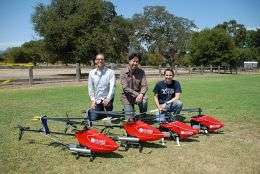
Computer Science Professor Andrew Ng (center) and his graduate students Pieter Abbeel (left) and Adam Coates have developed an artificial intelligence system that enables these helicopters to perform difficult aerobatic stunts on the their own. The “autonomous” helicopters teach themselves to fly by watching the maneuvers of a radio control helicopter flown by a human pilot.
Stanford computer scientists have developed an artificial intelligence system that enables robotic helicopters to teach themselves to fly difficult stunts by watching other helicopters perform the same maneuvers. The result is an autonomous helicopter than can perform a complete airshow of complex tricks on its own.
The stunts are "by far the most difficult aerobatic maneuvers flown by any computer controlled helicopter," said Andrew Ng, the professor directing the research of graduate students Pieter Abbeel, Adam Coates, Timothy Hunter and Morgan Quigley.
The dazzling airshow is an important demonstration of "apprenticeship learning," in which robots learn by observing an expert, rather than by having software engineers peck away at their keyboards in an attempt to write instructions from scratch.
Stanford's artificial intelligence system learned how to fly by "watching" the four-foot-long helicopters flown by expert radio control pilot Garett Oku. "Garett can pick up any helicopter, even ones he's never seen, and go fly amazing aerobatics. So the question for us is always, why can't computers do things like this?" Coates said.
Computers can, it turns out. On a recent morning in an empty field at the edge of campus, Abbeel and Coates sent up one of their helicopters to demonstrate autonomous flight. The aircraft, brightly painted Stanford red, is an off-the-shelf radio control helicopter, with instrumentation added by the researchers.
For five minutes, the chopper, on its own, ran through a dizzying series of stunts beyond the capabilities of a full-scale piloted helicopter and other autonomous remote control helicopters. The artificial-intelligence helicopter performed a smorgasbord of difficult maneuvers: traveling flips, rolls, loops with pirouettes, stall-turns with pirouettes, a knife-edge, an Immelmann, a slapper, an inverted tail slide and a hurricane, described as a "fast backward funnel."
The pièce de résistance may have been the "tic toc," in which the helicopter, while pointed straight up, hovers with a side-to-side motion as if it were the pendulum of an upside down clock.
"I think the range of maneuvers they can do is by far the largest" in the autonomous helicopter field, said Eric Feron, a Georgia Tech aeronautics and astronautics professor who worked on autonomous helicopters while at MIT. "But what's more impressive is the technology that underlies this work. In a way, the machine teaches itself how to do this by watching an expert pilot fly. This is amazing."
Writing software for robotic helicopters is a daunting task, in part because the craft itself, unlike an airplane, is inherently unstable. "The helicopter doesn't want to fly. It always wants to just tip over and crash," said Oku, the pilot.
To scientists, a helicopter in flight is an "unstable system" that comes unglued without constant input. Abbeel compares flying a helicopter to balancing a long pole in the palm of your hand: "If you don't provide feedback, it will crash."
Early on in their research, Abbeel and Coates attempted to write computer code that would specify the commands for the desired trajectory of a helicopter flying a specific maneuver. While this hand-coded approach succeeded with novice-level flips and rolls, it flopped with the complex tic-toc."
It might seem that an autonomous helicopter could fly stunts by simply replaying the exact finger movements of an expert pilot using the joy sticks on the helicopter's remote controller. That approach, however, is doomed to failure because of uncontrollable variables such as gusting winds.
When the Stanford researchers decided their autonomous helicopter should be capable of flying airshow stunts, they realized that even defining their goal was difficult. What's the formal specification for "flying well?" The answer, it turned out, was that "flying well" is whatever an expert radio control pilot does at an airshow.
So the researchers had Oku and other pilots fly entire airshow routines while every movement of the helicopter was recorded. As Oku repeated a maneuver several times, the trajectory of the helicopter inevitably varied slightly with each flight. But the learning algorithms created by Ng's team were able to discern the ideal trajectory the pilot was seeking. Thus the autonomous helicopter learned to fly the routine better—and more consistently—than Oku himself.
During a flight, some of the necessary instrumentation is mounted on the helicopter, some on the ground. Together, they continuously monitor the position, direction, orientation, velocity, acceleration and spin of the helicopter in several dimensions. A ground-based computer crunches the data, makes quick calculations and beams new flight directions to the helicopter via radio 20 times per second.
The helicopter carries accelerometers, gyroscopes and magnetometers, the latter of which use the Earth's magnetic field to figure out which way the helicopter is pointed. The exact location of the craft is tracked either by a GPS receiver on the helicopter or by cameras on the ground. (With a larger helicopter, the entire navigation package could be airborne.)
There is interest in using autonomous helicopters to search for land mines in war-torn areas or to map out the hot spots of California wildfires in real time, allowing firefighters to quickly move toward or away from them. Firefighters now must often act on information that is several hours old, Abbeel said.
"In order for us to trust helicopters in these sort of mission-critical applications, it's important that we have very robust, very reliable helicopter controllers that can fly maybe as well as the best human pilots in the world can," Ng said. Stanford's autonomous helicopters have taken a large step in that direction, he said.
Video: Stanford's robotic helicopter performs stunts
Provided by Stanford University
-
Send in the supplies: RoboCopters in Marines' future
Jan 10, 2012 |
5 / 5 (2) |
0
-
Streamlined rules for robots
Jun 13, 2011 |
5 / 5 (2) |
0
-
Engineering team developing helicopter that would investigate nuclear disasters
Mar 04, 2010 |
5 / 5 (1) |
1
-
Is it a bird, is it a plane? No it's supercopter
Oct 10, 2008 |
4.6 / 5 (9) |
0
-
Self-flying Stanford robocopter learn tricks though observation
Sep 18, 2008 |
4.8 / 5 (11) |
0
-
Engineers build first sub-10-nm carbon nanotube transistor
Feb 01, 2012 |
4.9 / 5 (29) |
30
-
Something old, something new: Evolution and the structural divergence of duplicate genes
Jan 31, 2012 |
4.6 / 5 (7) |
1
-
The hidden nanoworld of ice crystals: Revealing the dynamic behavior of quasi-liquid layers
Jan 30, 2012 |
5 / 5 (3) |
1
-
Stock market network reveals investor clustering
Jan 27, 2012 |
3.9 / 5 (23) |
8
-
Of microchemistry and molecules: Electronic microfluidic device synthesizes biocompatible probes
Jan 26, 2012 |
5 / 5 (1) |
0
-
Synergistic relations between computer science and technology.
Feb 06, 2012
-
how do iphone gloves work?
Feb 05, 2012
-
iPhone battery over time
Jan 30, 2012
-
Best alternate Tablet to an iPad for writing math or physics equations?
Jan 26, 2012
-
Sending SMS to a website
Jan 20, 2012
-
Need help with my technical fest!
Jan 19, 2012
- More from Physics Forums - Computing & Technology
More news stories
Windows 8 preview set for February 29
Microsoft on Wednesday revealed plans to unveil a test version of its latest Windows computer operating software later this month.
7 hours ago |
3.8 / 5 (4) |
5
Solar start-ups set new efficiency records
(PhysOrg.com) -- Although Alta Devices and Semprius make different types of solar panels, both start-ups have been breaking records in the past few days. Santa Clara, Calif.-based Alta Devices announced that ...
Darpa's Legged Squad Support System (LS3) to lighten troops' load
Todays dismounted warfighter can be saddled with more than 100 pounds of gear, resulting in physical strain, fatigue and degraded performance. Reducing the load on dismounted warfighters has become a ...
14 hours ago |
4.8 / 5 (6) |
13
Groupon fails to turn profit as revenue grows
Daily deals site Groupon on Wednesday issued its first earnings report as a publicly traded company, saying it failed to turn a profit despite revenue nearly tripling from a year earlier.
5 hours ago |
not rated yet |
0
Lawsuit seeks to block Google's privacy changes
(AP) -- A consumer watchdog group is suing the Federal Trade Commission in an attempt to prevent Google from making sweeping changes to its privacy policies next month.
5 hours ago |
not rated yet |
0
Astronomy team discovers nearby dwarf galaxy
(PhysOrg.com) -- A team led by UCLA research astronomer Michael Rich has used a unique telescope to discover a previously unknown companion to the nearby galaxy NGC 4449, which is some 12.5 million light years ...
Amasia: As next supercontinent forms, Arctic Ocean, Caribbean will vanish first
(PhysOrg.com) -- Geologists at Yale University have proposed a new theory to describe the formation of supercontinents, the epic process by which Earths major continental blocks combine into a single ...
Why are there so few fish in the Earth's oceans?
(PhysOrg.com) -- A Stony Brook University researcher has found that, contrary to popular belief, there are not plenty of fish in the sea.
Transparent iron? For the first time, an experiment shows that atomic nuclei can become transparent
At the high-brilliance synchrotron light source PETRA III, a team of DESY scientists headed by Dr. Ralf Röhlsberger has succeeded in making atomic nuclei transparent with the help of X-ray light. At the ...
Physicists build highly efficient 'no-waste' laser
A team of University of California, San Diego researchers has built the smallest room-temperature nanolaser to date, as well as an even more startling device: a highly efficient, "thresholdless" laser that ...
Scientists strengthen memory by stimulating key site in brain
Ever gone to the movies and forgotten where you parked the car? New UCLA research may one day help you improve your memory.
Sep 01, 2008
Rank: 3 / 5 (2)
Sep 01, 2008
Rank: not rated yet
If done from the helicopter's point of view this would a wonderful addition to any ground base robot as well.
Sep 02, 2008
Rank: 3 / 5 (2)
Sep 02, 2008
Rank: not rated yet
the article is incomplete without this link...
why publish it like that?
Sep 02, 2008
Rank: 4 / 5 (1)
...why not into a car? It could serve as a driving aid for impaired drivers and maybe reduce the numbers of people killed by drunk drivers!
Sep 02, 2008
Rank: not rated yet
Situation A: a machine follows a certain set of pre-written instructions (a code)
Situation B: a set of transducers transform the movements of an object into coordinates, that are
written as a dataset, transferred to another machine, read by a code that is executed by the machine itself.
The machine in B is not better than the machine in A, and IT'S NOT LEARNING anything, it is just executing the instructions almost simultaneously with the writing machine (the man-run helicopter).
Thinking that they learn is absurd, they have just been well-instructed in a very short time period!
Sep 02, 2008
Rank: 1 / 5 (1)
They could make a movie out of this! Oh, wait...
Sep 02, 2008
Rank: 2 / 5 (1)
I think some of you misunderstood the 'watching' part, there was no camera, the computer 'watched' positions of remote controls (recorded as a set of digital values) as the human pilot was flying.
Sep 02, 2008
Rank: 1 / 5 (1)
Sep 02, 2008
Rank: not rated yet
That isn't quite what the article said: "But the learning algorithms created by Ng's team were able to discern the ideal trajectory the pilot was seeking. Thus the autonomous helicopter learned to fly the routine better%u2014and more consistently%u2014than Oku himself."
I assume also when you said "true AI" you meant an AGI (artificial general intelligence). But I would say that these types of systems more closely resemble autonomous systems/regions within our brain, such as our sense of balance or our ability to create sentences on the fly. We certainly don't calculate these things consciously, indeed, such actions largely arise to the conscious mind fully formed. This seems similar (I completely agree there is no awareness, btw), but I think this completely fits the term AI, though on an extremely low scale (perhaps on a level a little below a fly?).
Sep 02, 2008
Rank: 3 / 5 (1)
If you mean learn and are self-conscious of the learning, I agree with you completely. However, it seems to me that the term "learn" (used in the sense of gaining knowledge previously withheld) fits the outcome the algorithms produced.
Again I refer to this piece of the article:
"But the learning algorithms created by Ng's team were able to discern the ideal trajectory the pilot was seeking. Thus the autonomous helicopter learned to fly the routine better%u2014and more consistently%u2014than Oku himself."
Going by that quote, it appears the algorithms were able to produce unique (through optimization) patterns of movement. A difference in degree, however, not in kind.
Sep 03, 2008
Rank: not rated yet
Its just a simple optimization which is not even done in real time. Basically if you consider it an AI then any algorithm calculating a least square fit to some dataset would also qualify as AI. (http://en.wikiped...squares)
I didn't mean general AI, I meant regular one as in http://en.wikiped...lligence
This definition is a bit lacking in my mind as a simple washing machine (which perceives input water temperature and its progress through the washing program and makes decisions on this data so as to maximize its chances of success - accomplishing the washing program specifications) or any other piece of electronic qualifies unless we consider that the actions have a certain level of sophistication and autonomy.
In my mind the helicopter would qualify as a true AI if you could tell it where to fly and it would pick the best route on its own, flying between buildings avoiding trees, electric cables and other obstacles.
It would also qualify if it made some other autonomous decisions based on its environment which went beyond calculating simple corrections for wind and such factors to the prerecorded flightpath. The main problem I have with it being called AI is that the flight is PRERECORDED and simply played back.
It would qualify as an AI if it could run the routine in a new, challenging, never before encountered environment - a sort of 3D maze for example. If it were able to decide in real time whether there is enough room for a given trick and if not where to fly to have enough room it would qualify as a true AI (the maze should be restricted vertically so simply going higher wouldn't suffice as that would make it trivial).
I think such an AI is the ultimate goal of the team described in this article and others in the field, they simply aren't there yet but its just a matter of time.
A "general AI" (as defined on the wiki page) is a completely different matter.
Sep 03, 2008
Rank: not rated yet
If 'true AI' doesn't mean AGI (which you said that isn't what you meant) but instead a level of real-world problem solving skill, we still only differ in level of complexity. I still consider it 'true' AI because it is 'a system that perceives its environment and takes actions which maximize its chances of success.' (from the wiki article) It is merely a very basic one.
Ah well, chalk it up to different interpretations.
Oct 09, 2008
Rank: not rated yet
http://www.heline...ion.com/