Directing a driver's gaze results in smoother steering
September 2, 2008 Tangent Point

Enlarge

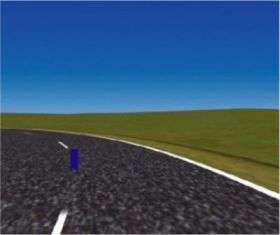
This video frame shows the blue target bar positioned on the tangent point -- the point at which the edge line on a road seems to begin changing direction -- as the road curves to the left. Credit: Journal of Vision 2008

A study recently published in ARVO's online Journal of Vision may inform the next generation of in-car driving assistance systems. New research finds that when drivers fix their gaze on specific targets placed strategically along a curve, their steering is smoother and more stable than it is in normal conditions.

Typically, drivers gaze along a curve as they negotiate it, but they also look at other parts of the road, the dashboard, traffic signs and oncoming vehicles. A new study finds that when drivers fix their gaze on specific targets placed strategically along a curve, their steering is smoother and more stable than it is in normal conditions.

The study, "Driving around bends with manipulated eye-steering coordination" was recently published in the online Journal of Vision (www.journalofvision.org/8/11/10" target="_blank">http://www.journalofvision.org/8/11/10">www.journalofvision.org/8/11/10), a peer-reviewed publication from the Association for Research in Vision and Ophthalmology.

"This work may be relevant for the design of visual driving assistance systems," explains author Franck Mars, PhD, of the Institut de Recherche en Communications et Cybernétique de Nantes (IRCCyN), Nantes, France.

"Indeed, the next generation of head-up displays in cars will offer the opportunity for a driving aid that offers a wide field of view and highlights key features in the visual scene," adds Dr. Mars. "This study may help answer the question of which visual cues should be made available in such displays."

The experiment included 13 drivers who drove a simulator vehicle while looking at a large screen displaying a roadway featuring a series of curves. The focus and direction of each driver's gaze was monitored and recorded.

In a series of control and test trials, researchers had drivers steer around the simulated course while fixing their gaze on a small blue bar.

The blue bar represents the tangent point — the point where, from the driver's viewpoint, the inside edge line seems to begin to change direction as it outlines the curve.

The results revealed that the ?xation targets helped the driver improve the stability of steering control.

This study suggests that indicating a point along the oncoming road in the vicinity of the tangent point may be a simple and efficient way to make vehicle control easier.

Source: Association for Research in Vision and Ophthalmology


Rate this story - 5 /5 (1 vote)


September 2, 2008 all stories

Comments: 0

5 /5 (1 vote)

  • hide
  • Related Stories

  • Watching me, watching you
    created Oct 21, 2009 | popularity not rated yet | comments 0
  • Cognitive scientists use eye-tracking technology to learn what makes a great geologist
    created Aug 27, 2009 | popularity not rated yet | comments 0
  • New study suggests the brain predicts what eyes in motion will see
    created Aug 25, 2009 | popularity not rated yet | comments 0
  • Vision researchers see unexpected gain a year into blindness trial
    created Aug 12, 2009 | popularity not rated yet | comments 0
  • Exploring the Moon, Discovering Earth
    created Jul 20, 2009 | popularity not rated yet | comments 0


  • hide
  • Relevant PhysicsForums posts

Other News

Whooping cough vaccine may be losing its punch: study

Medicine & Health / Diseases

created 34 minutes ago | popularity not rated yet | comments 0

(PhysOrg.com) -- Vaccination programs against whooping cough may not be fully effective because the bacteria that cause the disease have evolved new strains, a new study has found. A team of Australian scientists has ...


IQ among strongest predictors of cardiovascular disease -- second only to cigarette smoking

Medicine & Health / Health

created 3 hours ago | popularity not rated yet | comments 6 | with audio podcast

as reflected by low results on written or oral tests of IQ - have been associated with a raised risk of cardiovascular disease, no study has so far compared the relative strength of this association with other established ...


Communication breakdown: What happens to nerve cells in Parkinson's disease

Medicine & Health / Neuroscience

created 3 hours ago | popularity not rated yet | comments 0 | with audio podcast

A new study from The Montreal Neurological Institute and Hospital - The Neuro - at McGill University is the first to discover a molecular link between Parkinson's disease and defects in the ability of nerve cells to communicate. ...


A common cholesterol drug fights cataracts, too

Medicine & Health / Medications

created 2 hours ago | popularity not rated yet | comments 1

Statins, a class of drugs used to lower cholesterol levels, have been successfully fighting heart disease for years. A new study from Tel Aviv University has now found that the same drugs cut the risks of cataracts in men ...


Changes proposed in how psychiatrists diagnose

Medicine & Health / Psychology & Psychiatry

created 2 hours ago | popularity not rated yet | comments 0

(AP) -- Don't say "mental retardation" - the new term is "intellectual disability." No more diagnoses of Asperger's syndrome - call it a mild version of autism instead. And while "behavioral addictions" will be new to doctors' ...