The thousand-ruby galaxy
September 2, 2008 The thousand-ruby galaxy

Enlarge

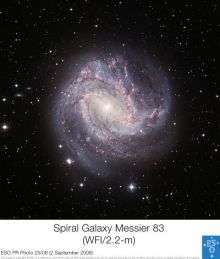
Color-composite image of the startling spiral galaxy Messier 83, made using data from the Wide Field Imager on the ESO/MPG 2.2-m telescope at La Silla. The WFI stared at M83 for four periods of 25 minutes through different filters (B, V, R, Halpha). The data were extracted from the ESO Science Archive and processed by Davide De Martin. The field of view covered by the image is about 17 x 17 arcmin. Credit: ESO

ESO's Wide Field Imager has captured the intricate swirls of the spiral galaxy Messier 83, a smaller look-alike of our own Milky Way. Shining with the light of billions of stars and the ruby red glow of hydrogen gas, it is a beautiful example of a barred spiral galaxy, whose shape has led to it being nicknamed the Southern Pinwheel.

This dramatic image of the galaxy Messier 83 was captured by the Wide Field Imager at ESO's La Silla Observatory, located high in the dry desert mountains of the Chilean Atacama Desert. Messier 83 lies roughly 15 million light-years away towards the huge southern constellation of Hydra (the sea serpent).

It stretches over 40 000 light-years, making it roughly 2.5 times smaller than our own Milky Way. However, in some respects, Messier 83 is quite similar to our own galaxy. Both the Milky Way and Messier 83 possess a bar across their galactic nucleus, the dense spherical conglomeration of stars seen at the centre of the galaxies.

This very detailed image shows the spiral arms of Messier 83 adorned by countless bright flourishes of ruby red light. These are in fact huge clouds of glowing hydrogen gas. Ultraviolet radiation from newly born, massive stars is ionising the gas in these clouds, causing the great regions of hydrogen to glow red. These star forming regions are contrasted dramatically in this image against the ethereal glow of older yellow stars near the galaxy's central hub. The image also shows the delicate tracery of dark and winding dust streams weaving throughout the arms of the galaxy.

Messier 83 was discovered by the French astronomer Nicolas Louis de Lacaille in the mid 18th century. Decades later it was listed in the famous catalogue of deep sky objects compiled by another French astronomer and famous comet hunter, Charles Messier. Recent observations of this enigmatic galaxy in ultraviolet light and radio waves have shown that even its outer desolate regions (farther out than those seen in this image) are populated with baby stars.

X-ray observations of the heart of Messier 83 have shown that its centre is a hive of vigorous star formation, held deep within a cloud of superheated gas, with temperatures of 7 million degrees Celsius. Messier 83 is also one of the most prolific producers of supernovae, that is, exploding stars: this is one of the two galaxies, which had 6 supernovae in the past 100 years. One of these, SN 1957D was observable for 30 years!

The Wide Field Imager (WFI) is a specialised astronomical camera attached to the 2.2-metre Max-Planck Society/ESO telescope, sited at the La Silla observatory in Chile. Located nearly 2400 m above sea level, atop the mountains of the Atacama Desert, ESO's La Silla enjoys some of the clearest and darkest skies on the whole planet, making the site ideally suited for studying the farthest depths of the Universe.

To make this image, the WFI stared at M83 for roughly 100 minutes through a series of specialist filters, allowing the faint detail of the galaxy to reveal itself. The brighter stars in the foreground are stars in our own galaxy, whilst behind M83 the darkness is peppered with the faint smudges of distant galaxies.

Source: ESO


print this article email this article download pdf blog this article bookmark this article     Stumble it Digg this share on Facebook retweet share on Reddit add to delicious
Rate this story - 4.5 /5 (25 votes)

Rank Filter

Move the slider to adjust rank threshold, so that you can hide some of the comments.


Display comments: newest first


September 2, 2008 all stories

Comments: 1

4.5 /5 (25 votes)
  • Stumble this up

  • Digg this

  • share this

  • hide
  • Related Stories

  • The Ring Nebula
    created Nov 02, 2009 | popularity not rated yet | comments 0
  • Herschel first images promise bright future
    created Jul 10, 2009 | popularity not rated yet | comments 0
  • Herschel Opens Its Infrared Eyes
    created Jun 29, 2009 | popularity not rated yet | comments 0
  • Giant galaxy Messier 87 finally sized up
    created May 20, 2009 | popularity not rated yet | comments 0
  • Globular clusters tell tale of star formation in nearby galaxy metropolis
    created Aug 05, 2008 | popularity not rated yet | comments 0


  • hide
  • Relevant PhysicsForums posts

Other News

New computer-developed map shows more extensive valley network on Mars

New computer-developed map shows more extensive valley network on Mars

Space & Earth / Space Exploration

created 6 hours ago | popularity 4.5 / 5 (4) | comments 0

New research adds to the growing body of evidence suggesting the Red Planet once had an ocean.


Supervolcano eruption -- in Sumatra -- deforested India 73,000 years ago

Supervolcano eruption -- in Sumatra -- deforested India 73,000 years ago

Space & Earth / Earth Sciences

created 8 hours ago | popularity 4 / 5 (6) | comments 1

A new study provides "incontrovertible evidence" that the volcanic super-eruption of Toba on the island of Sumatra about 73,000 years ago deforested much of central India, some 3,000 miles from the epicenter, ...


Spitzer Telescope Observes Baby Brown Dwarf

Spitzer Telescope Observes Baby Brown Dwarf

Space & Earth / Astronomy

created 5 hours ago | popularity 4.8 / 5 (5) | comments 0

(PhysOrg.com) -- NASA's Spitzer Space Telescope has contributed to the discovery of the youngest brown dwarf ever observed -- a finding that, if confirmed, may solve an astronomical mystery about how these ...


Is global warming unstoppable?

Space & Earth / Environment

created 17 hours ago | popularity 3.9 / 5 (22) | comments 21

In a provocative new study, a University of Utah scientist argues that rising carbon dioxide emissions - the major cause of global warming - cannot be stabilized unless the world's economy collapses or society builds the ...


The Crab Nebula: A Cosmic Icon

The Crab Nebula: Energy for 100,000 Suns

Space & Earth / Astronomy

created 5 hours ago | popularity 4.7 / 5 (3) | comments 0

(PhysOrg.com) -- A star's spectacular death in the constellation Taurus was observed on Earth as the supernova of 1054 A.D.