New stem cell tools to aid drug development
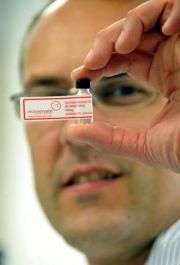
SCIENTISTS have designed, developed and tested new molecular tools for stem cell research to direct the formation of certain tissue types for use in drug development programmes.
A collaborative team of scientists from Durham University and the North East England Stem Cell Institute (NESCI) have developed two synthetic molecules which can be used to coax stem cells to 'differentiate' - that is, transform into other forms of tissue.
Their use could also help reduce the number of animals used in laboratory research.
The team's results are published in the current issue of the scientific journal, Organic and Biomolecular Chemistry.
The new molecules, called EC23 and EC19*, have been found in robust scientific tests to be far more stable than the naturally-occurring molecule currently used to induce stem cells to differentiate in the laboratory, known as All-trans-retinoic Acid (ATRA). Their use will thus improve the reliability of experiments.
The scientists, who tested the effectiveness of EC23 and EC19 on four types of stem cells, say it is also significant that each individual synthetic molecule has been found to be more effective at causing the cells to transform into specific types of tissue.
For example, EC23 was found to be particularly effective at producing neurons (nerve cells) which can be used in laboratory testing for drugs for brain disorders such as Alzheimer's Disease and Parkinson's Disease.
In contrast, EC19 was found to be particularly effective at producing epithelial cells – the cells that line the inner and outer surfaces of the body.
Stem cells are a special type of cell that has the ability to renew other cells in the body. One of the challenges facing stem cell scientists is to find out how these may be re-programmed to become different tissue types.
The team consisted of synthetic chemists, Dr Andrew Whiting and Professor Todd Marder and stem cell biologist, Dr Stefan Przyborski and their research groups at Durham University, who are all members of the North East England Stem Cell Institute (NESCI). They also worked with spin-out company Reinnervate; local SME, High Force Research Ltd and Newcastle University.
Dr Przyborski said: "The key thing about these synthetic molecules is that they remain stable and are exactly the same every time you use them, ensuring more reliable scientific experiments compared to those which use ATRA. Because the results will be more scientifically robust, this will accelerate drug development using human stem cell-derived tissues and potentially reduce the numbers of animals used in such research"
"Another significant characteristic of these synthetic molecules is that they direct stem cells down specific pathways, meaning that they, individually, will be useful for very specific types of drug development work. EC23, for example, produces almost 40 per cent more neurons than ATRA."
Dr Whiting said: "We've set out to make stable mimics of natural compounds which control cell development, but in this case, not only have we uncovered a compound which is not only stable and does what the natural system does, but it actually seems to be better as well. It's a real bonus and shows the validity of the approach."
Dr Przyborski, who is also Director and Chief Scientific Officer of spin-out company Reinnervate Limited, is currently marketing EC23 through Reinnervate. He said the results showed that synthetic retinoids EC23 and EC19 could be used to replace All-trans-retinoic acid (ATRA).
ATRA is sensitive to light, heat and air, and exposure to light especially causes it to degrade rapidly, meaning scientists are never sure exactly what concentration or what mixture of isomers they are working with.
The experiments on EC23 and EC19, which included highly detailed analysis by Nuclear Magnetic Resonance (NMR) showed that these synthetic molecules were not sensitive to light and therefore did not degrade.
The scientists are now developing a 'molecular toolkit' of synthetic compounds which are tailor made for specific stem cell and drug development work.
The project was funded in part by Reinnervate, the regional development agency, One NorthEast, Durham University, High Force Research Ltd., NESCI, and by research councils the MRC, EPSRC, BBSRC.
The close collaboration between chemists and biologists is critical to achieving this type of breakthrough.
Via a related collaboration with Durham University polymer chemist, Professor Neil Cameron, Reinnervate is also marketing a unique plastic scaffold to drug developers, which allows stem cells and other tissue to be grown in the laboratory in conditions similar to the way they grow in the human body. Extensive tests have shown the technology is a cheap and straightforward way of cultivating cells in three-dimensional forms.
* In the scientific paper, EC23 and EC19 are referred to as 4a and 4b respectively.
Source: Durham University


