Next stop: The fourth dimension
September 3, 2008 Next stop: The fourth dimension

Enlarge

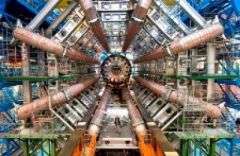
The Atlas experiment under construction at the LHC site, deep beneath the Alps. The large tubes that surround the empty space are magnets used to control the direction of subatomic particles. Credit: AFTAU

How did the universe come to be? What is it made of? What is mass? Can science prove that there are other dimensions? We may have answers soon.

On September 10, 2008, Tel Aviv University's Prof. Erez Etzion from the School of Physics and Astronomy will be in the control room of the new CERN Large Hadron Collider (LHC) on the border of France and Switzerland when the LHC is first turned on. Scientists are calling it the largest experiment in the world. It's taken about 6,000 researchers, $8 billion and ten years to build.

Of the 50 countries that have participated in the project, Israel is among those which have made the greatest contributions. Tel Aviv University in particular has played an essential role in constructing equipment for the collider tunnel, dug deep inside the Swiss-French Alps. And when the switch is thrown in September, science may be changed forever.

Prof. Etzion, an experimental physicist in high-energy research, expects the impact of the LHC to be greater than that of the first moon landing. "It is hard to grasp the dimensions of the practical benefits from this project," he says, "but we're expecting to explore the basic forces that hold the world together."

Getting to the Heart of the Matter

If all goes according to plan, the superconducting magnets in the collider will zap atomic particles around the 17-mile tunnel at roughly the speed of light. Then the scientists will smash the particles together, replicating what happened mere nanoseconds after the first big bang.

Prof. Etzion participated in the design and construction of the trigger chambers for ATLAS, one of the two main detectors in the collider. This critical piece of machinery will decide what online data to record ― and what data to discard ― from the 1 billion atomic collisions per second. There is no storage disk space in the universe big enough to hold all the data, says Prof. Etzion, making this detector a key component in the success of the LHC.

May The "Z*" Be With You

Prof. Etzion will be watching closely to see what happens to proton beams colliding at super speeds. While invisible particles are expected to leave a trace like a watermark after they collide, he believes that some particles will escape detection, possibly travelling to other dimensions.

This is an exotic theory, Prof. Etzion admits, but one which may explain why the force of gravity appears to be so weak. "It could be that while all the matter we know is trapped in three space dimensions, a gravity carrier can move into additional dimensions, resulting in a diluted gravitational force", he says, noting he and his colleagues will be looking for particles delivered by a force carrier called the "Z*" or "zee star." The physicists hypothesize that the Z* may be able to move between our own three-dimensional world and other hidden dimensions.

The notion of new dimensions is stranger than science fiction, though the possibility of their existence is quite real. Prof. Etzion believes that other dimensions may exist in parallel to ours, but that ― until now ― they were too small for us to experimentally detect. "For the first time we will reach a new energy scale in our lab, the Tera electron volt regime, and we expect to discover new phenomena there," he says. "At such high energies, we may be able to stimulate particles to jump through dimensions and can measure this by the disappearance of mass or energy, or the appearance of new excited state towers of particles."

Hanging by a Vibrating String

Prof. Etzion's research falls within a branch of theoretical physics known as string theory. The theory posits that all matter is made up of vibrating strings of energy, suggesting six or more dimensions we cannot see affect everything we do and see. It is an appealing model to physicists, since it offers mathematical solutions to the major unanswered questions in particle physics.

This September, physicists around the world will be on the edges of their seats to see what happens when the first beam is circulated through the collider. The first high-energy collisions are expected to take place in October 2008.

Source: American Friends of Tel Aviv University


print this article email this article download pdf blog this article bookmark this article     Stumble it Digg this share on Facebook retweet share on Reddit add to delicious
Rate this story - 4.4 /5 (69 votes)

Rank Filter

Move the slider to adjust rank threshold, so that you can hide some of the comments.


Display comments: newest first

  • robbycoats - Sep 03, 2008
    • Rank: 5 / 5 (4)
    hooray for physics
  • SmartK8 - Sep 03, 2008
    • Rank: 4 / 5 (8)
    Ok, I'll prepare my Executioner's Justice axe just in case the hordes of evil will flow thru the newly created portal in Switzerland.
  • NeilFarbstein - Sep 03, 2008
    • Rank: 1.7 / 5 (9)
    Just when the scientists at CERN had us convinced that an out of control black hole was impossible Etzion's theory makes me unsure. They variable gravitational force he has posited raises the possibility that micro-black holes might shift gravity into high gear in the fourth dimension and they might swallow up the earth when the gravity they produce intensifies to levels way beyond those we would normally expect. This is a lot more serious than silly raps songs the CERN people put on you tube.
  • wawadave - Sep 04, 2008
    • Rank: 1.7 / 5 (3)
    The inter dimensional gravity waves could set the cosmos arocking. But the time waves will definitely be a conCern to all...
  • Amanullah - Sep 04, 2008
    • Rank: 2.8 / 5 (4)
    I'll have my BFG 9000 ready.
  • kniedzius - Sep 04, 2008
    • Rank: 2.8 / 5 (5)
    I hope we will be able to travel to other dimensions in the near future. Just imagine the endless vacation possibilities!
  • Alizee - Sep 06, 2008
    • Rank: 1 / 5 (2)
    The LHC isn't needed for proof of existence of hidden dimensions. There is a lot of evidences, the vacuum behaves like multidimensional system, for example the 720 deg symmetry of electron/photon spins, Casimir force/distance relationship, Lamb shift, etc.
  • dconine - Sep 07, 2008
    • Rank: 1 / 5 (1)
    Gravity is simply an artifact of the electromagnetic forces which maintain the integrity of mass.
    All this money is being wasted to entertain us.
    Someone already knows these answers, and 'they ain't tellin' us'.
    Frankly, I can't blame them.

September 3, 2008 all stories

Comments: 8

4.4 /5 (69 votes)
  • Stumble this up

  • Digg this

  • share this

  • hide
  • Related Stories

  • Researchers find new route to nano self-assembly
    created Oct 22, 2009 | popularity not rated yet | comments 0
  • INL, ISU team on nanoparticle production breakthrough
    created Oct 19, 2009 | popularity not rated yet | comments 0
  • Physicist wins Packard Fellowship
    created Oct 16, 2009 | popularity not rated yet | comments 0
  • Physicists discover novel electronic properties in two-dimensional carbon structure
    created Oct 14, 2009 | popularity not rated yet | comments 0
  • Radiation-Hardened Microelectronics Could Reduce Spacecraft Weight
    created Sep 28, 2009 | popularity not rated yet | comments 0


  • hide
  • Relevant PhysicsForums posts

  • Bodies in motion…..
    created 1hour ago
  • Refraction optics help
    created 1hour ago
  • A basketball Jump Shot
    created 1hour ago
  • help with accelerometer
    created 3 hours ago
  • Young's Double Slit - Fringe Width
    created 8 hours ago
  • Pressure exerted by a liquid is different to gas?
    created 8 hours ago
  • More from Physics Forums - General Physics

Other News

The LHC tunnel

Peckish bird briefly downs big atom smasher

Physics / General Physics

created 11 hours ago | popularity 3.8 / 5 (9) | comments 11

A peckish bird briefly knocked out part of the world's biggest atom smasher by causing a chain reaction with a piece of bread, the European Organisation for Nuclear Research (CERN) said Monday.


First Bose-Einstein condensation of strontium

First Bose-Einstein condensation of strontium

Physics / Quantum Physics

created 4 hours ago | popularity 5 / 5 (4) | comments 1

In an international first, scientists from the Institute of Quantum Optics and Quantum Information (IQOQI, Austria) produced a Bose-Einstein condensate of the alkaline-earth element strontium, thus narrowly ...


Ginzburg helped develop the Soviet Union's hydrogen bomb in the late 1940s and early 1950s

Russian bomb physicist Ginzburg dead at 93

Physics / General Physics

created 13 hours ago | popularity 5 / 5 (4) | comments 0

Nobel Physics prize winner Vitaly Ginzburg, who helped develop the Soviet hydrogen bomb, has died at age 93, the Russian Academy of Sciences said Monday.


Plasma-in-a-bag for sterilizing devices

Physics / General Physics

created 2 hours ago | popularity not rated yet | comments 0

The practice of sterilizing medical tools and devices helped revolutionize health care in the 19th century because it dramatically reduced infections associated with surgery. Through the years, numerous ways of sterilization ...


Stars Fueled by Dark Matter Could Hold Secrets to the Universe

Stars Fueled by Dark Matter Could Hold Secrets to the Universe

Physics / General Physics

created Nov 03, 2009 | popularity 4.5 / 5 (52) | comments 43

(PhysOrg.com) -- The first stars in the universe may have been very different from the stars we see today, yet they may hold clues to understanding some of the mysterious features of the universe. These "dark ...