Warmer seas linked to strengthening hurricanes
September 3, 2008
Hurricane

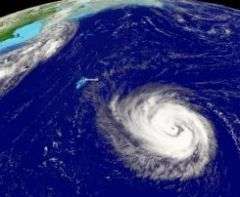
The theory that global warming may be contributing to stronger hurricanes in the Atlantic over the past 30 years is bolstered by a new study led by a Florida State University researcher. The study will be published in the Sept. 4 edition of the journal Nature.

Using global satellite data, FSU geography Professor James B. Elsner, University of Wisconsin-Madison Professor James P. Kossin and FSU postdoctoral researcher Thomas H. Jagger found that the strongest tropical cyclones are, in fact, getting stronger -- and that ocean temperatures play a role in driving this trend. This is consistent with the "heat-engine" theory of cyclone intensity.

"As seas warm, the ocean has more energy that can be converted to tropical cyclone wind," Elsner said. "Our results do not prove the heat-engine theory. We just show that the data are quite consistent with it."

Kerry Emanuel of the Massachusetts Institute of Technology first suggested the possible connection between global warming and increases in tropical cyclone intensity in a 2005 paper. He linked the increased intensity of storms to the heating of the oceans, which has been attributed to global warming.

Critics argued that the data were not reliable enough to make assertions about the relationship between climate change and hurricanes. Moreover, when scientists looked at the mean tropical cyclone statistics, they did not see an upward trend.

Elsner's team addressed both issues by using globally consistent, satellite-derived tropical cyclone wind speeds as opposed to the observational record and by focusing on the highest wind speeds of the strongest tropical cyclones each year.

Emanuel's theory is that the intake of warm air near the ocean surface and the exhaust of colder air above the cyclone is what drives a hurricane. Other factors being equal, the warmer the ocean, the warmer the intake of air. This heat-engine theory of how hurricanes increase their intensity is well accepted, but there are many environmental factors, such as wind shear, that might prevent a hurricane from strengthening, Elsner said.

To address that problem, Elsner's team looked at a subset of hurricanes that are closest to their maximum possible intensity (MPI). Under the heat-engine theory, every storm will lose some energy through inefficiency, and that loss will limit the storm's potential. The MPI represents the storm's maximum potential under ideal environmental conditions.

"We speculated that you might not see a trend in the intensity of typical hurricanes due to environmental factors, but if the heat-engine theory is correct, you should see a trend in the intensity of hurricanes at or near their MPI," Elsner said. "On average, the strongest storms are closest to their MPI."

The researchers created a data set from satellite observations of hurricane intensity of all tropical cyclones around the globe and looked at the maximum wind speeds for each one during a 25-year period. Tropical cyclones, which include hurricanes, typhoons and tropical storms, occur on average about 90 times per year worldwide.

The researchers found that the strongest tropical cyclones are getting stronger, particularly over the North Atlantic and Indian oceans. Wind speeds for the strongest tropical storms increased from an average of 140 mph in 1981 to 156 mph in 2006, while the ocean temperature, averaged globally over the all regions where tropical cyclones form, increased from 28.2 degrees Celsius to 28.5 degrees Celsius during this period.

"By creating a better, more consistent historical data set, we've been able to weed out quality issues that introduce a lot of uncertainty," Kossin said. "Then, by looking only at the strongest tropical cyclones, where the relationship between storms and climate is most pronounced, we are able to observe the increasing trends in storm intensity that both the theory and models say should be there."

While Elsner said the heat-engine theory might explain how tropical cyclones intensify given that everything else is the same, he noted, "We still do not have a complete understanding of why some cyclones intensify, sometimes quite rapidly, and others don't."

Source: Florida State University

3.5 /5 (31 votes)  

Filter


Move the slider to adjust rank threshold, so that you can hide some of the comments.


Display comments: newest first

MikeB
Sep 03, 2008

Rank: 3 / 5 (12)
"Kerry Emanuel of the Massachusetts Institute of Technology first suggested the possible connection between global warming and increases in tropical cyclone intensity in a 2005 paper."

Read about Kerry Emanuel of MIT thinks now:

http://wind.mit.e...hro2.htm
Velanarris
Sep 03, 2008

Rank: 2.8 / 5 (11)
"Kerry Emanuel of the Massachusetts Institute of Technology first suggested the possible connection between global warming and increases in tropical cyclone intensity in a 2005 paper."

Read about Kerry Emanuel of MIT thinks now:

http://wind.mit.e...hro2.htm


Especially seeing as hurricane activity has strengthened in neither intensity nor frequency over the past 30 years.
agg
Sep 03, 2008

Rank: 3.3 / 5 (12)

No mention of the measurement methods which the data spans. For instance, satellites are te primary method of measuring hurrican activity with actual flights into the hurricane as secondary measurements (but important for wind speeds). It's not hard to imagine how much room for error there is in measuring hurricane activity, and how much variation in measurement practice there has been in the time span of this study, but they don't seem to be talking about that.

Here's the point: If I take a position on something I want to investigate ( a bias if you will ) and the data I analyse is inhomgeneous and fraught with difficulty, it would be quite easy to project my bias on the data.

Unfortunately there are quite few who are taking a critical eye toward this, and why should they? It doesn't pay to criticize the anthropogenic global warming crowd since they are playing politics.
Velanarris
Sep 03, 2008

Rank: 2.9 / 5 (10)

It doesn't pay to criticize the anthropogenic global warming crowd since they are playing politics.


You forgot one part.

They are playing politics...

with our money.
barakn
Sep 04, 2008

Rank: 2.5 / 5 (13)
I think it's fascinating how many people rated MikeB's post highly. The vast majority of his post was a quote from the article they just read and a broken link. It doesn't take much to please people, I suppose.
MikeB
Sep 04, 2008

Rank: 3.3 / 5 (7)
The link was working wnen I posted it. Try this one.

http://canadafree...cle/4755
MikeB
Sep 04, 2008

Rank: 3.7 / 5 (9)
I just checked the first link (you are correct it doesn't work)and am reposting it.

http://wind.mit.e...hro2.htm

Excalibur
Sep 04, 2008

Rank: 3.8 / 5 (8)
I think it's fascinating how many people rated MikeB's post highly. The vast majority of his post was a quote from the article they just read and a broken link. It doesn't take much to please people, I suppose.
Yes, it is indeed a sad commentary on the intellectual bent of those who are the most vocal.

They would do well to heed Abraham Lincoln's adage that "It is better to remain silent, and be thought the fool, than speak and remove all doubt."
MikeB
Sep 04, 2008

Rank: 3.7 / 5 (6)


"Talk sense to a fool and he calls YOU foolish."
Euripides (484 BC - 406 BC)
MikeB
Sep 04, 2008

Rank: 2.7 / 5 (7)
A quotation that seems apropos relating to the "we can solve it" crowd.

"The fact that an opinion has been widely held is no evidence whatever that it is not utterly absurd; indeed in view of the silliness of the majority of mankind, a widespread belief is more likely to be foolish than sensible."
Bertrand Russell (1872 - 1970)

And here is one for Computer Climate Models.

"If you put tomfoolery into a computer, nothing comes out of it but tomfoolery. But this tomfoolery, having passed through a very expensive machine, is somehow ennobled and no-one dares criticize it."
Pierre Gallois
superhuman
Sep 07, 2008

Rank: 2.9 / 5 (7)
"Kerry Emanuel of the Massachusetts Institute of Technology first suggested the possible connection between global warming and increases in tropical cyclone intensity in a 2005 paper."

Read about Kerry Emanuel of MIT thinks now:

http://wind.mit.e...hro2.htm


http://wind.mit.e...hro2.htm
(If you put a link in your post and then edit it the link will be broken)

Looks like nothing changed in his views, he is still a cautious supporter of global warming as a reason for increased average energy of hurricanes in general and an increase in frequency of hurricanes in northern Atlantic.

His position looks pretty solid.

"Talk sense to a fool and he calls YOU foolish." Euripides (484 BC - 406 BC)


No need to quote dates, it shows google was involved.
Velanarris
Sep 08, 2008

Rank: 3 / 5 (8)
"Kerry Emanuel of the Massachusetts Institute of Technology first suggested the possible connection between global warming and increases in tropical cyclone intensity in a 2005 paper."

Read about Kerry Emanuel of MIT thinks now:

http://wind.mit.e...hro2.htm


http://wind.mit.e...hro2.htm
(If you put a link in your post and then edit it the link will be broken)

Looks like nothing changed in his views, he is still a cautious supporter of global warming as a reason for increased average energy of hurricanes in general and an increase in frequency of hurricanes in northern Atlantic.

His position looks pretty solid.
There is actually a marked decrease in frequency of hurricanes in the Atlantic. Typically we'd expect to see between 10 and 13 hurricane force storms in the season, lately we've been seeing around 8 or 9 that actually reach hurricane strength.

That and I recall reading that monsoon activity was down in intensity and regularity. If both of these hold true then it's more a shift in atmospheric energy than an increase.
superhuman
Sep 11, 2008

Rank: 5 / 5 (2)
There is actually a marked decrease in frequency of hurricanes in the Atlantic. Typically we'd expect to see between 10 and 13 hurricane force storms in the season, lately we've been seeing around 8 or 9 that actually reach hurricane strength.

That and I recall reading that monsoon activity was down in intensity and regularity. If both of these hold true then it's more a shift in atmospheric energy than an increase.


"Frequency of Atlantic Hurricanes Doubled During Last Century"
http://www.nsf.go...d=109701&org=GEO

Start backing your claims with links to relevant reports or data, your word alone is not enough.
Velanarris
Sep 24, 2008

Rank: 1 / 5 (4)
From the Nov 02 Journal of Climate

"The detection of a trend in hurricane activity in the North Atlantic basin has been restricted by the incompleteness of the record prior to 1946. In an earlier paper, the complete record of U.S. landfalling hurricanes was used to extend the period of analysis back to 1930. In this paper, a further extension is made back to 1900. In doing so, the assumption in the earlier paper of an exponential linear trend is relaxed and the trend is estimated nonparametrically. The results show no significant trend in basinwide hurricane activity over the period 1900-98."

Your study can't be factually accurate.
superhuman
Sep 25, 2008

Rank: 5 / 5 (2)
The one I cited is from 2007, national academy of science, yours is from 2002, if you have 2 conflicting results the newest one takes precedence. Besides those 5 years missing from your study seen the largest increase in frequency of hurricanes so perhaps it can explain the difference.

Here take a look at this graph (from the publication I cited), you have to be blind not to see the obvious increase so your claims are in direct opposition to known facts:
http://www.nsf.go...r2_h.jpg
Velanarris
Sep 25, 2008

Rank: 1 / 5 (3)
The one I cited is from 2007, national academy of science, yours is from 2002, if you have 2 conflicting results the newest one takes precedence. Besides those 5 years missing from your study seen the largest increase in frequency of hurricanes so perhaps it can explain the difference.

Here take a look at this graph (from the publication I cited), you have to be blind not to see the obvious increase so your claims are in direct opposition to known facts:
http://www.nsf.go...r2_h.jpg


Couple things of note.

1) Your article is in regard to tropical storm activity. A tropical storm and a hurricane are rather different things. Effectively you're comparing a 15 year old to an adult.

2) The graph measures tropical cyclone activity. I know this is more a matter of semantics but Cyclones aren't formed in the atlantic, nor are they hurricanes, they're tornados.

3) Age of a paper does not make it more of less relevant, especially concerning past data availability. If the data on the 1900-1930 period was not in existance in 2002, where did it come from for the 2007 paper?

4) Back to the graph, your graph is guilty of "hockey sticking". That's when you take the actual disambiguated results and create a mean line that shows a trend. That trend is not accurate as it takes disambiguated data and attempts to modify the perception.

5) Here is a similar graph from NOAA:
http://www.cpc.no...ure4.gif

If you notice the results measure overall hurricane energy and formation. There is no direct trend but if I apply the same method your graph does you'd see a marked decline from 2004-present. May I also point out that the peak years of hurricane energy were 2002, 2003, and 2004. Do you recall what other weather formation was not occuring during those years? That's right, there was a marked decrease in Saharan dust storm activity. So a lower energy in system over the African longitudes but a higher energy in Eastern seaboard longitudes. What would cause a shift of that nature?


That's right, in 2002 - 2004 there was a very strong weather pattern over the Pacific called el nino, which resulted in a drastic shift of the jet stream and an overall increase in tradewind dynamics, which was purported to have a great consequences for the Eastern seaboard due to the trade winds' effect on hurricane and tropical storm activity.

This would shift climate energy from African systems to mid atlantic systems in the southern hemisphere and the reverse in Northern hemispheres. Meaning, more hurricanes/tropical storms as well as stronger weather patterns over northern europe. The data directly correlates with this.

My claims are rather in line with known facts.
superhuman
Sep 26, 2008

Rank: 4 / 5 (4)
Couple things of note.

1) Your article is in regard to tropical storm activity. A tropical storm and a hurricane are rather different things. Effectively you're comparing a 15 year old to an adult.


Its not mine article, I only cited it, now take a look at the title (which is included in my post of course):

"Frequency of Atlantic Hurricanes Doubled During Last Century"

And yet you argue that this article is not about hurricanes? Haha that's a very convincing argument you made there.


2) The graph measures tropical cyclone activity. I know this is more a matter of semantics but Cyclones aren't formed in the atlantic, nor are they hurricanes, they're tornados.


LOL, you claim that tropical cyclones are tornados? Tornados are a completely different thing formed only on LAND and tornados only cover a tiny area, while tropical cyclones can strech over significant portion of the planet!

Also hurricanes ARE tropical cyclones, so tropical cyclones ARE formed in Atlantic.

Seriously google the terms before you use them you wont make yourself look so foolish.
http://en.wikiped.../Tornado
http://en.wikiped..._cyclone

Age of a paper does not make it more of less relevant, especially concerning past data availability. If the data on the 1900-1930 period was not in existance in 2002, where did it come from for the 2007 paper?


It does make it more relevant when it concerns LAST CENTURY, last century is today-100 years, so its pretty damn obvious it depends on the date.


4) Back to the graph, your graph is guilty of "hockey sticking". That's when you take the actual disambiguated results and create a mean line that shows a trend. That trend is not accurate as it takes disambiguated data and attempts to modify the perception.

What the hell are you talking about? What is "disambiguated data"? Your definition makes no sense whatsoever. It looks like your favorite way of proving your points is making up some random terms on the spot in hopes others will be scared by them. Haha, well it wont work here, either link to the definition or explain it properly.


5) Here is a similar graph from NOAA:
http://www.cpc.no...ure4.gif

Link is broken.

Let's face it, you have to try MUCH better then that!
Velanarris
Sep 26, 2008

Rank: 1 / 5 (4)
Couple things of note.

1) Your article is in regard to tropical storm activity. A tropical storm and a hurricane are rather different things. Effectively you're comparing a 15 year old to an adult.


Its not mine article, I only cited it, now take a look at the title (which is included in my post of course):

"Frequency of Atlantic Hurricanes Doubled During Last Century"

And yet you argue that this article is not about hurricanes? Haha that's a very convincing argument you made there.


2) The graph measures tropical cyclone activity. I know this is more a matter of semantics but Cyclones aren't formed in the atlantic, nor are they hurricanes, they're tornados.


LOL, you claim that tropical cyclones are tornados? Tornados are a completely different thing formed only on LAND and tornados only cover a tiny area, while tropical cyclones can strech over significant portion of the planet!

Also hurricanes ARE tropical cyclones, so tropical cyclones ARE formed in Atlantic.

Seriously google the terms before you use them you wont make yourself look so foolish.
http://en.wikiped.../Tornado
http://en.wikiped..._cyclone

Age of a paper does not make it more of less relevant, especially concerning past data availability. If the data on the 1900-1930 period was not in existance in 2002, where did it come from for the 2007 paper?


It does make it more relevant when it concerns LAST CENTURY, last century is today-100 years, so its pretty damn obvious it depends on the date.


4) Back to the graph, your graph is guilty of "hockey sticking". That's when you take the actual disambiguated results and create a mean line that shows a trend. That trend is not accurate as it takes disambiguated data and attempts to modify the perception.

What the hell are you talking about? What is "disambiguated data"? Your definition makes no sense whatsoever. It looks like your favorite way of proving your points is making up some random terms on the spot in hopes others will be scared by them. Haha, well it wont work here, either link to the definition or explain it properly.


5) Here is a similar graph from NOAA:
http://www.cpc.no...ure4.gif

Link is broken.

Let's face it, you have to try MUCH better then that!


I thank you for proving my point.
Bazz
Sep 26, 2008

Rank: 3.7 / 5 (3)
How did anyone including yourself do anyting to prove your point?

Was your point "there is no increased intensity in hurricane activity"? If so the arguments you provided dont stand up to the generally accepted records wich show a significant increase.

If they are wrong youll have to work harder to prove your point, claiming to have your point proven suggests you`re running on fumes.
Velanarris
Sep 26, 2008

Rank: 1 / 5 (3)
How did anyone including yourself do anyting to prove your point?

Was your point "there is no increased intensity in hurricane activity"? If so the arguments you provided dont stand up to the generally accepted records wich show a significant increase.

If they are wrong youll have to work harder to prove your point, claiming to have your point proven suggests you`re running on fumes.


The generally accepted records do not show an increase, and the paper on which he's based his argument is using data that doesn't exist to pontificate on their point of view.

I'm sorry, that's not science, and it's certainly not accurate to suggest that hurricane activity is strengthening when there is no corroborative evidence to support the statement.
Rank 3.5 /5 (31 votes)
Relevant PhysicsForums posts
  • Do some geologists actually act a lot like Randy Marsh?
    createdFeb 11, 2012
  • Discrepancy between oxygen and carbon-dioxide levels
    createdFeb 09, 2012
  • where gems are found in the world
    createdFeb 09, 2012
  • Wind Waves in Reservoir ~ Wind run-up and Wind set-up
    createdFeb 08, 2012
  • Balance of oxygen in the atmosphere
    createdFeb 01, 2012
  • The case for a methanol-based economy
    createdJan 30, 2012
  • More from Physics Forums - Earth

More news stories

Salvage workers begin pumping fuel from Italian shipwreck

Salvage workers Sunday began pumping fuel from the shipwrecked Italian cruise liner Costa Concordia, a day ahead of schedule, officials said.

Space & Earth / Environment

created 1 hour ago | popularity not rated yet | comments 0

Latin America mining boom clashes with conservation

Latin America is experiencing a mining boom as prices rise fuelled by a hike in global demand, but the region is also being hit by a wave of violent protests, strikes and rallies by environmentalists.

Space & Earth / Environment

created 9 hours ago | popularity 5 / 5 (1) | comments 1

Political leaders play key role in how worried Americans are by climate change: study

More than extreme weather events and the work of scientists, it is national political leaders who influence how much Americans worry about the threat of climate change, new research finds.

Space & Earth / Environment

created Feb 06, 2012 | popularity 5 / 5 (6) | comments 73

NASA budget will axe Mars deal with Europe: scientists

US President Barack Obama's budget proposal to be submitted next week for 2013 will cut NASA's budget by 20 percent and eliminate a major partnership with Europe on Mars exploration, scientists said Thursday.

Space & Earth / Space Exploration

created Feb 10, 2012 | popularity 5 / 5 (3) | comments 57

Humans may have helped the decline of African rainforests 3000 years ago

(PhysOrg.com) -- Large areas of rainforests in Central Africa mysteriously disappeared over three thousand years ago, to be replaced by savannas. The prevailing theory has been that the cause was a change ...

Space & Earth / Environment

created Feb 10, 2012 | popularity 4.1 / 5 (14) | comments 20 | with audio podcast report


Scientists discover molecular secrets of 2,000-year-old Chinese herbal remedy

For roughly two thousand years, Chinese herbalists have treated Malaria using a root extract, commonly known as Chang Shan, from a type of hydrangea that grows in Tibet and Nepal. More recent studies suggest that halofuginone, ...

New method to examine batteries -- MRI from the inside

There is an ever-increasing need for advanced batteries for portable electronics, such as phones, cameras, and music players, but also to power electric vehicles and to facilitate the distribution and storage of energy derived ...

Lab study raises questions over nano-particle impact

Tests involving chickens have raised questions about the impact on health from engineered nano-particles, the ultra-fine grains commonly used in drugs and processed foods, scientists said on Sunday.

Google might launch Drive for cloud storage soon

(PhysOrg.com) -- Google's next big move, according to the Wall Street Journal, is a cloud storage service called Drive. Hardly first to the plate, Google is simply catching up to introducing its cloud reposi ...

A mitosis mystery solved: How chromosomes align perfectly in a dividing cell

Although the process of mitotic cell division has been studied intensely for more than 50 years, Whitehead Institute researchers have only now solved the mystery of how cells correctly align their chromosomes during symmetric ...

Starve a virus, feed a cure? Findings show how some cells protect themselves against HIV

A protein that protects some of our immune cells from the most common and virulent form of HIV works by starving the virus of the molecular building blocks that it needs to replicate, according to research published online ...