Amateur Astronomers See Perseids Hit the Moon
One, the old-fashioned way: Find a dark place with starry skies and count the meteors streaking overhead. Two, the new way: Find a dark place with starry skies and then completely ignore the meteors. Instead, watch the Moon. That's where the explosions are.
On August 9th, a pair of amateur astronomers on opposite sides of the United States did it the new way. With the Perseid meteor shower just underway, they fixed their cameras on the Moon and watched meteoroids slam into the lunar surface. Silent explosions equivalent to ~100 lbs of TNT produced flashes of light visible a quarter of a million miles away on Earth. It was a good night for "lunar Perseids."
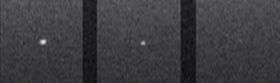
"I love watching meteor showers this way," says George Varros, who recorded this impact from his home in Mt. Airy, Maryland (see above).
The flash, which lit up a nighttime patch of Mare Nubium (the Sea of Clouds), was a bit dimmer than 7th magnitude--"an easy target for my 8-inch telescope and low-light digital video camera."
Hours later, another Perseid struck, on the western shore of Oceanus Procellarum (the Ocean of Storms). This time it was Robert Spellman of Azusa, California, who caught the flash. "It's exciting to witness these explosions in real time," he says. "I used a 10-inch telescope and an off-the-shelf Supercircuits video camera."
Rob Suggs of NASA's Meteoroid Environment Office has reviewed the data. "They look real to me," he says. "The flashes appear in multiple video frames and the light curves are similar to other lunar meteors we've recorded in the past."
Suggs would know. Along with colleague Bill Cooke, he leads a team at the Marshall Space Flight Center that has recorded more than 100 lunar explosions since 2005. "We monitor lunar meteors in support of NASA's return to the Moon," Suggs says. "The Moon has no atmosphere to protect the surface, so meteoroids crash right into the ground. Our program aims to measure how often that happens and answer the question, what are the risks to astronauts?"
NASA's official lunar meteor observatories are located in Alabama and Georgia. Both were off-line on August 9th, so the NASA team didn't see how many Perseids were hitting the Moon that night.
"This shows how amateur astronomers can contribute to our research," points out Suggs. "We can't observe the Moon 24-7 from our corner of the USA. Clouds, sunlight, the phase of the Moon—all these factors limit our opportunities. A global network of amateur astronomers monitoring the Moon could, however, approach full coverage."
By day, George Varros is a software engineer at NASA headquarters. After work, he takes off his NASA badge, goes home and fires up his self-described "barely adequate" telescope. "Until a few years ago, I really didn't like the Moon because it interfered with my observations of comets and meteors. Then, in 1999 during the Leonid meteor storm, (fellow amateur astronomer) David Dunham photographed six lunar impact events from my backyard in Maryland," Varros recalls. "I was hooked."
Dunham's observations inspired not only Varros, but also NASA. "Our own observing program can be traced back to those early amateur observations of lunar Leonids," says Suggs.
A major advance in lunar meteor detection came in 2006 in the form of LunarScan, a computer program written by amateur astronomer Pete Gural that searches digital video of the Moon for split-second flashes. Using LunarScan, Varros has bagged at least a dozen lunar meteors. Three of them were observed simultaneously by the NASA team in Alabama, confirming the fidelity of Varros' techniques. (LunarScan may be freely downloaded from Varros' web site - gvarros.com/ ; NASA uses the program, too!)
Like Varros, Robert Spellman's interest in lunar meteors began with the Leonids of 1999. "I read about the success of amateurs recording impact flashes," he recalls. "I've been in love with the Moon since my first observation when I was five years old, and I wanted to conduct an observing program with scientific value. Lunar meteors were a natural."
Spellman's day job is at the Natural History Museum of Los Angeles and the La Brea tar pits where he works as an educator. He also conducts public astronomy programs three nights a week at the Griffith Observatory. The rest of his evenings he devotes to the Moon.
Spellman uses no special software to catch his impacts. "I look for the flashes in real time," he says. "Although it may sound tedious to stare at a blank screen for hours on end, the prospect of seeing an explosion keeps me alert. In future, I do plan to use LunarScan to increase my success rate."
Suggs hopes other amateurs will take up this hobby, not only to improve NASA's lunar impact statistics, but also to support the agency's LCROSS mission: In 2009, the Lunar CRater Observation and Sensing Satellite (LCROSS) will intentionally dive into the Moon, producing a flash akin to a natural lunar meteor. Unlike natural meteoroids, which hit the Moon in random locations, LCROSS will carefully target a polar crater containing suspected deposits of frozen water. If all goes as planned, the impact will launch debris high above the lunar surface where astronomers can search the ejecta for signs of H2O. The impact flash (if not hidden by crater walls) and the debris plume may be visible to backyard telescopes on Earth.
Ready for meteor watching--the new way? NASA offers a FAQ and telescope tips to help you get started. Good hunting!
Source: Science@NASA, by Dr. Tony Phillips


