Baby's smell tamps down dad's testosterone levels
September 3rd, 2008 by Terry Devitt Baby's smell tamps down dad's testosterone levels

Enlarge

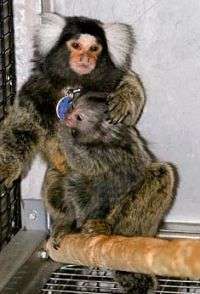
An infant marmoset monkey clings to his father at the Wisconsin National Primate Research Center (WNPRC) at UW-Madison. A new study by WNPRC scientist Toni Ziegler shows that the odor of their own offspring lowers testosterone levels in marmoset fathers. Photo: Jordana Lenon/WNPRC

Does eau de infant make dad a better parent? It does, it seems, if you are a common marmoset, a New World monkey known for its collaborative approach to rearing offspring.

In a new study from the Wisconsin National Primate Research Center (WNPRC) at the University of Wisconsin-Madison, researchers found that marmoset dads that get a whiff of their own babies experience decreased testosterone.

"We were a little surprised to see testosterone alter like that," says Toni Ziegler, a staff scientist at the WNPRC and the senior author of a study published Sept. 2 in the journal Biology Letters. "What we're seeing is that the system is flexible and that it can adjust up or down. It might be important for testosterone to be really flexible because there is a lot going on in the life of the primate dad. These moderations may allow him to be more tolerant toward his infants while facing external challenges that might distract him from focusing on his infant and family needs."

Testosterone is the most abundant, if not the most potent, male hormone in primates, including humans. Produced by the adrenal gland and the testicles, testosterone promotes the maintenance of secondary male characteristics, including such things as muscle mass and strength, fat distribution, bone mass and sex drive. Some studies suggest it may also contribute to male aggressiveness.

Marmosets live in family groups and are prolific breeders. Fathers play a big role in raising their young, joining the female in a care-giving role within a few hours of the birth of offspring, which frequently arrive in pairs. Marmoset babies are also large, each coming into the world at 10 percent of adult weight.

"The female totally needs help. She can't assume all of the parenting responsibilities on her own," says Ziegler, noting that marmoset females also typically become pregnant again within a few weeks of giving birth. "They need a lot of help. That's where the dads come in."

Marmoset males are known to be responsive to female scents, but the new Wisconsin study is the first to show that male physiology can also be influenced by a particular odor from a baby marmoset.

The new study was conducted by isolating experienced male marmoset fathers from their families — and their odors — and presenting them with either a scent from their infants' genital area or a control scent. Similarly, males with no experience as parents were presented with the same odors. Blood tests taken within 20 minutes of exposure revealed a marked decline in testosterone for only those experienced males given the scent of their own babies.

"This shows the male is responsive to chemical cues from their infants," explains Ziegler. ""We saw no behavioral response, but we saw in every single father a significant decline in testosterone."

The finding is interesting and mildly surprising, says Ziegler, because while depressed levels of the hormone may aid the father in his care-giving role, he still must assume important responsibilities such as defending his turf and family, behaviors that may benefit from a jolt of testosterone as opposed to lower levels of the hormone.

"What we are seeing is the system is flexible and that it adjusts up and down," says Ziegler. "It is interesting that the infant can have this parenting effect on the fathers."

In addition to Ziegler, co-authors of the new report include Shelley Prudom, Carrie Broz, Nancy Schultz-Darken and Charles Snowdon, all of UW-Madison; and Craig Ferris of Northeastern University. The study was supported by grants from the National Institutes of Health.

Provided by University of Wisconsin-Madison


print this article email this article download pdf blog this article bookmark this article     Digg this Stumble it share on Facebook share on Reddit add to delicious save to Yahoo! bookmarks
4.9/5 after 7 votes


September 3rd, 2008 all stories
Biology /

Comments: 0
Rank: 4.9/5 after 7 votes

  • Stumble this up

  • Digg this

  • Share it:
  • share on Facebook
  • share on MySpace
  • share on Slashdot
  • rss-newsfeed
  • share on Google
  • share on Reddit
  • add to delicious
  • save to Yahoo! bookmarks
  • share on Windows Live
  • Add to Mixx!
Rating: 4.9/5 after 7 votes


Tags


  • Physicists Demonstrate Quantum Memory with Matter Qubits
    Physicists Demonstrate Quantum Memory with Matter Qubits
    Physics / General Physics
    created Jul 03, 2009 | popularity 4.4 / 5 (17) | comments 1
  • 'Holey' Nanosheets for Wastewater Dye Removal
    Nanotechnology / Nanomaterials
    created Jul 01, 2009 | popularity 5 / 5 (5) | comments 1
  • Jellyfish Robot Swims Like its Biological Counterpart
    Jellyfish Robot Swims Like its Biological Counterpart
    Electronics / Robotics
    created Jun 26, 2009 | popularity 4.4 / 5 (8) | comments 1
  • Could Maxwell's Demon Exist in Nanoscale Systems?
    Could Maxwell's Demon Exist in Nanoscale Systems?
    Physics / General Physics
    created Jun 24, 2009 | popularity 4.4 / 5 (18) | comments 29
  • Living Safely with Robots, Beyond Asimov's Laws
    Living Safely with Robots, Beyond Asimov's Laws
    Electronics / Robotics
    created Jun 22, 2009 | popularity 4.6 / 5 (52) | comments 40
  • Other News

    Researchers uncover the potential for super-sized abalone

    Biology / Microbiology

    created 1hour ago | popularity not rated yet | comments 0

    (PhysOrg.com) -- Designer abalone could be an option in the foreseeable future, thanks to a project conducted at UQ's Heron Island Research Station and the St Lucia campus.


    Scientists 'rebuild' giant moa using ancient DNA

    Biology / Plants & Animals

    created Jul 01, 2009 | popularity 5 / 5 (10) | comments 12

    (PhysOrg.com) -- Scientists have performed the first DNA-based reconstruction of the giant extinct moa bird, using prehistoric feathers recovered from caves and rock shelters in New Zealand.


    California water plan aims to save Puget Sound orcas

    Biology / Ecology

    created 17 hours ago | popularity not rated yet | comments 0

    A plan to restore salmon runs on California's Sacramento River also could help revive killer whale populations 700 miles to the north in Puget Sound, as federal scientists struggle to protect endangered species in a complex ...


    Pacific Giant Salamander (Dicamptodon tenebrosus)

    Salamanders, regenerative wonders, heal like mammals, people

    Biology / Microbiology

    created Jul 01, 2009 | popularity 5 / 5 (20) | comments 11

    The salamander is a superhero of regeneration, able to replace lost limbs, damaged lungs, sliced spinal cord -- even bits of lopped-off brain. But it turns out that remarkable ability isn't so mysterious after ...


    Genetically modified trees

    Anti-biotech groups obstruct forest biotechnology

    Biology / Biotechnology

    created Jun 30, 2009 | popularity 3.7 / 5 (7) | comments 5

    The potential of forest biotechnology to help address significant social and environmental issues is being "strangled at birth" by the rigid opposition of some groups and regulations that effectively preclude ...