Fermilab physicists discover 'doubly strange' particle
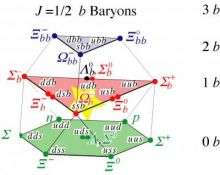
September 3, 2008 Baryon Model

Enlarge

Baryons are particles made of three quarks. The quark model predicts the combinations that exist with either spin J=1/2 (this graphic) or spin J=3/2. The graphic shows the various three-quark combinations with J=1/2 that are possible using the three lightest quarks -- up, down and strange -- and the bottom quark. The DZero collaboration discovered the Omega-sub-b, highlighted in the graphic. There exist additional baryons involving the charm quark, which are not shown. The top quark, discovered at Fermilab in 1995, is too short-lived to become part of a baryon. Credit: Fermilab

Physicists of the DZero experiment at the U.S. Department of Energy's Fermi National Accelerator Laboratory have discovered a new particle made of three quarks, the Omega-sub-b (Ωb). The particle contains two strange quarks and a bottom quark (s-s-b). It is an exotic relative of the much more common proton and weighs about six times the proton mass.

The discovery of the doubly strange particle brings scientists a step closer to understanding exactly how quarks form matter and to completing the "periodic table of baryons." Baryons (derived from the Greek word "barys," meaning "heavy") are particles that contain three quarks, the basic building blocks of matter. The proton comprises two up quarks and a down quark (u-u-d).
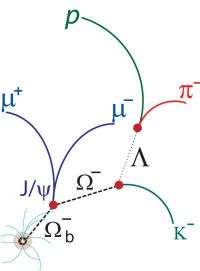
Omega b Decay
Enlarge

Once produced, the decay of the Omega-sub-b proceeds like fireworks. The particle travels about a millimeter before it disintegrates into two intermediate particles called J/Psi and Omega-minus. The J/Psi then promptly decays into a pair of muons. The Omega-minus baryon, on the other hand, can travel several centimeters before decaying into yet another unstable particle called a Lambda baryon along with a long-lived particle called kaon. The Lambda baryon, which has no electric charge, also can travel several centimeters prior to decaying into a proton and a pion. Credit: DZero Collaboration

Combing through almost 100 trillion collision events produced by the Tevatron particle collider at Fermilab, the DZero collaboration found 18 incidents in which the particles emerging from a proton-antiproton collision revealed the distinctive signature of the Omega-sub-b. Once produced, the Omega-sub-b travels about a millimeter before it disintegrates into lighter particles. Its decay, mediated by the weak force, occurs in about a trillionth of a second.

Theorists predicted the mass of the Omega-sub-b baryon to be in the range of 5.9 to 6.1 GeV/c2. The DZero collaboration measured its mass to be 6.165 ± 0.016 GeV/c2. The particle has the same electric charge as an electron and has spin J=1/2.

The Omega-sub-b is the latest and most exotic discovery of a new type of baryon containing a bottom quark at the Tevatron particle collider at Fermilab. Its discovery follows the observation of the Cascade-b-minus baryon (Ξb-), first observed by the DZero experiment in 2007, and two types of Sigma-sub-b baryons (Σb), discovered by the CDF experiment at Fermilab in 2006.

"The observation of the doubly strange b baryon is yet another triumph of the quark model," said DZero cospokesperson Dmitri Denisov, of Fermilab. "Our measurement of its mass, production and decay properties will help to better understand the strong force that binds quarks together."

According to the quark model, invented in 1961 by theorists Murray Gell-Mann and Yuval Ne'eman as well as George Zweig, the four quarks up, down, strange and bottom can be arranged to form 20 different spin-1/2 baryons. Scientists now have observed 13 of these combinations.

"The measurement of the mass of the Omega-sub-b provides a great test of computer calculations using lattice quantum chromodynamics," said Fermilab theorist Andreas Kronfeld. "The discovery of this particle is an example of all the wonderful results pouring out of accelerator laboratories over the past few years."

The Omega-sub-b is a relative of the famous and "even stranger" Omega-minus, which is made of three strange quarks (s-s-s).

"After the discovery of the Omega-minus, people started to accept that quarks really exist," said DZero co-spokesperson Darien Wood, of Northeastern University. "Its discovery, made with a bubble chamber at Brookhaven National Laboratory in 1964, is the textbook example of the predictive power of the quark model."

The DZero collaboration submitted a paper that summarizes the details of its discovery to the journal Physical Review Letters. It is available online at: http://www-d0.fnal.gov/Run2Physics/WWW/results/final/B/B08G/

Source: Fermi National Accelerator Laboratory


print this article email this article download pdf blog this article bookmark this article     Stumble it Digg this share on Facebook retweet share on Reddit add to delicious
Rate this story - 4.8 /5 (64 votes)

Rank Filter

Move the slider to adjust rank threshold, so that you can hide some of the comments.


Display comments: newest first

  • googleplex - Sep 04, 2008
    • Rank: 5 / 5 (1)
    Combing through almost 100 trillion collision events

    Anyone know how they do this?
    Is it with a computer using AI/pattern recognition to fit curves onto the cloud chamber traces. It must adjust the curve to account for the plane that the particle trail is in.
    To me this computerization of traces (if that is what it is) is a modern marvel. It reminds me of the DNA sequencing going robotic dramatically speeding up the process.

September 3, 2008 all stories

Comments: 1

4.8 /5 (64 votes)
  • Stumble this up

  • Digg this

  • share this

  • hide
  • Related Stories

  • 3 Questions: Steven Nahn on the elusive Higgs boson
    created Oct 19, 2009 | popularity not rated yet | comments 0
  • 'Masters of light' win Nobel Physics Prize
    created Oct 06, 2009 | popularity not rated yet | comments 0
  • Belle Finds a Hint of New Physics in Extremely Rare B Decays
    created Sep 07, 2009 | popularity not rated yet | comments 0
  • In Search of Antimatter Galaxies
    created Aug 17, 2009 | popularity not rated yet | comments 0
  • Fermilab's CDF observes Omega-sub-b baryon
    created Jun 29, 2009 | popularity not rated yet | comments 0


  • hide
  • Relevant PhysicsForums posts

  • Entropy vs. video game controllers
    created 1hour ago
  • Electron oscillating in vacuum
    created 1hour ago
  • Swings
    created 2 hours ago
  • Bicycling on the Moon
    created 3 hours ago
  • Where'd the energy come from?
    created 3 hours ago
  • Need help understanding negative pressure
    created 4 hours ago
  • More from Physics Forums - General Physics

Other News

Stars Fueled by Dark Matter Could Hold Secrets to the Universe

Stars Fueled by Dark Matter Could Hold Secrets to the Universe

Physics / General Physics

created Nov 03, 2009 | popularity 4.5 / 5 (49) | comments 40

(PhysOrg.com) -- The first stars in the universe may have been very different from the stars we see today, yet they may hold clues to understanding some of the mysterious features of the universe. These "dark ...


Second Law of Thermodynamics May Explain Economic Evolution

Second Law of Thermodynamics May Explain Economic Evolution

Physics / General Physics

created Nov 02, 2009 | popularity 4.3 / 5 (29) | comments 28

(PhysOrg.com) -- Terms such as the "invisible hand," laissez-faire policy, and free-market principles suggest that economic growth and decline in capitalist societies seem to be somehow self-regulated. Now, ...


High-performance plasmas may make reliable, efficient fusion power a reality

High-performance plasmas may make reliable, efficient fusion power a reality

Physics / Plasma Physics

created Nov 02, 2009 | popularity 4.7 / 5 (37) | comments 31

In the quest to produce nuclear fusion energy, researchers from the DIII-D National Fusion Facility have recently confirmed long-standing theoretical predictions that performance, efficiency and reliability ...


'Teapot effect' solved

Solving Teapot Effect

Physics / General Physics

created Nov 02, 2009 | popularity 4.9 / 5 (11) | comments 10

(PhysOrg.com) -- A team of scientists from France have worked out why teapots dribble at low flow rates, and how to stop them. The effect is called the "teapot effect", and solving it could finally put an ...


Laser accelerated protons to the highest energies so far

Researchers use trident laser to accelerate protons to record energies

Physics / General Physics

created Nov 02, 2009 | popularity 4.6 / 5 (5) | comments 10

An international team of physicists at Los Alamos National Laboratory has succeeded in using intense laser light to accelerate protons to energies never before achieved. Using this technique, scientists can ...