The ATLAS Pixel Detector
September 3, 2008 by Kelen Tuttle
The ATLAS Pixel Detector

Enlarge

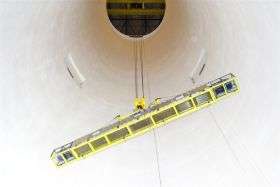
The ATLAS pixel detector is lowered into the LHC. (Photo courtesy of CERN)

With the Large Hadron Collider start-up only weeks away, SLAC researchers working on the LHC are feeling the excitement. SLAC has been involved in designing and building the ATLAS (A Toroidal LHC ApparatuS) detector since mid-2006, when the lab officially joined the collaboration.

Since then, SLAC has become an ATLAS Tier 2 computing center and begun contributing to efforts on the ATLAS pixel detector and high-level trigger system. In addition, many SLAC researchers currently work on the LHC accelerator and theoretical studies. Overall, eight SLAC researchers are based at CERN, with another 10 to 15 working there part-time and about 50 others working on LHC projects from SLAC.

"SLAC's skills are a good match to several ATLAS efforts, and although we didn't join the collaboration until just a few years ago, we are sharing our expertise wherever we can help," said Charlie Young, who co-leads the SLAC ATLAS team with physicist Su Dong. Young serves as the run coordinator for the large crew that operates, tests and commissions the ATLAS pixel detector. He is currently at the LHC preparing for the start-up.

The ATLAS detector has an onion-like structure; it comprises several different detectors layered upon one another. At the center is the pixel detector, which nestles closest to the beam pipe and the interaction point. As dense bunches of protons collide 40 million times per second, the pixel detector records the aftermath like a big digital camera. But instead of the average digital camera's 4 million pixels, this mega-digital camera has 80 million.

As a charged particle travels through one of these pixels, that pixel records the amount of energy the particle deposits, much as a digital camera records color. The detector also tracks the directions in which particles travel using its three-layer structure: as a particle travels away from the collision point, the detector senses its location in each layer, allowing analysts to later reconstruct the particle's trajectory.

SLAC researchers, including Assistant Professor Ariel Schwartzman and postdoctoral researcher Claus Horn, are writing software with which to calibrate all 80 million of the detector's pixels to ensure that no pixel is artificially bright or dim. This project also compiles calibration data taken by many different research teams.

"This software helps to understand the performance of the pixel detector over time and to test new calibration techniques," said Schwartzman. "We can help many groups with this one project."

Although the beam has yet to circulate in the Large Hadron Collider, plans for future enhancements are already in the works. The planned upgrade to the proton beams will boost the number of interactions by a factor of ten. This will require a significant modification to the pixel detector. The detector sits close enough to the beam that the increase in interactions would cause enough radiation damage to require replacement of the current model every one to two years. It took far more than two years to build the pixel detector, so it will need to be redesigned to be more radiation tolerant. SLAC researchers are helping to develop a new type of sensor that can handle the radiation.

"As we transition from the research part of R&D to the development part, there is a lot more work to be done," said Young. "We're trying to figure out how we can take our current ideas and develop them into something that could actually be built."

Provided by SLAC


Rank 4 /5 (8 votes)
Related Stories
Relevant PhysicsForums posts
  • Physics question for the brainiacs
    created2 hours ago
  • minimum magnetic field detected and measured
    created2 hours ago
  • Diffraction
    created3 hours ago
  • Compressible vs. Incompressible Flow Equations
    created4 hours ago
  • How fast, on average, does the gas come out of a rocket's nozzle?
    created10 hours ago
  • Projectile Arrow Angle Transformation Equation
    created11 hours ago
  • More from Physics Forums - General Physics

More news stories

Tandem polymer solar cells that set record for energy-conversion

(PhysOrg.com) -- In the effort to convert sunlight into electricity, photovoltaic solar cells that use conductive organic polymers for light absorption and conversion have shown great potential. Organic polymers ...

Physics / Optics & Photonics

created 5 hours ago | popularity 5 / 5 (4) | comments 2 | with audio podcast

Fast photon control brings quantum photonic technologies closer

(PhysOrg.com) -- Using photons instead of electrons to transmit information could lead to faster and more secure ways to communicate, among other advantages. Now a team of physicists has taken another step toward realizing ...

Physics / Optics & Photonics

created 10 hours ago | popularity 5 / 5 (4) | comments 0 | with audio podcast feature

Leading the quest to crack cosmological mysteries

Sometimes a scientist can only laugh in the face of a seemingly insurmountable challenge.

Physics / General Physics

created 4 hours ago | popularity 3.8 / 5 (4) | comments 2 | with audio podcast

Two new records: The world's strongest and purest neutron beam

The world's strongest neutron beam is produced by a scientific instrument at the research neutron source FRM II (Forschungs-Neutronenquelle Heinz Maier-Leibnitz) at the Technischen Universitaet Muenchen (TUM). ...

Physics / General Physics

created 5 hours ago | popularity 5 / 5 (1) | comments 1 | with audio podcast

Researchers make better heat sensor based on butterfly wings

(PhysOrg.com) -- Scientists have long known that butterfly wings produce their iridescent colors by bouncing light around and between tiny ridges in structures made of chitin. More recently they’ve discovered ...

Physics / Optics & Photonics

created 11 hours ago | popularity 5 / 5 (2) | comments 0 | with audio podcast report


First-of-its-kind stem cell study re-grows healthy heart muscle in heart attack patients

Results from a Cedars-Sinai Heart Institute clinical trial show that treating heart attack patients with an infusion of their own heart-derived cells helps damaged hearts re-grow healthy muscle.

Scientists discover reason for Mt. Hood's non-explosive nature

(PhysOrg.com) -- For a half-million years, Mount Hood has towered over the landscape, but unlike some of its cousins in Oregon’s Cascade Mountains and many other volcanoes around the Pacific “Rim ...

Discovery paves way for salmonella vaccine

(Medical Xpress) -- An international research team led by a University of California, Davis, immunologist has taken an important step toward an effective vaccine against salmonella, a group of increasingly antibiotic-resistant ...

Time of year important in projections of climate change effects on ecosystems

(PhysOrg.com) -- Does it matter whether long periods of hot weather, such as last year's heat wave that gripped the U.S. Midwest, happen in June or July, August or September?

Smoking bans lead to less, not more, smoking at home: study

Smoking bans in public/workplaces don't drive smokers to light up more at home, suggests a study of four European countries with smoke free legislation, published online in Tobacco Control.

Ovarian cancer arises in fallopian tube of knockout mice

(Medical Xpress) -- The most deadly form of "ovarian" cancer arises in the fallopian tubes – not the ovaries – of knockout mice that lack two genes associated with the disease, said researchers led by Baylor College ...