Molecular evolution is echoed in bat ears
September 4, 2008
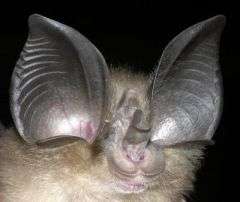
Big-Eared Horseshoe Bat

Enlarge

The big-eared horseshoe bat, Rhinolophus macrotis. Credit: Professor Gareth Jones

Echolocation may have evolved more than once in bats, according to new research from the University of Bristol published this week in Proceedings of the National Academy of Sciences (PNAS).

Professor Gareth Jones of the University of Bristol and Dr Stephen Rossiter of Queen Mary University of London, in collaboration with colleagues from East China Normal University in Shanghai, investigated the evolution of a gene called Prestin in echolocating bats – mammals with the most sensitive hearing at high frequencies.

Prestin codes for a protein of the outer hair cells – the tiny structures in the inner ear that help to give mammals their sensitive hearing. Important mutations occurred during the emergence of mammals that led to the evolution of Prestin from similar proteins. Since mammals evolved, it has been argued that the Prestin gene has changed little.

The researchers studied the Prestin DNA sequence in a range of echolocating bats and fruit bats, which do not echolocate. They found that parts of the gene appear to have evolved to be similar in the distantly related echolocating species. Furthermore, they could not find any evidence of genetic changes in the Prestin of fruit bats that might be expected from a loss of high frequency hearing.

If Prestin does indeed help bats to hear their high-pitched echoes, then these results appear to support the idea that echolocation has evolved more than once in bats. This apparent independent evolution of a trait in distant relatives is known as convergence, a term that is more commonly used to describe the physical features of species that live in similar habitats and face similar selection pressures, such as the spines of hedgehogs and porcupines. Examples of convergence at a molecular level are very rare.

Professor Jones and Dr Rossiter said: "If hearing were an Olympic event, echolocating bats would be strong medal contenders. Their ears are tuned to higher sound frequencies than those of any other mammals because they need to listen to the returning echoes of their ultra-sonic calls.

"In recent years, scientists have discovered the curious fact that echolocating bats do not all group together in the evolutionary tree of life, but instead, some are more related to their non-echolocating cousins, the fruit bats. This has raised the question of whether echolocation in bats has evolved more than once, or whether the fruit bats lost their ability to echolocate.

"Evolutionary biologists have long appreciated that morphological similarities may not reflect evolutionary affinities among animals because of convergent evolution – similar lifestyles can cause distantly related animals to resemble one another when they occupy similar environments because natural selection will favour similar outcomes.

"Now the same seems to be true for gene sequences – the need to echolocate can cause genes to converge in their structure. Our study suggests that scientists should be cautious when inferring evolutionary relationships from genes that may be involved in important functions and, therefore, could be shaped by convergent evolution ."

Source: University of Bristol

4.8 /5 (5 votes)  

Rank 4.8 /5 (5 votes)
Relevant PhysicsForums posts

More news stories

Integrated pest management recommendations for the southern pine beetle

The southern pine beetle, Dendroctonus frontalis Zimmermann, is a chronic insect pest within pine forests in the southeastern United States. Under favorable environmental and host conditions, it is an agg ...

Biology / Ecology

created 1 hour ago | popularity not rated yet | comments 0

A mitosis mystery solved: How chromosomes align perfectly in a dividing cell

Although the process of mitotic cell division has been studied intensely for more than 50 years, Whitehead Institute researchers have only now solved the mystery of how cells correctly align their chromosomes during symmetric ...

Biology / Cell & Microbiology

created 16 hours ago | popularity 4.5 / 5 (22) | comments 0 | with audio podcast

Researchers find extensive RNA editing in human transcriptome

In a new study published online in Nature Biotechnology, researchers from BGI, the world's largest genomics organization, reported the evidence of extensive RNA editing in a human cell line by analysis of RNA-seq data, demons ...

Biology / Biotechnology

created 16 hours ago | popularity 5 / 5 (4) | comments 0 | with audio podcast

The proteins ensuring genome protection

Researchers from the University of Geneva (UNIGE), Switzerland, have discovered the crucial role of two proteins in developing a cell 'anti-enzyme shield'. This protection system, which operates at the level of molecular ...

Biology / Cell & Microbiology

created 16 hours ago | popularity 5 / 5 (3) | comments 0 | with audio podcast

Entire genome of extinct human decoded from fossil

(PhysOrg.com) -- In 2010, Svante Pääbo and his colleagues presented a draft version of the genome from a small fragment of a human finger bone discovered in Denisova Cave in southern Siberia. The ...

Biology / Biotechnology

created Feb 07, 2012 | popularity 4.7 / 5 (60) | comments 51 | with audio podcast


Rapunzel, Leonardo and the physics of the ponytail

(PhysOrg.com) -- New research provides the first mathematical understanding of the shape of a ponytail and could have implications for the textile industry, computer animation and personal care products.

Cognitive impairment in older adults often unrecognized in the primary care setting

A new study published in the Journal of the American Geriatrics Society reveals that brief cognitive screenings combined with offering further evaluation increased new diagnoses of cognitive impairment in older veterans two to ...

Climate change causes harmful algal blooms in North Atlantic: study

Warming oceans and increases in windiness could be causing of an abundance of harmful algal blooms in the North Atlantic Ocean and North Sea, according to new research.

Hacker claims porn site users compromised

A hacker claims to have compromised the personal information of more than 350,000 users after breaking into a disused website operated by pornography provider Brazzers.

Primary care program helps obese teen girls manage weight, improve body image and behavior

Teenage girls gained less weight, improved their body image, ate less fast food, and had more family meals after participating in a 6- month program that involved weekly peer meetings, consultations with primary care providers ...

AT&T customers surprised by 'unlimited data' limit

(AP) -- Mike Trang likes to use his iPhone 4 as a GPS device, helping him get around in his job. Now and then, his younger cousins get ahold of it, and play some YouTube videos and games.