Do 68 molecules hold the key to understanding disease?
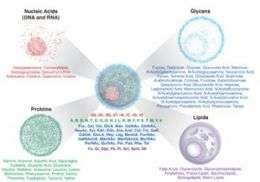
Why is it that the origins of many serious diseases remain a mystery? In considering that question, a scientist at the University of California, San Diego School of Medicine has come up with a unified molecular view of the indivisible unit of life, the cell, which may provide an answer.
Reviewing findings from multiple disciplines, Jamey Marth, Ph.D., UC San Diego Professor of Cellular and Molecular Medicine and Investigator with the Howard Hughes Medical Institute, realized that only 68 molecular building blocks are used to construct these four fundamental components of cells: the nucleic acids (DNA and RNA), proteins, glycans and lipids. His work, which illustrates the primary composition of all cells, is published in the September issue of Nature Cell Biology.
Like the periodic table of elements, first published in 1869 by Russian chemist Dmitri Mendeleev, is to chemistry, Marth's visual metaphor offers a new framework for biologists.
This new illustration defines the basic molecular building blocks of life and currently includes 32 glycans (sugar linkages found throughout the cell) and eight kinds of lipids (which compose cell membranes) along with the more well-known 20 amino acids that are used to make proteins and the eight nucleosides that compose the nucleic acids, DNA and RNA.
"These 68 building blocks provide the structural basis for the molecular choreography that constitutes the entire life of a cell," said Marth. "And two of the four cellular components are produced by these molecular building blocks in processes that cannot be encoded by the genes. These cellular components – the glycans and lipids – may now hold the keys to uncovering the origins of many grievous diseases that continue to evade understanding."
Currently, the vast majority of medical research looks to the human genome and proteome for answers, but those answers remain elusive, and perhaps for good reason.
"We have now found instances where the pathogenesis of widespread and chronic diseases can be attributed to a change in the glycome, for example, in the absence of definable changes in the genome or proteome," Marth said, adding that, as biomedical researchers, "we need to begin to cultivate the integration of disciplines in a holistic and rigorous way in order to perceive and most effectively manipulate the biological mechanisms of health and disease."
"What is important is that no one has composed it and laid it out so clearly before," said Ajit Varki, M.D., Distinguished Professor of Medicine and Cellular and Molecular Medicine and founder and co-director of the Glycobiology Research and Training Center at UC San Diego School of Medicine, and chief editor of the major textbook in the field, The Essentials of Glycobiology. "Glycobiology, for example, is a relatively new field of study in which researchers at UC San Diego have much expertise, and Dr. Marth's work further illustrates the importance of these glycan molecules."
Marth believes that biology should become more integrative both in academic and research settings. "I'm one who believes that we don't need to sacrifice breadth of knowledge in order to acquire depth of understanding."
Source: University of California - San Diego


