Researchers Find 'Junk DNA' May Have Triggered Key Evolutionary Changes in Human Thumb and Foot
September 4, 2008
Researchers Find 'Junk DNA' May Have Triggered Key Evolutionary Changes in Human Thumb and Foot

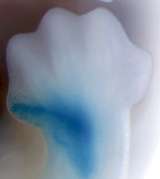
A rapidly evolving sequence from the human genome drives gene activity in the developing thumb, wrist and ankle of mouse embryos.

(PhysOrg.com) -- Out of the 3 billion genetic letters that spell out the human genome, Yale scientists have found a handful that may have contributed to the evolutionary changes in human limbs that enabled us to manipulate tools and walk upright.

Results from a comparative analysis of the human, chimpanzee, rhesus macaque and other genomes reported in the journal Science suggest our evolution may have been driven not only by sequence changes in genes, but by changes in areas of the genome once thought of as "junk DNA."

Those changes activated genes in primordial thumb and big toe in a developing mouse embryo, the researchers found.

"Our study identifies a potential genetic contributor to fundamental morphological differences between humans and apes," said James Noonan, Assistant Professor of Genetics in the Yale University School of Medicine and the senior author of the study.

Researchers have long suspected changes in gene expression contributed to human evolution, but this had been difficult to study until recently because most of the sequences that control genes had not been identified. In the last several years, scientists have discovered that non-coding regions of the genome, far from being junk, contain thousands of regulatory elements that act as genetic "switches" to turn genes on or off.

An indication of their biological importance, many of these non-coding sequences have remained similar, or "conserved," even across distantly related vertebrate species such as chickens and humans. Recent functional studies suggest some of these "conserved non-coding sequences" control the genes that direct human development.

In collaboration with scientists at Lawrence Berkeley National Laboratory in California, the Genome Institute of Singapore, and the Medical Research Council in the United Kingdom, Noonan searched the vast non-coding regions of the human genome to identify gene regulatory sequences whose function may have changed during the evolution of humans from our ape-like ancestors.

Noonan and his colleagues looked for sequences with more base pairs in humans than in other primates. The most rapidly evolving sequence they identified, termed HACNS1, is highly conserved among vertebrate species but has accumulated variations in 16 base pairs since the divergence of humans and chimpanzees some 6 million years ago. This was especially surprising, as the human and chimpanzee genomes are extremely similar overall, Noonan said.

Using mouse embryos, Noonan and his collaborators examined how HACNS1 and its related sequences in chimpanzee and rhesus monkey regulated gene expression during development. The human sequence activated genes in the developing mouse limbs, in contrast to the chimpanzee and rhesus sequences. Most intriguing for human evolution, the human sequence drove expression at the base of the primordial thumb in the forelimb and the great toe in the hind limb. The results provided tantalizing, but researchers say preliminary, evidence that the functional changes in HACNS1 may have contributed to adaptations in the human ankle, foot, thumb and wrist-- critical advantages that underlie the evolutionary success of our species.

However, Noonan stressed that it is still unknown whether HACNS1 causes changes in gene expression in human limb development or whether HACNS1 would create human-like limb development if introduced directly into the genome of a mouse.

"The long-term goal is to find many sequences like this and use the mouse to model their effects on the evolution of human development," Noonan said.

Provided by Yale University

4.8 /5 (19 votes)  

Filter


Move the slider to adjust rank threshold, so that you can hide some of the comments.


Display comments: newest first

Icester
Sep 05, 2008

Rank: 3 / 5 (1)
I'm not trying to start a huge argument, but could someone please answer the following questions regarding evolution?

(1) Where are all the "in-betweens"? You know, those evolved animals that aren't quite there yet? Shouldn't the world be flooded with a wide degree of these since evolution takes millions to billions of years? Logic dictates that there should practically be a continuum of evolution "states" from one species to the next.

(2) How does evolution account for mutations crossing the species line in which involve different numbers of chromosomes? Every chromosomal defect I've ever heard of (caused by too many or missing chromosomes) results in a non-viable animal. Or in the best case, a weakened animal that is usually unable to reproduce.

(3) What is the mathematical probability of the following circumstances:
(a) mutation results in a positive mutation
(b) mutation results in an animal that can reproduce
(c) enough mutated animals occur to create a self-sustaining population This requires that (1) the animals are geographically close and (2) animals are chronologically close so that they are within breeding age

Thanks
zevkirsh
Sep 05, 2008

Rank: 4 / 5 (1)
junk dna is anything but junk. it is a testament to scientific arrogance that what we do not understand we call junk. no, if anything, nature conserved it there for us to observe because it is treasure, not junk. i recall in 1997 telling my advanced placement biology teacher in high school that calling it junk dna made no sense and that is was obvious that it was there for a reason and was both necessary and full of more information we could not yet decipher.....
ofidiofile
Sep 05, 2008

Rank: not rated yet
I'm not trying to start a huge argument, but could someone please answer the following questions regarding evolution?


the answers are out there, but if you're asking for simple one-liners that will fit in a comment box, you're out of luck.

1)natural selection has no goals -- it is NOT a conscious process -- species evolve in response to changes in their environment so as to be able to continue to survive and reproduce. that is all. as for transitionals, to make any claims about present-day "missing links" is to claim to have knowledge of the future (i.e., you'd have to know what it was "turning into"). transitional species only appear in hindsight, by defintion.

2)look up the red viscacha-rat, which is tetraploid [4n] (nearly double the chromosomes of its closest relative). somewhere down the line, its ancestors were born with double the normal number of chromosomes, though losing the sex chromos and a few others (which prevented what would otherwise be lethal effects).

i suspect you're a creationist (i know the signs, having been raised one myself), but i'll grant you the benefit of the doubt. if you're honest in that you are actually curious (i.e., you're not just a troll), you can go here:

http://www.talkor...indexcc/

browse around. i've heard your questions before, many more times than i care to recall.

if, however, you are a dyed-in-the-wool creationist, there are no facts in existence that will change your mind, and no one anywhere who will be able to give reasonable answers to your questions.

i hope you find what you're looking for.
HenisDov
Sep 06, 2008

Rank: 3 / 5 (1)
Extra, Extra Read All About It !
Researchers Uncover DNA Mystery !


A. Mystery uncovered!

Yale researchers:" 'junk DNA' may have triggered...evolution of..."

http://www.eureka...0208.php

"... evolution may have been driven not only by sequence changes in genes, but by changes in areas of the genome once thought of as "junk DNA"..."


B. Mystery uncovered?

NO NO NO

DNA does not "trigger" nor drive anything.

DNA is a component of life's prime organism, the gene. The gene, the organism, is "driven" to acquire new capability. The driver is the ubiquitous biological entity, culture.


C. Mystery uncovered. Evolution recomprehended.

Genes, Earth's primal organisms even when they are interdependent members of their genome communal cooperative, evolve in response to their survival requirements, which are THEIR CULTURE.

Darwinism starts with pre-Archaea individual independent genes, their evolution driven by their culture.

From http://blog.360.y...Q--?cq=1]http://blog.360.y...Q--?cq=1[/url]&p=409

- Genes are organisms, interdependent members of genes communes, genomes, all continuously undergoing evolution directed towards survival as long as possible, for maintaining Earth's biosphere as long as possible, which is the reason and purpose of their, and our, existence.

- Culture is a ubiquitous biological entity and is the major effector of genetic evolution, of capabilities and attributes selected for survival.

- The major course of natural selection is NOT via random mutations followed by survival, but via interdependent, interactive and interenhencing selection of biased replication routes by genes at their alternative-splicing-steps junctions, effected by the cultural feedback of the 3rd stratum celled organisms to their 1st stratum genes organisms via their 2nd stratum genome organisms.


Dov Henis

http://blog.360.y...Q--?cq=1]http://blog.360.y...Q--?cq=1[/url]&p=372

Puzzled why even Darwinians do not comprehend that Darwinism starts all the way back with Life's day one, with the pre-archaea not-yet-genomed-celled genes...


Rank 4.8 /5 (19 votes)
Relevant PhysicsForums posts

More news stories

Study finds that anti-diabetic medication can prevent the long-term effects of maternal obesity

In a study to be presented today at the Society for Maternal-Fetal Medicine's annual meeting, The Pregnancy Meeting, in Dallas, Texas, researchers will report findings that show that short therapy with the anti-diabetic medication ...

Medicine & Health / Health

created 14 hours ago | popularity 5 / 5 (1) | comments 1

Steroid injections prove effective in treatment of lumbar disc herniations

The use of epidural steroid injections may be a more efficient treatment option for lumbar disc herniations, according to research presented today at the American Orthopaedic Society for Sports Medicine's Specialty Day in ...

Medicine & Health / Health

created 14 hours ago | popularity not rated yet | comments 0

Amateur football players not always keen on returning to play after ACL injuries

Despite the known success rates of reconstructive Anterior Cruciate Ligament (ACL) surgery, the number of high school and collegiate football players returning to play may not be as high as anticipated, say researchers presenting ...

Medicine & Health / Health

created 14 hours ago | popularity not rated yet | comments 0

Study finds elevated levels of cell-free DNA in first trimester do not predict preeclampsia

In a study to be presented today at the Society for Maternal-Fetal Medicine's annual meeting, The Pregnancy Meeting, in Dallas, Texas, researchers will report findings that indicate that elevated levels of cell-free DNA in ...

Medicine & Health / Other

created 14 hours ago | popularity not rated yet | comments 0

PRP treatment aids healing of elbow injuries say researchers

As elbow injuries continue to rise, especially in pitchers, procedures to help treat and get players back in the game quickly have been difficult to come by. However, a newer treatment called platelet rich plasma (PRP) may ...

Medicine & Health / Other

created 14 hours ago | popularity 5 / 5 (1) | comments 0


Walney offshore wind farm is world's biggest (for now)

(PhysOrg.com) -- The Walney wind farm on the Irish Sea--characterized by high tides, waves and windy weather--officially opened this week. The farm is treated in the press as a very big deal as the Walney ...

GPS court ruling leaves US phone tracking unclear

A US Supreme Court decision requiring a warrant to place a GPS device on the car of a criminal suspect leaves unresolved the bigger issue of police tracking using mobile phones, legal experts say.

Europeans protest controversial Internet pact

Tens of thousands of people marched in protests in more than a dozen European cities Saturday against a controversial anti-online piracy pact that critics say could curtail Internet freedom.

Europe stakes billion-dollar bet on new rocket

A pencil-slim rocket is scheduled to lift into space from South America on Monday, carrying a billion-dollar bet that Europe can grab a juicy slice of the market to place satellites in low orbit.

Netflix settlement trims 14 pct off 4Q earnings

(AP) -- Netflix pressed the rewind button on its fourth-quarter earnings after settling allegations that the video subscription service violated a consumer-privacy law.

Navy to begin tests on electromagnetic railgun prototype launcher

The Office of Naval Research (ONR)'s Electromagnetic (EM) Railgun program will take an important step forward in the coming weeks when the first industry railgun prototype launcher is tested at a facility ...