Global sea-rise levels by 2100 my be lower than some predict, says new study
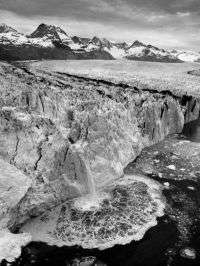
September 4, 2008 Columbia Glacier

Enlarge

While the disintegrating Columbia Glacier is adding to ocean levels this century, the total global sea rise by 2100 may be lower than many are anticipating, according to a new University of Colorado at Boulder study. Credit: Tad Pfeffer, University of Colorado

(PhysOrg.com) -- Despite projections by some scientists of global seas rising by 20 feet or more by the end of this century as a result of warming, a new University of Colorado at Boulder study concludes that global sea rise of much more than 6 feet is a near physical impossibility.

Tad Pfeffer, a fellow of CU-Boulder's Institute of Arctic and Alpine Research and his colleagues made calculations using conservative, medium and extreme glaciological assumptions for sea rise expected from Greenland, Antarctica and the world's smaller glaciers and ice caps -- the three primary contributors to sea rise. The team concluded the most plausible scenario, when factoring in thermal expansion due to warming waters, will lead to a total sea level rise of roughly 3 to 6 feet by 2100.

A paper on the subject was published in the Sept. 5 issue of Science. Co-authors of the study were of the University of Montana's Joel Harper and Shad O'Neel of the Scripps Institute of Oceanography at the University of California, San Diego. The study was funded by the National Science Foundation and a University of Colorado Faculty Fellowship.

"We consider glaciological conditions required for large sea level rise to occur by 2100 and conclude increases of 2 meters are physically untenable," the team wrote in Science. "We find that a total sea level rise of about 2 meters by 2100 could occur under physically possible glaciological conditions but only if all variables are quickly accelerated to extremely high limits."

"The gist of the study is that very simple, physical considerations show that some of the very large predictions of sea level rise are unlikely, because there is simply no way to move the ice or the water into the ocean that fast," said Pfeffer.

The team began the study by postulating future sea level rise at about 2 meters by 2100 produced only by Greenland, said Pfeffer. Since rapid, unstable ice discharge into the ocean is restricted to Greenland glacier beds based below sea level, they identified and mapped all of the so-called outlet glacier "gates" on Greenland's perimeter -- bedrock bottlenecks most tightly constraining ice and water discharge.

"For Greenland alone to raise sea level by two meters by 2100, all of the outlet glaciers involved would need to move more than three times faster than the fastest outlet glaciers ever observed, or more than 70 times faster than they presently move," said Pfeffer. "And they would have to start moving that fast today, not 10 years from now. It is a simple argument with no fancy physics."

In Antarctica, the majority of ice entering the ocean comes from the Antarctic Peninsula and the Pine Island and Thwaites glaciers, said Pfeffer. Most of the marine-based ice in West Antarctica is held behind the Ross and Filcher-Ronne ice shelves, which Pfeffer's team believes are unlikely to be removed by climate or oceanographic processes during the next century. The researchers used varying glacier velocities to calculate sea-rise contribution estimates from the Antarctic Peninsula, Pine Island and Thwaites glaciers.

The team also used assessments of the world's small glacier and ice cap contributions to sea level rise calculated by a CU-Boulder team and published in Science in July 2007. That study indicated small glaciers and ice caps contribute about 60 percent of the world's ice to oceans at present, a percentage that is accelerating.

Considering all major sources of sea level rise, including Greenland, Antarctica, smaller glaciers and ice caps and the thermal expansion of water, the team's most likely estimate of roughly 3 to 6 feet by 2100 is still potentially devastating to huge areas of the world in low-lying coastal areas, said Pfeffer.

Some scientists have theorized that continuing warming trends in Greenland and Antarctica could warm the Earth by 4 degrees F over the present by 2100. The last time that happened, roughly 125,000 years ago during the last interglacial period, glacier changes raised sea level by 12 to 20 feet or more. But the time scale is poorly constrained and may have required millennia, Pfeffer said.

"In my opinion, some of the research out there calling for 20 or 30 feet of sea rise by the end of the century is not backed up by solid glaciological evidence," said Pfeffer.

Policymakers need to be able to predict sea level accurately if communities, cities and countries around the world are going to be able to plan effectively, Pfeffer said. "If we plan for 6 feet and only get 2 feet, for example, or visa versa, we could spend billions of dollars of resources solving the wrong problems."

Source: University of Colorado at Boulder


Rate this story - 4.2 /5 (54 votes)

Rank Filter

Move the slider to adjust rank threshold, so that you can hide some of the comments.


Display comments: newest first

  • dbren - Sep 04, 2008
    • Rank: 2.9 / 5 (16)
    But Manbearpig is real! Why won't you take me serial?
  • Velanarris - Sep 04, 2008
    • Rank: 4 / 5 (16)
    Now this is real science in regard to sea level rise. It's about time.
  • Modernmystic - Sep 04, 2008
    • Rank: 2.7 / 5 (10)
    Isn't there another article floating around here which is all a twitter about how FAST the sea level rise is going to be??
  • NotParker - Sep 04, 2008
    • Rank: 3.7 / 5 (12)
    "If we plan for 6 feet and only get 2 feet, for example, or visa versa, we could spend billions of dollars of resources solving the wrong problems."

    Whoahhhhhhhhh. That smacks of common sense. Shout him down Al!
  • D666 - Sep 04, 2008
    • Rank: 2.1 / 5 (20)
    Yeah, I fully expected the denialists to get all a-twitter about an article that "debunks" GW. Ooooh. The excitement.

    Except of course, it doesn't.

    It doesn't say that GW doesn't exist. It doesn't say that temperatures won't rise, or even that they won't rise as much as predicted. It doesn't say there isn't enough ice there to make the oceans rise 20 ft. In fact, it doesn't even say the oceans won't rise 20 ft!!!

    What it says is that the oceans *probably* (notice the author uses the word "opinion") won't rise as fast or as soon as some other predictions, because all the ice falling off the glaciers is going to get logjammed. So if the author's right (not guaranteed), the oceans will hit 20 ft maybe what, 20 years later? 10? 30? He doesn't say. Wow. Time to celebrate.

    And of course, there's always the caveat that *he* might be the one that's wrong. Remember, the idea of GW prep is to try to fix things BEFORE they go blewy.

    {sigh} I don't know why I bother...
  • Velanarris - Sep 04, 2008
    • Rank: 3.9 / 5 (16)
    Yeah, I fully expected the denialists to get all a-twitter about an article that "debunks" GW. Ooooh. The excitement.

    Except of course, it doesn't.

    What are you talking about? We're appreciating an article that's using science to describe what they think is happening by testing and observing.

    It doesn't say that GW doesn't exist. It doesn't say that temperatures won't rise, or even that they won't rise as much as predicted. It doesn't say there isn't enough ice there to make the oceans rise 20 ft. In fact, it doesn't even say the oceans won't rise 20 ft!!!
    Right, because unlike the AGW crowd he has conclusive data about his theory, and he didn't run off to make a movie about it then use those profits to buy a houseboat.

    What it says is that the oceans *probably* (notice the author uses the word "opinion") won't rise as fast or as soon as some other predictions, because all the ice falling off the glaciers is going to get logjammed. So if the author's right (not guaranteed), the oceans will hit 20 ft maybe what, 20 years later? 10? 30? He doesn't say. Wow. Time to celebrate.

    And of course, there's always the caveat that *he* might be the one that's wrong. Remember, the idea of GW prep is to try to fix things BEFORE they go blewy.

    {sigh} I don't know why I bother...


    Neither do I, you're going the wrong way with this. We appreciate this article because whether we agree with the guy or not, he's using rational science, not speculation based on interpretive data.

    We don't jump on the AGW crowd for any reason other than "we're right because we say so" mentalities that are pushed on us by the AGW supporters.

    If you bring a paper to the table with accurate data and intelligent discourse then you won't see the anti agw regulars jump on it.

  • paulthebassguy - Sep 04, 2008
    • Rank: 4.6 / 5 (7)
    Yeah, there are so many conflicting studies on this area. Many articles are like this one and state that sea rise will not be as much, and then others say it will be much higher than we currently believe. It's all a big uncertainty.
  • MikeB - Sep 04, 2008
    • Rank: 2.9 / 5 (11)
    Look at this graph of global sea level. Especially notice the last two years. You have to scroll down a little.
    http://sealevel.colorado.edu/
  • MikeB - Sep 04, 2008
    • Rank: 3.1 / 5 (13)
    Notice the last two years on this global sea level graph.

    http://sealevel.colorado.edu/
  • MikeB - Sep 04, 2008
    • Rank: 3.3 / 5 (11)
    At this rate the sea level will rise about 14" in a hundred years.
  • Velanarris - Sep 05, 2008
    • Rank: 3.6 / 5 (10)
    At this rate the sea level will rise about 14" in a hundred years.


    And that's assuming the rise is constant.
  • Soylent - Sep 05, 2008
    • Rank: 3.6 / 5 (9)
    Look at this graph of global sea level. Especially notice the last two years.


    Doesn't look like a statistically significant deviation from the trend.
  • Velanarris - Sep 05, 2008
    • Rank: 4 / 5 (10)
    The last two years on that graph could also be attributed to the new satellite's greater accuracy in measurement over it's predecessor.
  • mysticfree - Sep 05, 2008
    • Rank: 3.9 / 5 (11)
    What it says is that the oceans *probably* (notice the author uses the word "opinion") won't rise as fast or as soon as some other predictions,
    I noticed! :) Too bad the alarmists rarely uses those words. I also noticed that he didn't try to blame evil humans as the root cause of a natural phenomenon.
  • Minnaloushe - Sep 05, 2008
    • Rank: 2.4 / 5 (7)
    How did this Heresy make it past the dogmatists onto the website...?

    With so many studies making conclusions that are mutually exclusive, I'd say, as far as GW goes: "They just don't know."
  • CaptSpaulding - Sep 05, 2008
    • Rank: 2.4 / 5 (7)
    What it says is that the oceans *probably* (notice the author uses the word "opinion")


    Wow, obviously you don't know science well. At it's heart is a whole bunch of untestable philosophy (like do we exist, etc.) that we *assume* to be true. If we all took these words of "opinion", "assumption", "probably", "insert other soft stance word here" as strongly as you did then we would come to the decision that either:
    1) the world doesn't exist so nothing matters anyway
    2) that God is making the warming, so we should live our lives as we do now and use his gifts as we see fit. If he wants us flooded, then we will be flooded. If he wants us to stay dry, then he will make a great miracle and stop it.

    Because, after all there is only a *probability* to existance and that we are only *probably* in control of our situation.

    As always with global warming issues, I personally take no opinion. However, the science usually seems quite weak from what I've seen on both sides of the fence. We ARE at the end of an ice age. There ARE periodic fluctuations in atmospheric temperatures (see the little ice age, etc.). The earth is believed to have historically been WARMER than it currently is. Deforestation and habitat destruction has been SEVERE since the 1600s. Continued population growth will only make the situation worse. I'm actually quite surprised that the GW alarmists haven't stepped up with a campaign of ZPG, as this would be a sure fire way to reduce the growth of CO2 emissions.
  • GrayMouser - Sep 05, 2008
    • Rank: 3.4 / 5 (5)
    Notice the last two years on this global sea level graph.

    http://sealevel.colorado.edu/


    From looking at that chart I'd say that it was 3.2mm plus/minus 10mm instead of 0.4mm.

    Looking at the calibration graphs for TOPEX and Jason-1 seem to confirm that. The interesting issue those bring up are:
    1) the negative slope to the linear coefficient,
    2) the precision appears to be plus or minus 4mm
    3) the accuracy appears to be all over the place (plus or minus ~30mm)
  • tpb - Sep 05, 2008
    • Rank: 3.2 / 5 (5)
    Also looking at the chart it appears that the slope on sea level change is zero from 2005 to 2008
  • Velanarris - Sep 05, 2008
    • Rank: 2.7 / 5 (6)
    What it says is that the oceans *probably* (notice the author uses the word "opinion")


    Wow, obviously you don't know science well. At it's heart is a whole bunch of untestable philosophy (like do we exist, etc.) that we *assume* to be true. If we all took these words of "opinion", "assumption", "probably", "insert other soft stance word here" as strongly as you did then we would come to the decision that either:
    1) the world doesn't exist so nothing matters anyway
    2) that God is making the warming, so we should live our lives as we do now and use his gifts as we see fit. If he wants us flooded, then we will be flooded. If he wants us to stay dry, then he will make a great miracle and stop it.

    Because, after all there is only a *probability* to existance and that we are only *probably* in control of our situation.

    As always with global warming issues, I personally take no opinion. However, the science usually seems quite weak from what I've seen on both sides of the fence. We ARE at the end of an ice age. There ARE periodic fluctuations in atmospheric temperatures (see the little ice age, etc.). The earth is believed to have historically been WARMER than it currently is. Deforestation and habitat destruction has been SEVERE since the 1600s. Continued population growth will only make the situation worse. I'm actually quite surprised that the GW alarmists haven't stepped up with a campaign of ZPG, as this would be a sure fire way to reduce the growth of CO2 emissions.


    Friends don't let friends post high on Physorg.
  • oceaneng - Sep 06, 2008
    • Rank: 2.7 / 5 (6)
    A couple of thoughts:
    "Science" is a peer reviewed journal known for high quality content and this adds more weight to this article.

    Also regarding sea level measurement, convert the unit weight of 1 inch of mercury (atmospheric pressure change) to the unit weight of seawater and you will see that it will cause about a 15 inch sea level change - thus the surface of the ocean is going up and down in different regions just from changes is atmospheric pressure, not even considering the effect of tides and wind...where do you think that puts the "accuracy" of these measurements?
  • MikeB - Sep 06, 2008
    • Rank: 3 / 5 (4)
    They have the measurements displayed with or without the inverted barometer applied, however you would like to see them. See here, you have to scroll down a little.

    http://sealevel.c...ults.php
  • GrayMouser - Sep 07, 2008
    • Rank: 1 / 5 (1)
    Notice the last two years on this global sea level graph.

    http://sealevel.colorado.edu/


    The TOPEX satellite was orbiting at about 1366KM. NASA's acuracy data is that measurements are plus or minus 4cm to 5cm.

    I would question the data from the satellites until I'd matched it against other measuring techniques. Certainly averaging a large number of measurements can improve your resolution IF the variation is totally random (white noise) instead of a periodic event or sensor bias (it's been known to happen.) Discarding data through statistical manipulation is sometimes controversial and almost always requires a deep knowledge of the processes involved and statistics.
  • DKA - Sep 07, 2008
    • Rank: 1 / 5 (4)

    This sounds like quite a bad news, as the very conservative predictions from IPCC estimated that the sea level would not rise more than 18cm to 59cm. Now we are saying that 3 meters are possible by 2100. Maybe someone should ask then, what about 2200? Is it looking like 6 meters to 10 meters? I do not understand the reason behind limiting our view to 2100 only but anyway.

    Did anyone read their full paper by the way? Something I would like to know is if ice can also melt quite much on top of their estimates? It seems that they estimated the amount of ice that flows from the icefields into the sea, but that they did not count the water increase due to the melting of ice apart from the ice on these icefields flowing into the sea. Does anyone know?

    If they did not count such ice, how much would this ice amount to and what would be a fair estimate of it's contribution to the sea level rise?
  • Velanarris - Sep 08, 2008
    • Rank: 3.7 / 5 (3)

    This sounds like quite a bad news, as the very conservative predictions from IPCC estimated that the sea level would not rise more than 18cm to 59cm. Now we are saying that 3 meters are possible by 2100. Maybe someone should ask then, what about 2200? Is it looking like 6 meters to 10 meters? I do not understand the reason behind limiting our view to 2100 only but anyway.
    That rise is far under the alarmist IPCC prediction as well. The problem I have with bringing the IPCC into this is they are more of a political organization than a scientific one. According to the paper past 2100 there would be no net change as that particular ice field would be exhausted assuming it gains no more precipitation.

    Did anyone read their full paper by the way? Something I would like to know is if ice can also melt quite much on top of their estimates? It seems that they estimated the amount of ice that flows from the icefields into the sea, but that they did not count the water increase due to the melting of ice apart from the ice on these icefields flowing into the sea. Does anyone know?

    If they did not count such ice, how much would this ice amount to and what would be a fair estimate of it's contribution to the sea level rise?
    As for your question of meltwater, the rise would be the same regardless, ice when melted does not gain mass so melting the ice would not make a difference in the sea level once it's already in the ocean which the paper proposes.
  • MiniMonsterGroup - Sep 08, 2008
    • Rank: not rated yet
    @dbren - Lol !
  • DKA - Sep 09, 2008
    • Rank: 1 / 5 (3)

    This sounds like quite a bad news, as the very conservative predictions from IPCC estimated that the sea level would not rise more than 18cm to 59cm. Now we are saying that 3 meters are possible by 2100. Maybe someone should ask then, what about 2200? Is it looking like 6 meters to 10 meters? I do not understand the reason behind limiting our view to 2100 only but anyway.
    That rise is far under the alarmist IPCC prediction as well. The problem I have with bringing the IPCC into this is they are more of a political organization than a scientific one. According to the paper past 2100 there would be no net change as that particular ice field would be exhausted assuming it gains no more precipitation.

    Did anyone read their full paper by the way? Something I would like to know is if ice can also melt quite much on top of their estimates? It seems that they estimated the amount of ice that flows from the icefields into the sea, but that they did not count the water increase due to the melting of ice apart from the ice on these icefields flowing into the sea. Does anyone know?

    If they did not count such ice, how much would this ice amount to and what would be a fair estimate of it's contribution to the sea level rise?
    As for your question of meltwater, the rise would be the same regardless, ice when melted does not gain mass so melting the ice would not make a difference in the sea level once it's already in the ocean which the paper proposes.


    The maximum rise here is 2 to 3 meters while the politicaly influenced IPPC by the Oil industry, sorry I meant the Bush administration predicts a maximum of 59cm.

    "ice when melted does not gain mass so melting the ice". On Greenland the ice is on land, therefore when it melts, it goes into the sea and adds to sea level. Thanks to Co2 Caused Global Warming.
  • Velanarris - Sep 09, 2008
    • Rank: 3.7 / 5 (3)

    This sounds like quite a bad news, as the very conservative predictions from IPCC estimated that the sea level would not rise more than 18cm to 59cm. Now we are saying that 3 meters are possible by 2100. Maybe someone should ask then, what about 2200? Is it looking like 6 meters to 10 meters? I do not understand the reason behind limiting our view to 2100 only but anyway.
    That rise is far under the alarmist IPCC prediction as well. The problem I have with bringing the IPCC into this is they are more of a political organization than a scientific one. According to the paper past 2100 there would be no net change as that particular ice field would be exhausted assuming it gains no more precipitation.

    Did anyone read their full paper by the way? Something I would like to know is if ice can also melt quite much on top of their estimates? It seems that they estimated the amount of ice that flows from the icefields into the sea, but that they did not count the water increase due to the melting of ice apart from the ice on these icefields flowing into the sea. Does anyone know?

    If they did not count such ice, how much would this ice amount to and what would be a fair estimate of it's contribution to the sea level rise?
    As for your question of meltwater, the rise would be the same regardless, ice when melted does not gain mass so melting the ice would not make a difference in the sea level once it's already in the ocean which the paper proposes.


    The maximum rise here is 2 to 3 meters while the politicaly influenced IPPC by the Oil industry, sorry I meant the Bush administration predicts a maximum of 59cm.

    "ice when melted does not gain mass so melting the ice". On Greenland the ice is on land, therefore when it melts, it goes into the sea and adds to sea level. Thanks to Co2 Caused Global Warming.


    Sorry, there are a lot of advancing and thickening glaciers. That and the ice packs in greenland are theorized to be melting due to subglacial tectonic activity and vulcanism.

  • Velanarris - Sep 09, 2008
    • Rank: 3.7 / 5 (3)
    That and the IPCC has still failed to prove AGW let alone that CO2 is a main factor of it.

    It's a hypothesis as it's never undergone proper peer reviewed scientific exploration or experimentation.

    That is why you will consistantly see articles revealing facts like the above "Global see rise will be lower than expected." Because the "expected" sea rise is based off a model with arbitrary varibles and is of questionable design.

    If the IPCC practiced science and not hobby modeling they would come up with far different results, as well as more credible findings.

    Like I've said before, I don't oppose the idea of AGW, I don't think AGW is impossible (although highly improbable), but I know that AGW is nothing more than an unverified hypothesis. And an unverified hypothesis is not deserving of intergovernmental funding, press coverage, acclaim, financial or social reform.


September 4, 2008 all stories

Comments: 28

4.2 /5 (54 votes)

  • hide
  • Related Stories


  • hide
  • Relevant PhysicsForums posts

  • Carbon Dioxide emissions question
    created Feb 08, 2010
  • Photosynthesis vs. carbonization
    created Feb 07, 2010
  • Sheep's footprints
    created Feb 05, 2010
  • How did Victorians estimate the ages of fossils?
    created Feb 03, 2010
  • How can we defeat pollution as individuals?
    created Jan 29, 2010
  • Formation of lava fields on Lanzarote
    created Jan 27, 2010
  • More from Physics Forums - Earth

Other News

URI researcher calls for global effort to monitor marine pollutants

Space & Earth / Environment

created 2 minutes ago | popularity not rated yet | comments 0

A University of Rhode Island researcher who studies chemical pollutants in the marine environment has called on colleagues around the world to establish a global monitoring network to verify that the chemicals banned by the ...


A new 3-D map of the interstellar gas within 300 parsecs from the sun

A new 3D map of the interstellar gas within 300 parsecs from the Sun

Space & Earth / Astronomy

created 1hour ago | popularity 5 / 5 (3) | comments 0 | with audio podcast

(PhysOrg.com) -- Astronomy & Astrophysics is publishing new 3D maps of the interstellar gas in the local area around our Sun. A French-American team of astronomers presents new absorption measurements toward ...


Rho Ophiuchus cloud

Professor: We have a 'moral obligation' to seed universe with life

Space & Earth / Astronomy

created 10 hours ago | popularity 3.6 / 5 (18) | comments 31 | with audio podcast report

(PhysOrg.com) -- Eventually, the day will come when life on Earth ends. Whether that’s tomorrow or five billion years from now, whether by nuclear war, climate change, or the Sun burning up its fuel, the last ...


New international satellite observations help assess future earthquake risk in Haiti

New international satellite observations help assess future earthquake risk in Haiti

Space & Earth / Earth Sciences

created 2 hours ago | popularity not rated yet | comments 0

Virginia Key, Florida--Scientists at the University of Miami have analyzed images based on Synthetic Aperture Radar (SAR) observations taken before and just after Haiti's earthquake, on January 12. The images ...


Russian Soyuz TMA-17 rocket blasts off to the International Space Station

Russia wants to charge more for rides to space: report

Space & Earth / Space Exploration

created 12 hours ago | popularity 5 / 5 (1) | comments 2

Russia, which is set to hold a monopoly on flights to the international space station (ISS), wants to charge more for rides on its Soyuz rocket, the space agency head said Tuesday.