Recovery efforts not enough for critically endangered Asian vulture
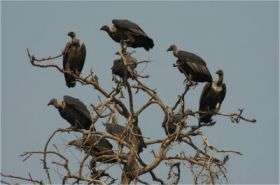
Captive breeding colonies of a critically endangered vulture, whose numbers in the wild have dwindled from tens of millions to a few thousand, are too small to protect the species from extinction, a University of Michigan analysis shows.
Adding wild birds to the captive colonies, located in Pakistan and India, is crucial, but political and logistical barriers are hampering efforts, says lead author Jeff A. Johnson. The study was published online August 15 in the journal Biological Conservation.
With a seven-foot wingspan, the oriental white-backed vulture (Gyps bengalensis) was an awesome presence in south Asia until the mid-1990s, when populations began to collapse. At first the cause was unclear, but researchers eventually zeroed in on an anti-inflammatory drug, diclofenac, that is used to alleviate arthritis-like symptoms in livestock but is toxic to vultures. Vultures that feed on carcasses of animals treated with the drug die of kidney failure within a day or two after eating the tainted meat. And although India, Nepal and Pakistan outlawed its manufacture in 2006, diclofenac is still available, and birds are still dying.
While the death of an unattractive bird that scavenges for a living may not sound like a great loss, vultures have important cultural and religious significance in south Asia. The ancient Parsi religion holds earth, fire and water sacred, and to avoid contaminating them, the Parsis dispose of their dead by placing them on "Towers of Silence," where vultures consume the remains. In addition, the vulture saint Jatayu is an important figure in Hindu religion. The absence of vultures poses a direct threat to public health as well, as uneaten livestock carcasses provide breeding grounds for bacteria and attract feral dogs, which may spread rabies and other diseases.
When any large population crashes, as the vultures have, the amount of genetic diversity in the population also is likely to dwindle. This is a concern, Johnson said, because a population's genetic diversity reflects its ability to adapt to environmental challenges such as changing climate or outbreaks of disease. Without the ability to adapt, populations and whole species may become extinct.
Johnson and coworkers used museum specimens collected before the decline began, along with recent feather and tissue samples from birds in Pakistan's last remaining wild breeding colony, to see how genetic diversity in the wild population has changed as the population has plummeted. Then, assuming captive populations of various sizes, they used computer simulations to determine how large captive populations must be to preserve genetic diversity.
The analysis showed that while there was still a fair amount of genetic diversity in the wild population two years ago when their last samples were obtained, current captive populations are not large enough to maintain that diversity if the wild populations are wiped out---a fate that seems inevitable if people keep using diclofenac. The simulation results also suggest that levels of genetic diversity in the wild may already be in decline.
"We know the problem, and we know the solution," said Johnson, who was an assistant research scientist at U-M when the research was done and recently accepted a position as an assistant professor at the University of North Texas in Denton. "We just need to get diclofenac out of the environment and more birds into protection before it is too late."
The Peregrine Fund, a organization that works to conserve birds of prey in nature, is trying to prevent the birds' extinction, but it's an effort that requires money and international cooperation, both of which can be problematic in the vultures' home countries.
"One of my goals with this paper," Johnson said, "is to raise awareness of the problem and to increase political will in India and Pakistan to get this matter resolved."
Source: University of Michigan


