Old sheep raising the baaa
September 5th, 2008 Soay Sheep

Enlarge

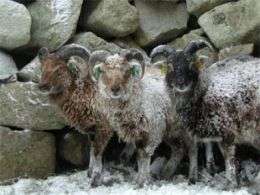
Oldest sheep make larger contributions to population growth when conditions are harsh. Credit: Owen Jones

Populations of wild animals face the challenge of surviving in a changing climate. Researchers at Imperial College London and Université Claude Bernard Lyon have shown how a sheep population on a remote island off the west coast of Scotland responds to two consequences of climate change: altered food availability and the unpredictability of winter storms.

Dr. Thomas Ezard, lead author of the study, revealed, "When times are good and food is plentiful, lambs contribute almost twice as much to changes in population size than when times are hard. On the flip side, the oldest sheep contribute most to population growth when conditions are harsh." The work, published in the September issue of The American Naturalist, suggests that the dynamics of populations are influenced not only by the weather but also by the ability of individuals to respond to it.

New mathematical breakthroughs have made it possible to show how environmental change affects populations, like these sheep. The key is appreciating (1) how weather affects individual sheep and (2) how the weather changes from one year to the next. If consecutive years have similar weather, the dynamics of the population will be very different than if conditions are unrelated from one year to the next.

Professor Tim Coulson concluded, "A thorough understanding of the likely effects of climate change on the ecology of wild populations requires linking populations to their environment. This demands application of innovative mathematical methods, as used here."

Citation: Thomas H. G. Ezard, Jean-Michel Gaillard, Michael J. Crawley, and Tim Coulson, "Habitat Dependence and Correlations between Elasticities of Long-Term Growth Rates." American Naturalist (2008) 172:424-430.

Source: University of Chicago


print this article email this article download pdf blog this article bookmark this article     Digg this Stumble it share on Facebook share on Reddit add to delicious save to Yahoo! bookmarks
4.6/5 after 5 votes


September 5th, 2008 all stories
Biology /

Comments: 0
Rank: 4.6/5 after 5 votes

  • Stumble this up

  • Digg this

  • Share it:
  • share on Facebook
  • share on MySpace
  • share on Slashdot
  • rss-newsfeed
  • share on Google
  • share on Reddit
  • add to delicious
  • save to Yahoo! bookmarks
  • share on Windows Live
  • Add to Mixx!
Rating: 4.6/5 after 5 votes

  • Related Stories

  • 'Deadly dozen' reports diseases worsened by climate change
    created Oct 07, 2008 | popularity not rated yet | comments 0
  • Midge-hunting scientists tackle spread of devastating bluetongue virus
    created Aug 07, 2008 | popularity not rated yet | comments 0
  • Afghanistan releases its first-ever list of protected species
    created Jun 04, 2009 | popularity not rated yet | comments 0
  • Scientists devise accelerated method to determine infectious prion strains
    created May 29, 2009 | popularity not rated yet | comments 0
  • Counting sheep in climate change predictions
    created May 29, 2009 | popularity not rated yet | comments 0


  • Physicists Demonstrate Quantum Memory with Matter Qubits
    Physicists Demonstrate Quantum Memory with Matter Qubits
    Physics / General Physics
    created Jul 03, 2009 | popularity 4.4 / 5 (17) | comments 1
  • 'Holey' Nanosheets for Wastewater Dye Removal
    Nanotechnology / Nanomaterials
    created Jul 01, 2009 | popularity 5 / 5 (5) | comments 1
  • Jellyfish Robot Swims Like its Biological Counterpart
    Jellyfish Robot Swims Like its Biological Counterpart
    Electronics / Robotics
    created Jun 26, 2009 | popularity 4.4 / 5 (8) | comments 1
  • Could Maxwell's Demon Exist in Nanoscale Systems?
    Could Maxwell's Demon Exist in Nanoscale Systems?
    Physics / General Physics
    created Jun 24, 2009 | popularity 4.4 / 5 (18) | comments 29
  • Living Safely with Robots, Beyond Asimov's Laws
    Living Safely with Robots, Beyond Asimov's Laws
    Electronics / Robotics
    created Jun 22, 2009 | popularity 4.6 / 5 (52) | comments 40
  • Other News

    California water plan aims to save Puget Sound orcas

    Biology / Ecology

    created 12 hours ago | popularity not rated yet | comments 0

    A plan to restore salmon runs on California's Sacramento River also could help revive killer whale populations 700 miles to the north in Puget Sound, as federal scientists struggle to protect endangered species in a complex ...


    Scientists 'rebuild' giant moa using ancient DNA

    Biology / Plants & Animals

    created Jul 01, 2009 | popularity 5 / 5 (10) | comments 12

    (PhysOrg.com) -- Scientists have performed the first DNA-based reconstruction of the giant extinct moa bird, using prehistoric feathers recovered from caves and rock shelters in New Zealand.


    Pacific Giant Salamander (Dicamptodon tenebrosus)

    Salamanders, regenerative wonders, heal like mammals, people

    Biology / Microbiology

    created Jul 01, 2009 | popularity 5 / 5 (20) | comments 11

    The salamander is a superhero of regeneration, able to replace lost limbs, damaged lungs, sliced spinal cord -- even bits of lopped-off brain. But it turns out that remarkable ability isn't so mysterious after ...


    Genetically modified trees

    Anti-biotech groups obstruct forest biotechnology

    Biology / Biotechnology

    created Jun 30, 2009 | popularity 3.7 / 5 (7) | comments 5

    The potential of forest biotechnology to help address significant social and environmental issues is being "strangled at birth" by the rigid opposition of some groups and regulations that effectively preclude ...


    Super-sleepers could help super-sizers!

    Super-sleepers could help super-sizers!

    Biology / Plants & Animals

    created Jun 29, 2009 | popularity 5 / 5 (2) | comments 4

    Burrowing frogs can survive buried for several years without food or water. Scientists have discovered that the metabolism of their cells changes radically during the dormancy period allowing the frogs to ...